AI Hiring Platforms:
Why They Fail at Scale and How Smart Recruit Builds Decision-Driven Hiring
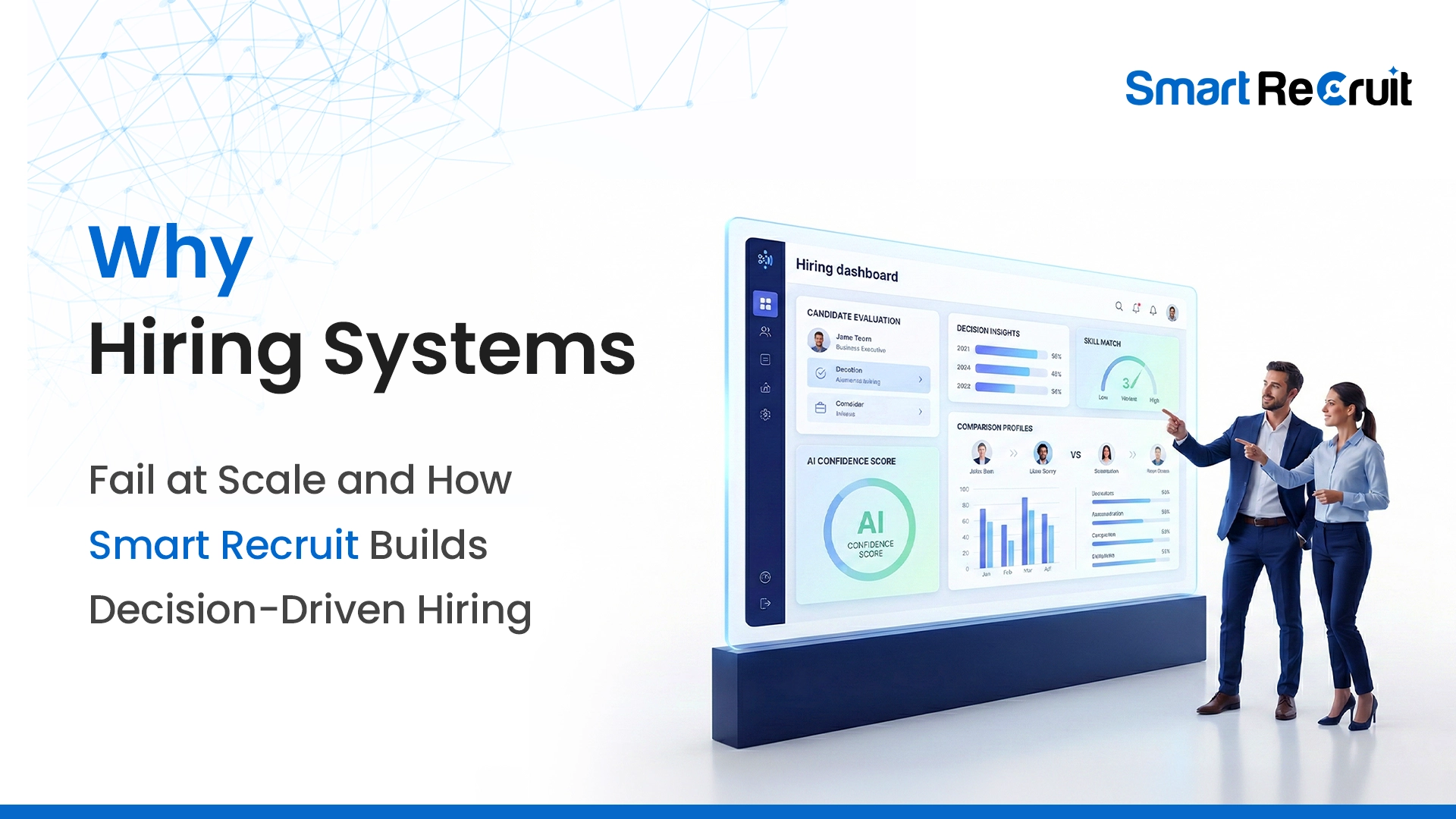
Hiring is no longer a workflow problem. It is a decision infrastructure problem. Smart Recruit introduces a new category: Hiring Decision Intelligence. Hiring teams are doing more work than ever, yet confidence in outcomes keeps slipping. Application volumes are rising, interview loops are expanding, and AI hiring platforms promise speed and control. Traditional ATS workflows and AI recruitment platforms track candidate movement, but they do not support consistent decision making in a modern AI hiring system. As hiring at scale grows, delays, fragmented data, and misaligned interviews erode decision confidence.
Candidates disengage when the process breaks down. Research from OpenArc shows up to 60 percent abandon hiring due to poor communication, and nearly half lose interest after 10 to 14 days of silence. These patterns point to a deeper issue: hiring systems were built for process flow, not decision quality. Industry analyses summarized by Integrity Asia indicate poor hiring decisions contribute significantly to employee turnover, underscoring the long-term risk of inconsistent evaluation.
Roles stay open longer. Strong candidates drop out. Teams revisit decisions months later without clear explanations. The blame falls on people, but the issue is structural. Most hiring systems were never designed to support decision making at scale.
Smart Recruit addresses this gap by treating hiring as a decision-driven system and part of a new category: Hiring Decision Intelligence, built to hold up under volume, speed, and pressure.
1. Why ATS Systems Fail at Scale
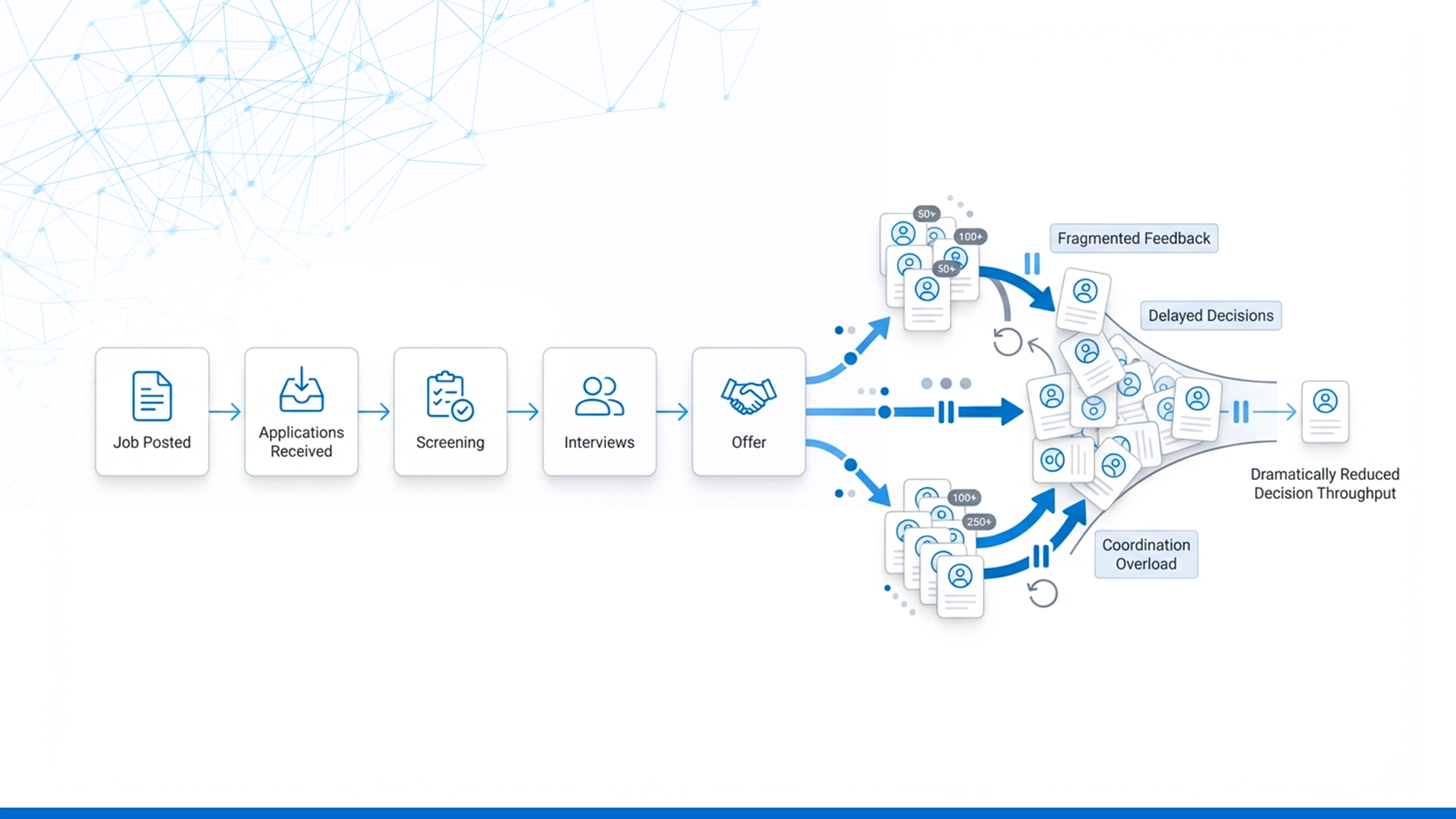
Traditional ATS workflows are designed to move candidates through stages, not to support shared judgment. Most teams still treat hiring as a linear process:
Post a job → Applications arrive → Screening happens → Interviews are conducted → An offer is made
When volume is low and expectations are stable, this works well enough.
But scale changes the nature of the problem. Hiring stops being a simple process and becomes a coordination challenge. Decisions now depend on multiple people sharing context, using the same criteria, and acting within tight timelines.
Traditional hiring assumes that if candidates keep moving forward, good decisions will naturally follow.
At scale, movement increases, but judgment does not.
Without a system that supports decisions, the pipeline becomes a bottleneck instead of a solution.
2. Where Hiring Systems Break: Screening and Interviews
These weaknesses show up not because teams stop caring but because the system gives them no structure to rely on.
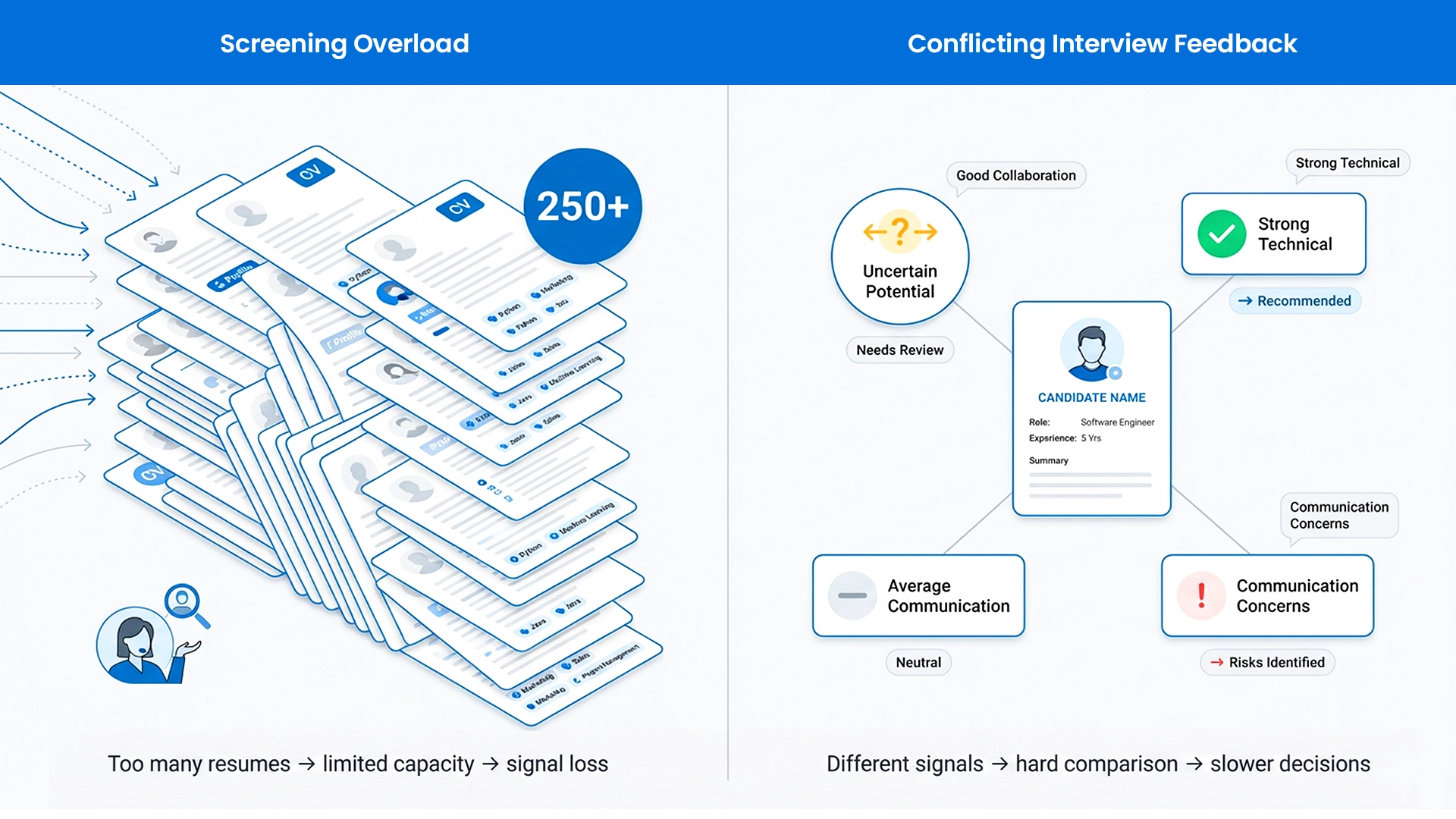
Screening Overload
Recruiters are expected to review large volumes of resumes in limited time. Manual resume reviews often become snap judgments based on superficial cues, not actual skill signals. That leads strong candidates with unconventional backgrounds to fall out early, not because they lack capability but because the system cannot surface it reliably.
This is not a skill problem. It is a capacity and design problem.
Smart Recruit uses AI candidate screening to evaluate role-specific competencies, extracting skill signals beyond resume keywords.
If you want a deeper look at how skill signals outperform keyword filtering, our earlier piece on intelligent candidate matching explains the shift.
Interview Inconsistency
Unstructured interviews often create noise instead of clarity. When evaluation criteria are not defined upfront, interviewers focus on different signals, provide uneven feedback, and leave hiring managers reconciling opinions rather than evaluating evidence. This inconsistency increases time-to-hire, reduces offer acceptance rates, and exposes organizations to biased or indefensible hiring decisions.
Consider a common scenario. One interviewer praises technical ability but questions communication. Another highlights collaboration but doubts execution. A third leaves minimal notes with no clear recommendation. Each perspective may be valid, but the feedback is not comparable. Decisions slow, follow-ups multiply, and the candidate experience deteriorates. The breakdown is not due to individual judgment but to the absence of a shared evaluation structure.
Smart Recruit functions as structured interview software, aligning criteria before interviews begin and capturing feedback against shared competencies enabling AI interview evaluation through consistent, comparable feedback. Hiring managers compare evidence instead of reconciling narratives, enabling faster, fairer, and more defensible decisions.
Fragmented Information
Candidate context lives everywhere: resumes, emails, calendars, interview notes, spreadsheets.
When information fragments, accountability weakens. Decisions slow down. Confidence erodes because no one can clearly explain why a choice was made.
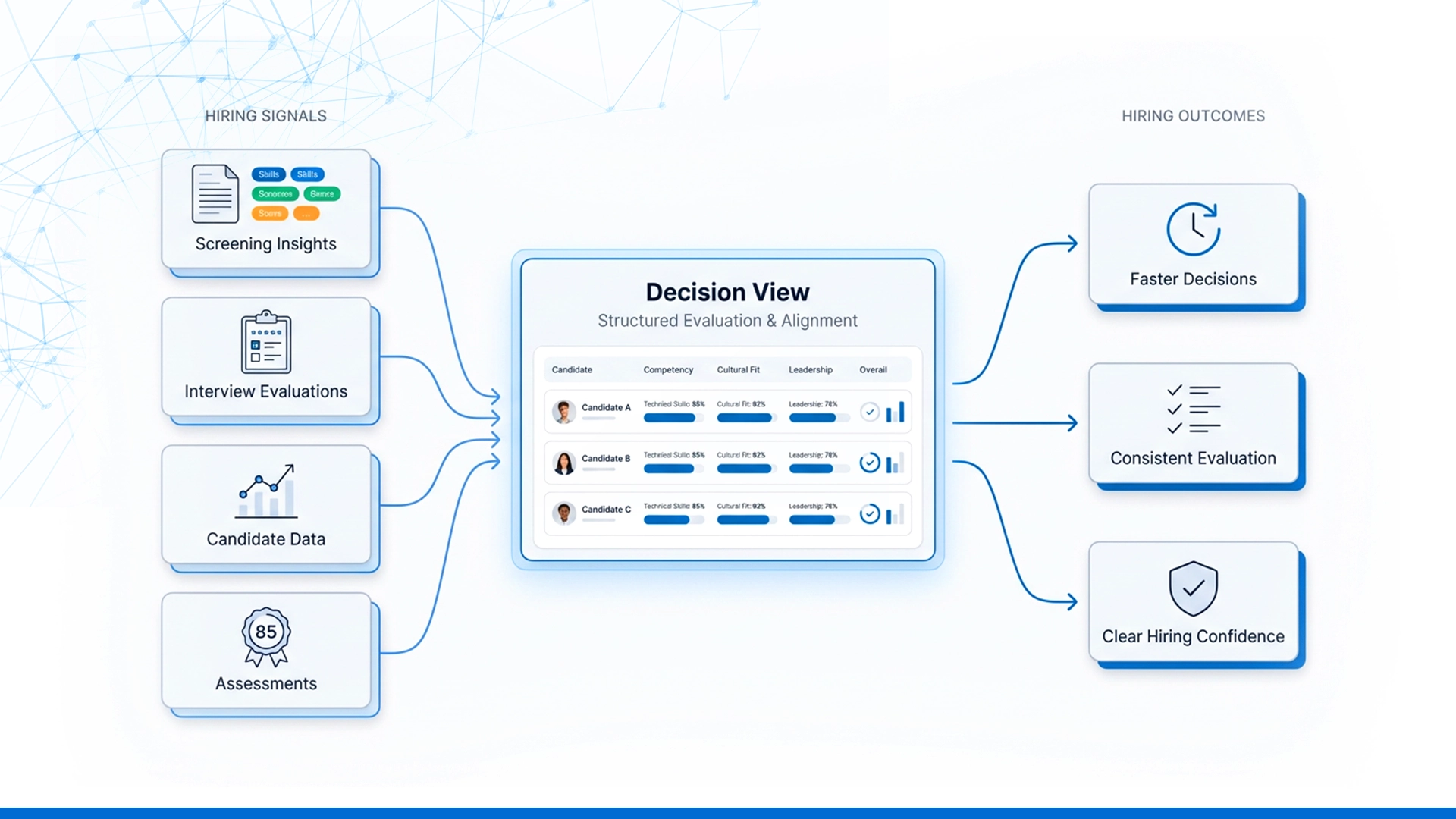
Smart Recruit brings these signals together into a single decision view. Teams evaluate candidates with shared context instead of reconstructing it after the fact.
3. From Workflow Tools to Decision-Driven Hiring
Most applicant tracking systems were designed to manage movement through the hiring pipeline. They show where candidates are, move them between stages, and store resumes and notes. While this improves coordination, it does not provide the structure needed for consistent decision making.
An ATS can display status without explaining reasoning. It can collect feedback without enforcing shared evaluation criteria. It can accelerate movement without improving judgment. As a result, organizations often add more tools on top of their ATS and still struggle with slow decisions and inconsistent outcomes. The issue is not adoption. It is design.
This limitation exists because ATS platforms were built as workflow systems, not decision systems. Systems optimized for flow alone cannot support high-quality decisions at scale.
Smart Recruit is designed differently as an enterprise AI hiring system where the ATS layer is only one component. By structuring evaluation, aligning interview criteria, and consolidating decision signals, it transforms hiring from pipeline management into decision intelligence.
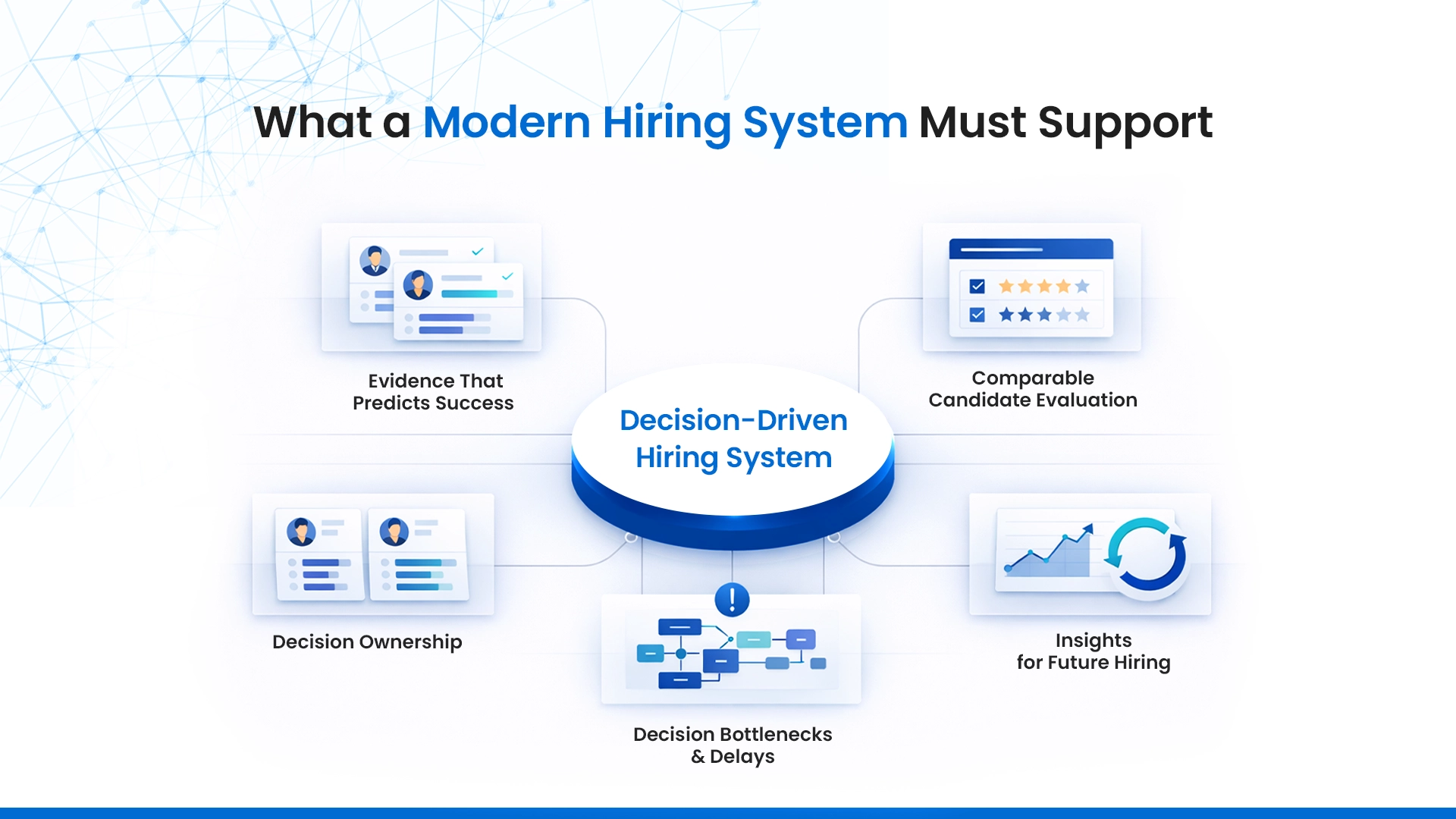
4. What a Modern Hiring System Must Support
A hiring system creates value when it helps teams answer a few core questions for every role:
- What evidence actually matters for success?
- Who owns each decision?
- How should candidates be compared fairly?
- Where do decisions slow down and why?
- What insights carry forward into future hiring cycles?
When these questions are answered by the system, hiring becomes predictable instead of reactive.
This is the gap Smart Recruit is designed to fill.
5. How Smart Recruit Enables Decision-Driven Hiring
Smart Recruit operates as AI-powered hiring software that treats hiring as a connected system rather than isolated steps. It generates role-specific scorecards automatically, aligns interview criteria before scheduling, and provides a real-time decision view that compares candidates using structured skill signals.
For a practical view of how structured, AI-assisted workflows come together, our step-by-step guide walks through the process in detail.
Candidate data, screening insights, interview evaluations, and assessments are consolidated into structured profiles designed for comparison and decision making, not just record keeping. Hiring managers can see how each candidate performs against defined competencies instead of piecing together scattered feedback.
Decision ownership is visible, and bottlenecks surface early through alerts when candidates remain idle or feedback is delayed. Teams move forward with clarity instead of relying on follow-ups, reminders, and manual coordination.
By embedding structure into every stage, Smart Recruit supports people rather than forcing them to compensate for missing systems.
6. What Changes When Hiring Is Treated as Infrastructure
When hiring is treated as a pipeline, teams spend their time moving candidates and managing logistics. When hiring is treated as a system, teams spend their time evaluating talent and making decisions.
Time to decide improves without sacrificing quality. Interview loops shorten because feedback aligns. Recruiters spend less time chasing information, and hiring outcomes become easier to explain and defend. Organizations see faster time-to-decision, improved hiring consistency, and higher confidence in selection outcomes.
These improvements come from design, not extra effort.
7. The Future of Decision-Driven Hiring
Hiring is moving toward decision intelligence, where systems structure evaluation and learn from past outcomes to improve future hiring. As roles evolve and hiring volumes fluctuate, organizations can no longer rely on manual coordination or informal judgment to make consistent decisions.
The next phase of hiring will prioritize decision traceability, comparable evaluation, and real-time visibility into bottlenecks. Leaders will expect to see why a candidate was selected, how interview feedback aligned, and where delays affected outcomes. Hiring will be measured not only by speed, but by consistency, defensibility, and long-term retention.
Teams that continue to rely on fragmented workflows will struggle to scale decision quality. Those that invest in decision infrastructure will adapt faster, maintain fairness, and operate with greater confidence under changing demand.
Hiring Needs Infrastructure, Not More Effort
Would You Make the Same Hire Again?
Think about the last role you filled.
- Could you defend the decision six months later?
- Could you compare the top two candidates side by side?
- Could a new leader understand the reasoning without asking anyone?
If not, your hiring process is producing outcomes without producing decisions.
Smart Recruit ensures every hire is explainable, comparable, and repeatable.
See how decision-driven hiring works in practice. Talk to us.
FAQs:
1. Why do hiring systems break when hiring at scale?
Hiring systems break during hiring at scale because traditional workflows rely on coordination rather than structured evaluation. As application volume increases, teams struggle to maintain consistent criteria, comparable interview feedback, and clear decision ownership. An AI hiring system introduces decision structure through AI candidate screening, shared evaluation frameworks, and real-time visibility. This approach supports decision-driven hiring, helping organizations improve hiring accuracy and maintain consistency even as demand fluctuates.
2. How is an AI hiring platform different from a traditional ATS?
An AI hiring platform differs from a traditional ATS by focusing on decision quality rather than pipeline movement. In an AI vs traditional ATS comparison, ATS tools track candidate stages, while an AI recruitment platform structures evaluation, enables AI interview evaluation, and supports structured interview software for consistent feedback. This shift allows organizations to reduce time to hire, ensure fair comparisons, and build defensible decisions through decision-driven hiring.
3. How does AI candidate screening improve decision quality?
AI candidate screening improves decision quality by evaluating role-specific competencies instead of relying solely on resume keywords. Through AI resume screening, systems extract skill signals that enable fair comparisons across diverse candidate backgrounds. Integrated into an AI-powered hiring software environment, this approach helps organizations improve hiring accuracy, reduce bias, and support decision-driven hiring. It becomes especially critical when hiring at scale, where manual screening leads to inconsistent outcomes.
4. Why is structured interview software essential for consistent hiring decisions?
Structured interview software ensures candidates are evaluated against shared criteria, enabling AI interview evaluation and comparable feedback across interviewers. Within an enterprise AI hiring system, this structure reduces subjectivity, supports decision-driven hiring, and helps organizations reduce time to hire by eliminating follow-ups and conflicting opinions. Without structured evaluation, even advanced AI hiring platforms cannot prevent inconsistent decisions or defend hiring outcomes.
5. What role does decision-driven hiring play in improving hiring outcomes?
Decision-driven hiring shifts the focus from moving candidates through pipelines to making consistent, evidence-based choices. Supported by an AI hiring system and AI recruitment platform, this approach aligns evaluation criteria, enables AI candidate screening, and consolidates decision signals. Organizations that adopt this model improve hiring accuracy, reduce time to hire, and maintain confidence in outcomes. It transforms hiring into a reliable system rather than a coordination challenge.
Related Posts
Discover other posts that deepen your understanding of smart hiring, from AI-led interviews to streamlined candidate management techniques.
-
 What to Look for in a Recruitment Platform That Actually Works
Hiring today demands automation, fairness, and full visibility.
-
 The Hidden Hiring Bottleneck:
How Recruitment Automation Fixes Screening Delays