High Volume Hiring:
The Exact Failure Points Slowing Your Hiring Pipeline
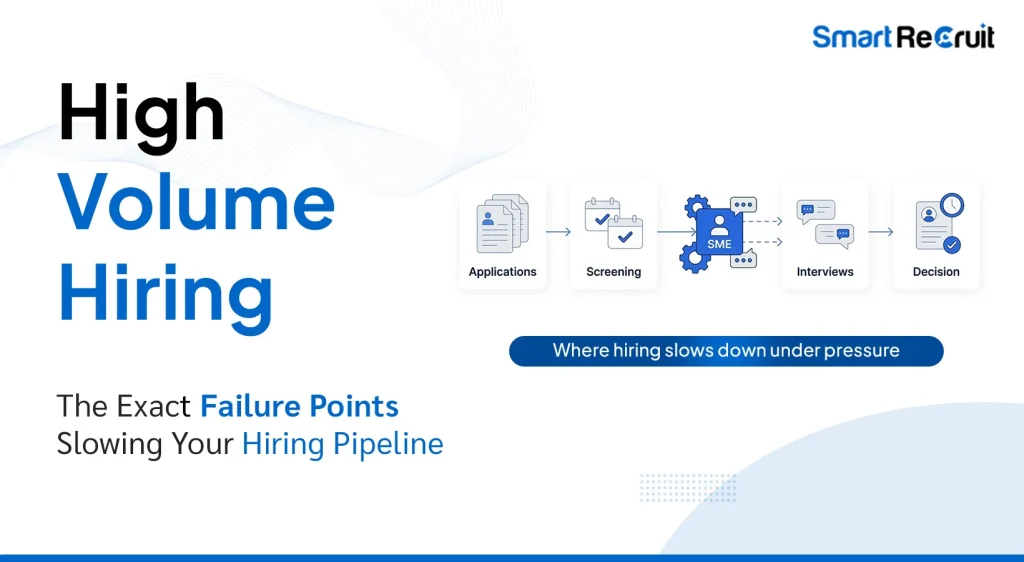
Strong pipelines do not fail all at once. They slow down in places that hiring leaders feel immediately, late shortlists, missed candidates, and growing backlogs. In High Volume Hiring, these signals are often mistaken for a capacity problem. The instinct is to add more recruiters or tools. In reality, hiring at scale breaks at specific failure points where manual workflows cannot keep up, and a screening bottleneck starts to shape outcomes.
This is where hiring breakdown begins. Decisions take longer, candidate quality becomes inconsistent, and pipeline velocity drops without clear visibility into why. Smart Recruit is designed to correct this at the system level by structuring how hiring decisions are made, not just how workflows are managed.
Below, we map the exact hiring failure points and show practical fixes to restore hiring throughput without adding noise.
The Failure Map: Where Hiring Breaks at Scale
Most teams assume breakdown happens because of volume. In reality, hiring at scale fails at predictable points where human workflows cannot keep up. These are structural failure points that reduce hiring throughput and create delays.
Volume thresholds and screening collapse
There is a tipping point where systems begin to strain. According to SHRM, recruiters handling more than 20 requisitions or roles with 300+ applications see performance drop. Hiring shifts from structured execution to reactive processing, and screening capacity cannot keep up.
Screening bottleneck
This is the first major failure point in high volume hiring. Resume review, repeated calls, and context switching consume most recruiter time.
Common signals include:
- Backlog of unreviewed applications
- Rising time-to-first-screen
- Recruiters filtering instead of evaluating
At this stage, candidate screening becomes a throughput problem, and strong candidates are often delayed or missed.
Panel and SME choke points
After screening, coordination becomes the issue. More interviewers mean more delays and inconsistent feedback, slowing decisions further.
Vendor and tool fragmentation
Adding tools or vendors often increases complexity. Duplicate work, repeated screening, and higher coordination effort follow, amplifying hiring failure points instead of solving them.
These breakdowns are predictable and fixable when hiring is structured as a system, not managed across disconnected workflows.
How Volume Breaks Human Workflows
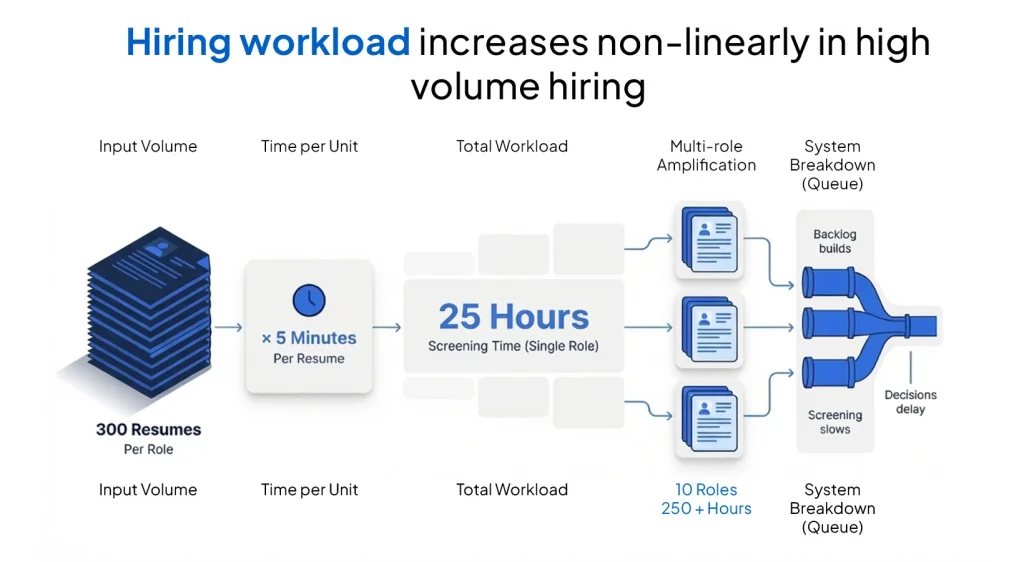
The challenge in High Volume Hiring is not just volume. It is how quickly manual effort compounds as applications increase. What looks manageable at 50 applications becomes unmanageable at 300, creating a queuing effect where delays multiply into a hiring breakdown.
The arithmetic of collapse
The math is simple:
- 300 resumes × 5 minutes = 25 hours of screening for one role
Now scale this across multiple roles. A recruiter handling 10 roles is already dealing with over 250 hours of screening effort. This is where the screening bottleneck becomes structural, not an efficiency issue but a capacity limit.
Context switching amplifies delays
Screening does not happen in one place. Recruiters move across ATS platforms, emails, scheduling tools, and vendor inputs. This leads to:
- Interrupted workflows
- Repeated context rebuilding
- Inconsistent evaluation
As fragmentation increases, decision quality drops and hiring throughput slows.
Role-dependent thresholds
Some roles absorb volume better than others. Standardized roles scale more easily, but specialist hiring breaks earlier due to deeper evaluation needs.
Industry research shows that beyond 300 applications per role, manual screening can add delays of up to 23 days. This highlights a key reality. Bulk hiring challenges are not just about volume, but about how human workflows fail under it.
These pressures do not slow hiring evenly. They create breakdown points. Next, we look at how coordination issues like panel overload and vendor complexity make this worse.
Panel Overload, SME Dependency, and Vendor Amplification
Once candidates move past the screening bottleneck, the problem does not disappear. It shifts into coordination failure. At this stage, hiring at scale depends on multiple stakeholders, and delays begin to compound.
Panel interview overload
As volume grows, more interviewers get involved. What feels like thorough evaluation often turns into scheduling friction and decision lag. Research from HBR shows that multi-stakeholder setups can slow decisions by up to 40%. In hiring, this leads to:
- Delayed interview scheduling
- Inconsistent feedback timelines
- Longer gaps between rounds
Each additional panel member adds dependency, slowing pipeline velocity and increasing time to hire.
SME dependency in hiring workflows
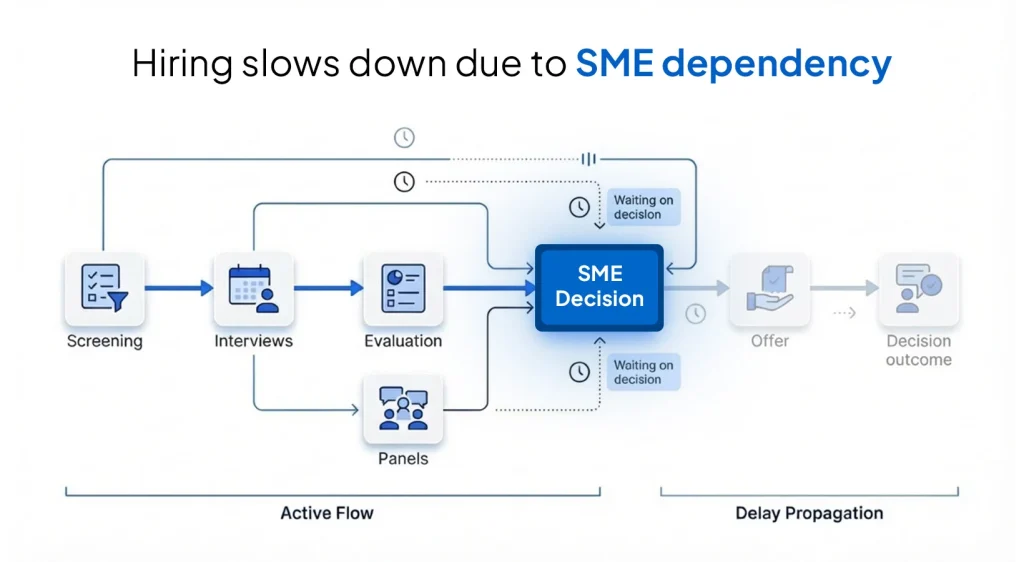
Subject matter experts are critical, but their availability becomes a constraint at scale.
For example:
- 45 minutes per interview × 10 interviews = 7.5 hours per week
As demand grows, this becomes unsustainable. Interviews get delayed, feedback cycles stretch, and decisions wait on a single stakeholder.
Vendor amplification of chaos
To solve bulk hiring challenges, teams often add more vendors. This increases complexity instead of speed. Data shows:
- Up to 28% duplicate candidate submissions
- Nearly 15 hours per week spent on coordination
In a typical multi-vendor setup, recruiters re-screen candidates, manage overlaps, and chase feedback across tools.
These coordination failures do not just slow hiring. They reduce decision clarity and consistency, turning hiring into a fragmented process rather than a structured system.
Why Adding Recruiters Worsens Coordination
When hiring breakdown becomes visible, the default reaction is to add more recruiters. It feels like the fastest way to increase hiring throughput. In reality, it often makes the problem worse.
More recruiters do not just add capacity. They add coordination.
The hidden cost of scaling headcount
New recruiters need time to ramp. They require context on roles, alignment on evaluation criteria, and familiarity with stakeholders. During this phase, output is inconsistent and often needs rework, slowing hiring at scale instead of accelerating it.
Duplicate effort and inconsistent decisions
Without shared frameworks, multiple recruiters working on the same role create:
- Overlapping candidate outreach
- Inconsistent shortlists
- Repeated screening of similar profiles
This reduces decision clarity and slows progress.
The coordination tax
As team size grows, alignment becomes harder. More recruiters mean more handoffs, more communication loops, and more dependency on shared understanding. This leads to:
- More sync meetings
- More status tracking
- More effort spent aligning decisions
Instead of improving hiring process optimization, pipeline velocity drops and time to hire increases.
What to do instead
Do:
- Standardize evaluation criteria
- Use structured scorecards
- Automate low-signal screening
Don’t:
- Add recruiters without fixing process gaps
- Rely on manual coordination
- Allow inconsistent decision frameworks
High volume hiring does not fail due to a lack of recruiters. It fails when decision-making is not structured.
Restore Throughput without Adding Noise
When hiring breakdown becomes visible, the instinct is to add more tools, recruiters, or vendors. In reality, this increases fragmentation. Restoring hiring throughput requires a system correction, not incremental fixes. The focus shifts from managing workflows to structuring how decisions are made.
Smart Recruit operates as the decision layer across the hiring pipeline, ensuring every stage produces consistent and actionable signals.
Structure data early
The first correction happens at the input level. Instead of manual resume review, candidate data is converted into structured profiles.
Using resume parsing and data enrichment, resumes become standardized signals. This reduces screening time and removes repeated interpretation. Recruiters shift from reading resumes to reviewing insights.
Standardize early assessment
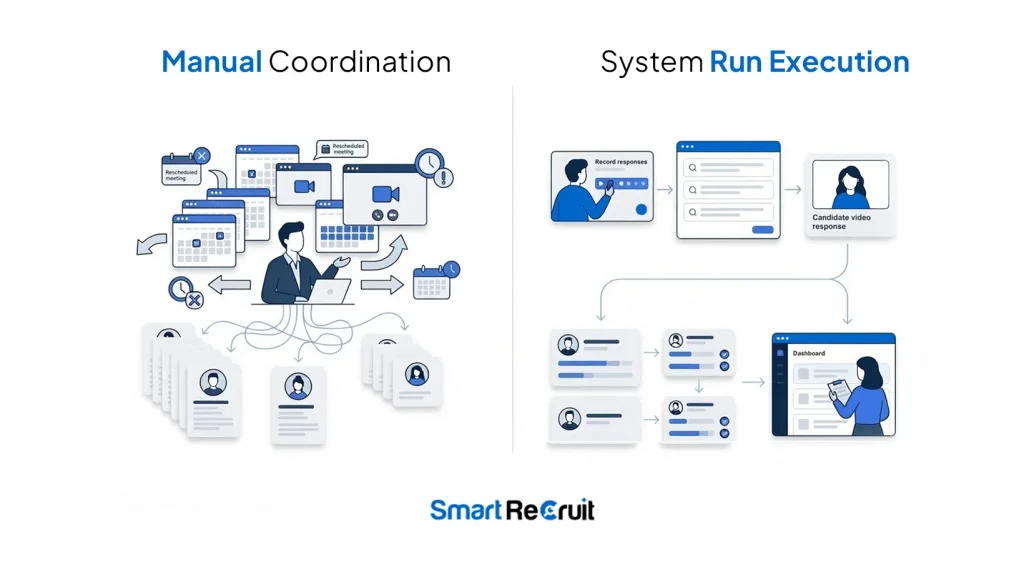
The next step removes repeated qualification effort. Early-stage screening is replaced with system-run early interviews, where candidates are evaluated using consistent criteria. This eliminates redundant calls and ensures fair comparison across candidates.
Unify decision evidence
Finally, decision-making is centralized. Feedback, interview inputs, and evaluation signals are brought into a single view. This allows:
- Structured and comparable feedback
- Traceable, consistent decisions
- Alignment across recruiters, panels, and vendors
The outcome is clear. Shortlists move faster, screening effort reduces, and hiring teams spend more time making decisions instead of managing coordination.
Seeing a backlog? Pilot a structured early-stage screening workflow with Smart Recruit on one role and measure how quickly your first shortlist comes together. Start a 2-week trial.
Execution Thinking: How to Pilot and Scale
Most hiring transformations fail because they try to change everything at once. The better approach is simple. Start small, measure fast, and scale what works.
You do not need a complete overhaul to improve hiring throughput. You need one controlled experiment that proves the shift.
Pilot one role
Start with a single high-volume role where the screening bottleneck is clearly visible. Introduce structured parsing and asynchronous early-stage interviews for two weeks.
Track one key metric, time to first screen. This gives a clear signal of whether your high volume hiring process is improving.
Define decision criteria
Before scaling, align on how candidates will be evaluated. Use a shared scoring rubric across recruiters and hiring managers.
This removes inconsistent shortlists and ensures decisions are based on comparable signals, not individual judgment.
Control vendor scope
If multiple vendors are involved, centralize how they operate. Define clear submission rules, reduce duplicate entries, and set SLAs for feedback.
This prevents coordination overhead from increasing as volume grows.
Once one role shows faster screening, clearer decisions, and reduced coordination time, the same model can scale across functions without disrupting existing workflows.
The Takeaway
High volume hiring does not fail due to a lack of candidates. It fails when the process cannot keep up with decision-making. As volume increases, screening, coordination, and handoffs create delays that slow hiring throughput and push strong candidates out.
Smart Recruit addresses this by turning hiring into a structured system. It organizes candidate data, standardizes evaluation, and aligns decisions across teams. This reduces screening bottlenecks and improves hiring process optimization.
For teams hiring at scale, the shift is not about adding more people. It is about building a process that holds under volume.
Start your 2-week trial to see how Smart Recruit improves high volume hiring outcomes.
FAQs
What are the biggest challenges in hiring at scale?
Hiring at scale often fails due to hiring failure points like screening bottlenecks, inconsistent evaluation, and coordination delays. While high volume hiring increases pipeline activity, the real issue is unstructured decision-making that slows hiring throughput and reduces pipeline velocity.
Why does high volume hiring lead to hiring breakdowns?
High volume hiring creates pressure on candidate screening and recruiter bandwidth. When manual resume screening increases, screening capacity is exceeded, leading to delays, missed candidates, and overall hiring system breakdown across stages.
How does a screening bottleneck impact time to hire?
A screening bottleneck slows down early-stage evaluation, increasing backlog and delaying shortlists. When recruiters spend excessive time on resume screening, it directly increases time to hire and reduces overall hiring throughput.
What role do panel interview overload and SME dependency play in hiring delays?
Panel interview overload and SME dependency hiring create coordination challenges. Scheduling conflicts, delayed feedback, and inconsistent evaluations reduce pipeline velocity and make hiring decisions slower and less reliable.
How can organizations improve hiring throughput without increasing recruiter headcount?
Improving hiring throughput requires hiring process optimization, not just more recruiters. Platforms like Smart Recruit – AI Hiring Platform help by structuring candidate screening, standardizing evaluation, and removing manual coordination, enabling faster and more consistent hiring decisions.
Related Posts
Discover other posts that deepen your understanding of smart hiring, from AI-led interviews to streamlined candidate management techniques.
-
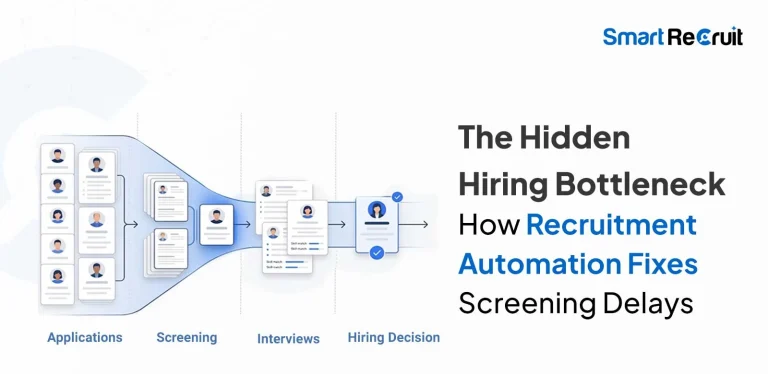 The Hidden Hiring Bottleneck:
How Recruitment Automation Fixes Screening Delays
-
 Aspira: Turn First Interviews Into a Hiring Advantage
This is where Aspira changes the equation.
-
 Why Industries Need Smart Recruit: AI-Powered Hiring Without the Guesswork
Why Industries Need Smart Recruit: AI-Powered Hiring Without the Guesswork
