The Hidden Hiring Bottleneck:
How Recruitment Automation Fixes Screening Delays
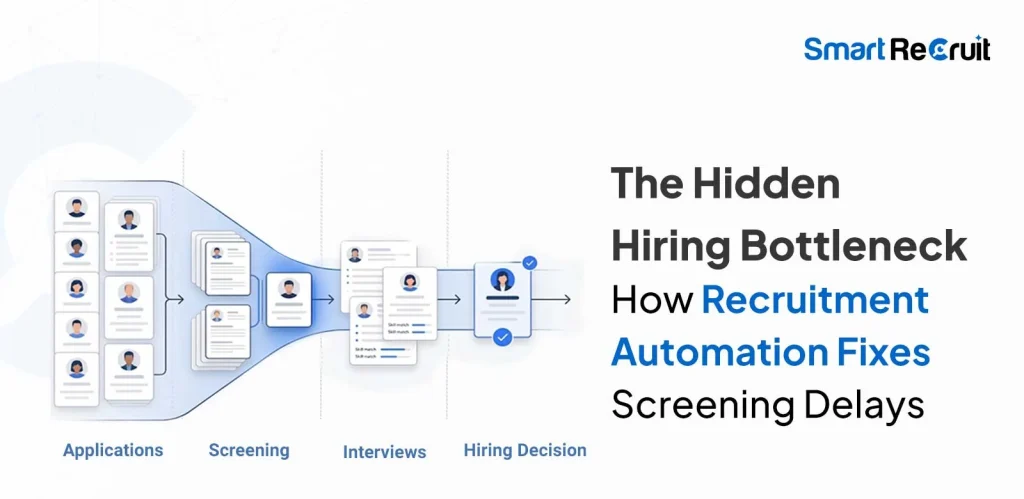
Your next strong hire probably already applied. They submitted their resume three, maybe four days ago. They’re qualified, they’re available, and right now they’re waiting. Your recruiter buried under 80 other applications, trying to get through the queue before the end of day.
By the time your team gets to them, they may have already said yes to someone else.
That’s not a sourcing problem. That’s a screening problem.
Most hiring teams keep investing in sourcing – more job boards, more referral incentives, more outreach campaigns. The pipeline fills up. But hiring still doesn’t move faster. Because the bottleneck was never at the top of the funnel. It was always in the middle, where someone has to manually review every resume, repeat the same qualification call fifteen times, and somehow still get a shortlist to the hiring manager by Thursday.
This is where Recruitment Automation changes the outcome. Below, we examine exactly where screening breaks down, why more sourcing won’t fix it, and how Aspira by Smart Recruit is built to solve it.
The Problem: Screening, Not Sourcing
When a role remains open longer than expected, the first reaction in many hiring teams is to increase candidate sourcing. More job boards are added, referral incentives increase, and recruiters spend additional time reaching out to passive candidates. The assumption is straightforward: if more candidates enter the funnel, hiring outcomes will improve.
In reality, most hiring pipelines do not slow down because of a shortage of applicants. They slow down because of how those applicants are processed. The real constraint often appears during candidate screening, where recruiters must review resumes, verify qualifications, and prepare candidate shortlists for hiring managers.
Research from SHRM illustrates how common this challenge is. According to the SHRM Talent Access Benchmarking Report, fewer than one third of organizations use automated pre-screening tools. This means most hiring teams still rely on manual processes that are difficult to scale as application volume increases.
For talent leaders, the symptoms are easy to recognize:
- Large numbers of resumes waiting to be reviewed
- Delays in preparing candidate shortlists for hiring managers
- Recruiter time spent repeating similar qualification conversations
- Inconsistent evaluation across different recruiters
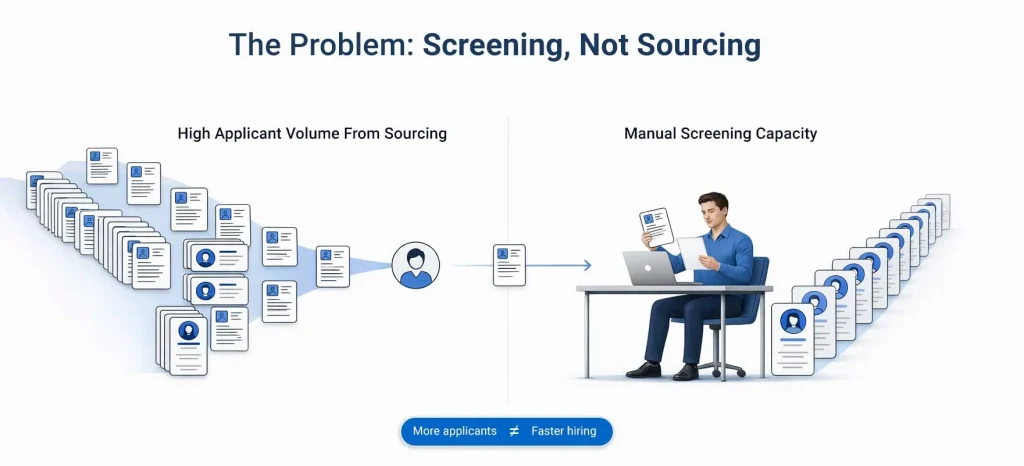
These issues create what many hiring leaders describe as a screening bottleneck. Recruiters spend valuable hours sorting through applications instead of engaging with the strongest candidates.
Before organizations invest further in sourcing capacity, the more important question is this: how efficiently are candidates being evaluated once they arrive?
Why Screening Becomes a Bottleneck at Scale
Each step in manual screening seems manageable in isolation. Review a resume. Make a quick call. Compare two candidates. But when a role receives 50, 100, or 200 applications, those individual steps stack into a workload that one recruiter cannot clear in a day.
Three patterns drive most screening bottlenecks:
Manual resume review at volume. Recruiters examine each application individually, matching experience and skills against role requirements. Careful and necessary work but impossible to scale when volume spikes.
Repeated early qualification calls. Recruiters frequently conduct near-identical first conversations with dozens of candidates simply to confirm basic eligibility. These calls generate limited insight but consume significant time and scheduling bandwidth.
Fragmented tools. Recruiters often toggle between an ATS, a scheduling platform, email, spreadsheets, and internal messaging to manage a single candidate. Every context switch slows progress.
When these patterns combine, the result is predictable. Recruiters spend more time processing applications than evaluating people. Hiring managers receive shortlists late. And strong candidates move on.
Volume vs. Throughput: The Misconception Most Leaders Miss
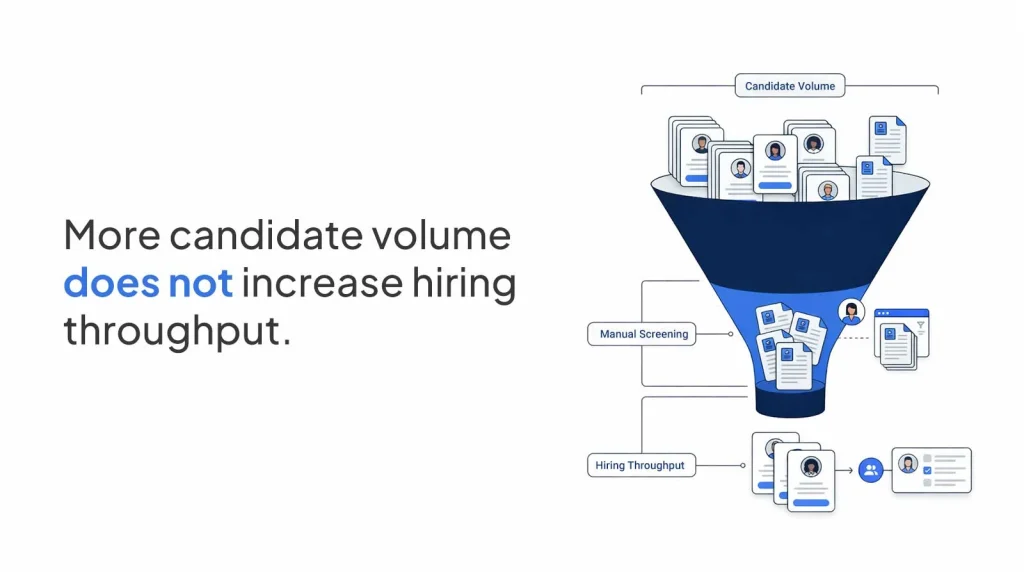
Hiring leaders often respond to slow hiring pipelines by increasing candidate sourcing. More roles are promoted across job boards, recruiters reach out to additional candidates, and sourcing activity expands. The expectation is simple. If more candidates enter the funnel, hiring will move faster.
In practice, the opposite often happens.
A role that receives 150 applications does not become easier to fill if every one of those applications still requires resume screening, qualification checks, and early conversations. Recruiters must review resumes, compare skills, and determine which candidates deserve a deeper evaluation. When these steps rely on manual resume screening, the queue of applications grows faster than recruiters can process it.
For many talent leaders, the most frustrating moment arrives later.
A hiring manager finally reviews a shortlist after several days of screening work, identifies a strong candidate, and asks the recruiter to move forward. The recruiter reaches out only to learn that the candidate has already accepted another offer. The candidate did not fail the interview process. The hiring process simply moved too slowly.
This is the difference between volume and throughput. Volume measures how many candidates enter the funnel. Throughput measures how quickly those candidates move through candidate screening and reach meaningful evaluation stages.
If screening capacity does not increase, more applicants only deepen the screening bottleneck. Recruitment Automation helps hiring teams increase throughput so qualified candidates move forward before opportunities are lost.
Aspira: A Practical Approach to Fixing the Screening Bottleneck
Once the screening bottleneck becomes visible, the next question for hiring leaders is how to fix it without increasing recruiter workload. This is where Smart Recruit’s Aspira applies Recruitment Automation directly to early hiring stages. Instead of adding another tool to the stack, Aspira restructures how candidate screening happens.
Aspira follows a four-pillar framework that helps hiring teams process candidates more efficiently.
Structure
Candidate information is organized as soon as an application arrives. Through resume parsing and data enrichment, resumes are converted into structured profiles that highlight skills, experience, and qualifications. Recruiters no longer need to manually scan each resume to understand candidate suitability.
Evaluate
Instead of repeated qualification calls, Aspira conducts system-run early interviews. Candidates respond to structured, role-specific prompts asynchronously. Recruiters review responses when convenient – no scheduling, no repetition, no inconsistency. Every candidate is assessed against the same criteria, which removes a significant source of evaluation variance.
Track
All screening signals, resume data, interview responses, evaluation scores, are captured in one place. Recruiters and hiring managers see exactly where every candidate stands without chasing updates across tools. The pipeline becomes visible and manageable.
Decide
Structured data and consistent evaluation signals give hiring managers what they need to make confident decisions quickly. Not a gut feel based on a resume. Evidence-based insight built from the first interaction.
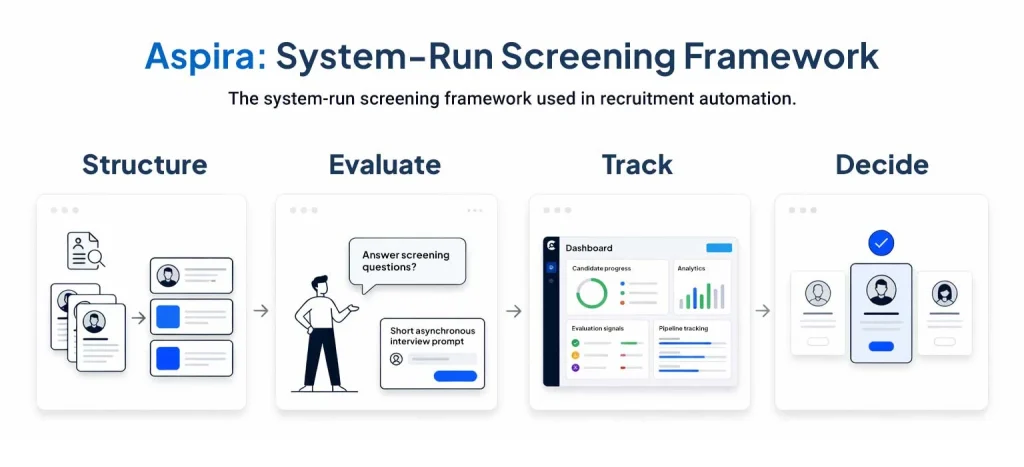
Aspira’s system-run early interviews demonstrate this approach in practice. Instead of recruiters repeating the same first-round questions, candidates record short responses to role-specific prompts. Recruiters then review these responses when convenient and quickly identify candidates who demonstrate the strongest communication and problem-solving ability.
See how Aspira works in practice. Start a 2-WEEK TRIAL to experience how Recruitment Automation can streamline screening for your hiring team.
Getting Started with Recruitment Automation
Adopting Recruitment Automation does not require a complete redesign of the hiring process. Most organizations begin by improving the early screening stages where recruiters spend the largest amount of time reviewing applications and conducting preliminary conversations. When this stage becomes more structured, the rest of the hiring pipeline often becomes more predictable.
For talent leaders, the first step is identifying where delays appear during candidate screening. This usually involves reviewing how long it takes to move from application submission to the first meaningful evaluation of a candidate. If recruiters are spending large portions of their day reviewing resumes or repeating basic qualification calls, automation can help streamline those tasks.
Several practical steps can help organizations introduce Recruitment Automation effectively:
- Identify screening tasks that involve repetitive manual review, such as resume screening or qualification checks.
- Introduce structured candidate information so hiring teams can compare applicants more easily.
- Standardize early evaluation questions so candidates are assessed using consistent criteria.
- Align recruiters and hiring managers on how screening insights should inform interview decisions.
Research from Deloitte highlights that organizations adopting automation in talent processes are increasingly focusing on improving decision speed and data visibility across hiring teams.
When implemented thoughtfully, Recruitment Automation helps hiring teams spend less time processing applications and more time engaging with qualified candidates.
What Hiring Leaders Should Take Away
If your hiring pipeline slows down before interviews begin, sourcing more candidates will not solve it. The constraint is screening capacity – how quickly your team can evaluate the applicants already waiting.
When screening becomes system-driven, four things change:
- Recruiters spend time on evaluation, not administration
- Hiring managers receive stronger shortlists, faster
- Screening decisions become consistent across the team
- Qualified candidates reach a decision before they move on
Screening must become system-driven. That is what Smart Recruit is built to make possible.
Contact Smart Recruit or start your two-week free trial at thesmartrecruit.ai to see the impact firsthand.
FAQs
1. Why does candidate screening slow down the hiring process?
Most hiring teams still rely on manual resume review and repeated qualification calls. When application volume grows, these tasks accumulate faster than recruiters can clear them. The result is a growing queue of unreviewed applications, delayed shortlists, and candidates who move on while waiting.
2. Why is resume screening difficult to scale in high-volume hiring?
Traditional resume screening requires recruiters to review each resume individually and match candidate experience with job requirements. For roles that receive hundreds of applications, this process quickly becomes time consuming. Automated systems help by organizing candidate data and highlighting the most relevant applicants, allowing recruiters to focus on stronger profiles.
3. What causes the screening bottleneck in recruitment?
Three things: manual resume review at scale, repeated early qualification conversations that provide limited signal, and fragmented tools that require constant context switching. When these patterns combine, screening becomes the slowest stage in the hiring pipeline.
4. Why does manual resume screening create hiring delays?
Manual resume screening requires recruiters to review each application separately, which consumes significant time when many candidates apply for a role. This approach also makes it difficult to maintain consistent evaluation standards across hiring teams. Structured candidate data and automated evaluation tools help reduce these delays and improve the consistency of screening decisions.
5. How can companies improve early-stage interviews during hiring?
By replacing repeated recruiter-led qualification calls with structured, asynchronous interview prompts. Candidates respond on their own time. Recruiters review responses at scale, compare candidates against consistent criteria, and identify the strongest profiles before committing to a live conversation.
Related Posts
Discover other posts that deepen your understanding of smart hiring, from AI-led interviews to streamlined candidate management techniques.
-
 What to Look for in a Recruitment Platform That Actually Works
Hiring today demands automation, fairness, and full visibility.
-
 Aspira: Turn First Interviews Into a Hiring Advantage
This is where Aspira changes the equation.
-
 Step-by-Step Guide to Smarter Hiring with AI-Powered Smart Recruit
Structured, transparent hiring aligned with financial regulations.
