Intelligent Candidate Matching:
How Resume Parsing Turns Profiles Into Real Hiring Insight
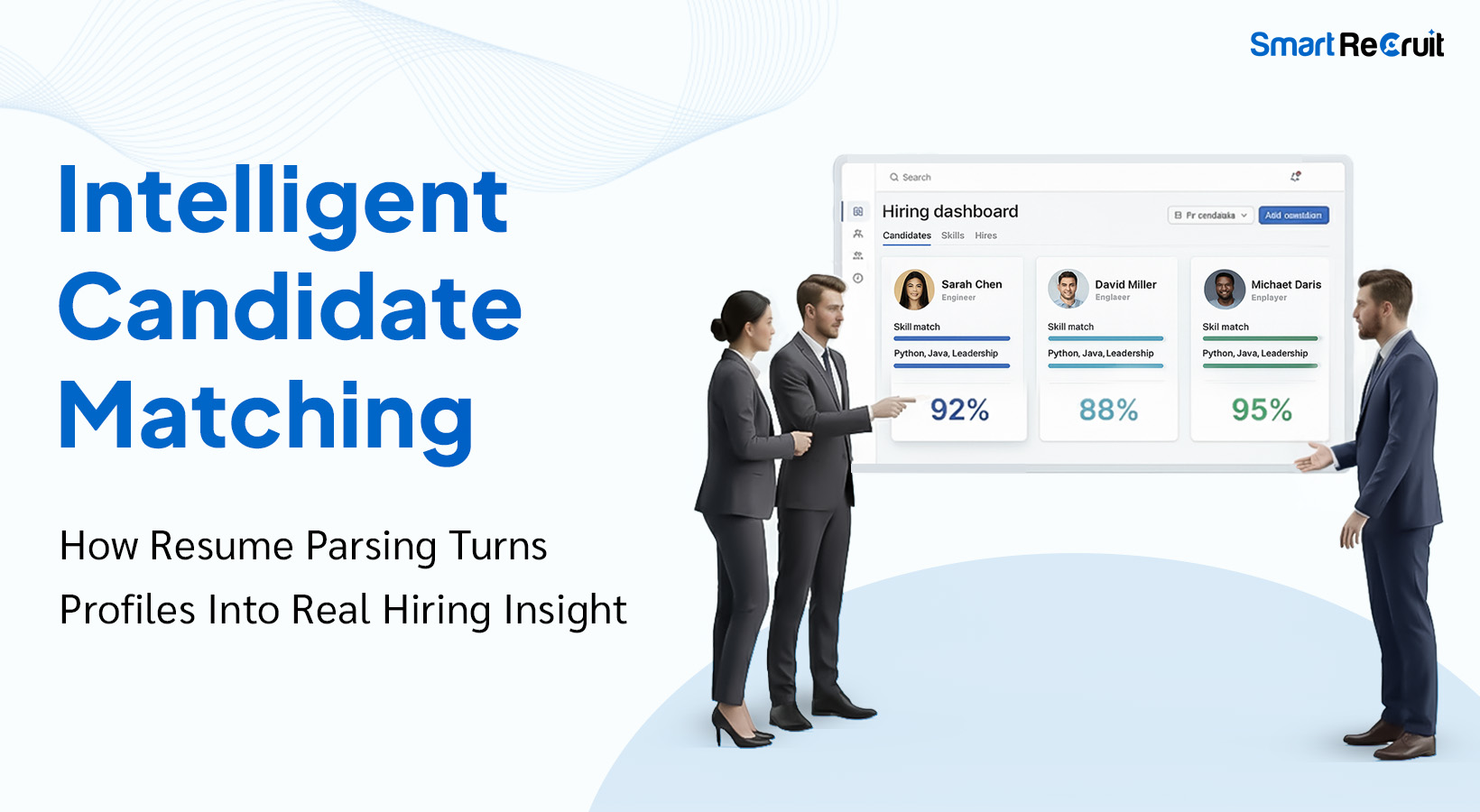
Hiring teams are drowning in resumes, yet starving for clarity. A study of hiring patterns shows that a typical corporate role receives close to 250 applications, and most never make it past the first screening stage.
Every open role brings a wave of applications, but only a fraction actually matches what the job needs. The rest of the effort goes into sorting, reading, guessing, and hoping that important details were not missed along the way.
A resume holds plenty of talent signals. Skills, achievements, tools, certifications, and project results are all there. The problem is that they sit buried inside paragraphs, bullet points, formats, and writing styles that vary from one person to another. Recruiters do not have the time or consistency to turn all of that into structured insight.
Smart Recruit answers that problem by combining resume parsing, skill extraction, and intelligent matching into one workflow. It transforms messy applicant data into clear talent profiles that reveal who is actually capable of doing the work. This gives hiring teams faster shortlists, more accurate matches, and a view of candidate potential that is simply not possible with manual screening.
1. The Hidden Problem Inside Every Hiring Pipeline
The first screening step slows everything down because recruiters are forced to make quick calls with incomplete or inconsistent information.
Why screening breaks down:
• Resumes appear in dozens of formats.
• Important skills are hidden between lines of text.
• People exaggerate with keywords or undersell real achievements.
• Some resumes are too long. Others are too vague.
• Recruiters have minutes, sometimes seconds, to decide.
All of this creates a predictable chain reaction. Strong candidates with modest resumes get missed, while keyword-heavy profiles slip through.
2. What Smart Recruit’s Parsing Actually Delivers
Resumes arrive in formats that make quick comparison almost impossible. Smart Recruit cuts through that by turning every resume into a clean, structured profile within seconds. Recruiters see skills, tools, projects, and experience clearly instead of hunting for them across pages. Duplicate profiles get flagged. Missing details stand out.
Picture this. A marketing candidate mentions Google Analytics in one job, web analytics in another, and tracking dashboards in a project bullet. A recruiter would normally have to connect those dots on their own. Smart Recruit pulls those signals together so the team sees one clear view of the candidate’s analytics experience instead of three scattered hints.
3. Intelligent Matching: Beyond Keyword Hiring
Most ATS systems still treat hiring like a keyword search. If a resume repeats the right terms, it rises to the top, even if the actual experience behind those words is thin. That is why candidates often stuff their resumes with buzzwords. The system rewards it.
Smart Recruit takes a different route. Its matching engine looks at the meaning behind the resume, not the density of keywords. It evaluates skill depth, how recent the experience is, the kinds of projects a candidate worked on, and the tools they actually used. It also picks up seniority signals, certifications, and the outcomes candidates delivered, not just the tasks they listed.
Let’s say two candidates mention Python. One finished a short online course. The other used Python last year to build a model that went into production. Traditional screening often treats them as similar because the keyword is the same. Intelligent matching separates them instantly and puts the real practitioner at the top of the list.
This is how shortlists get stronger. Recruiters stop chasing profiles that only look right on paper and start seeing who is truly equipped to do the work.
4. Turning Profiles Into Real Hiring Insight
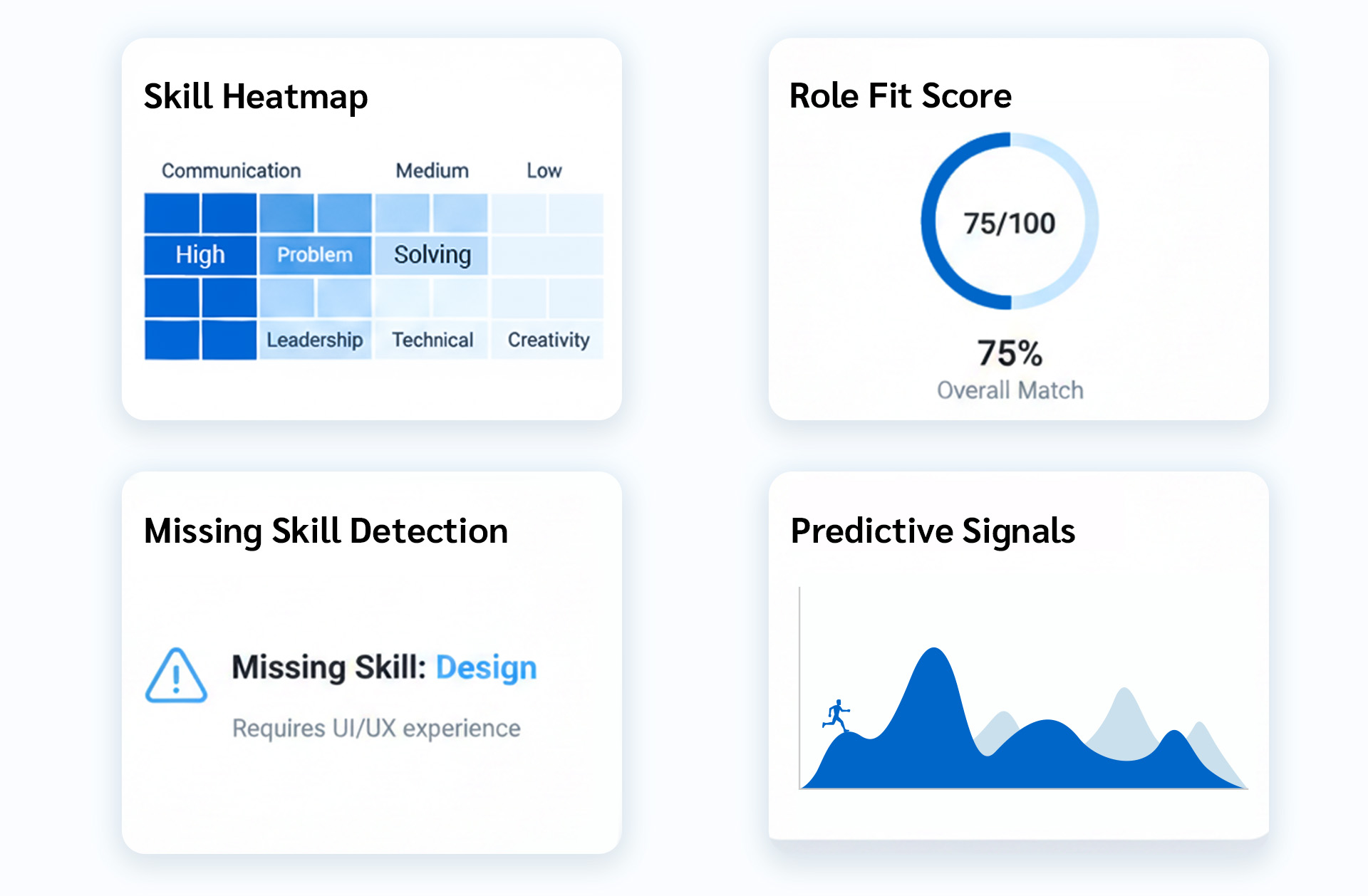
Parsing and matching do far more than speed up screening. They reveal patterns in the talent pipeline that are almost impossible to catch through manual review.
- Skill Heatmaps
Teams can see which skills show up often and which are harder to find across the applicant pool. This helps hiring managers adjust requirements early rather than losing time interviewing candidates who were never aligned. - Role Fit Scores
Smart Recruit assigns a fit score based on skills, project work, seniority, domain experience, and tool usage. Recruiters and hiring managers review the same structured shortlist, which keeps conversations focused on evidence instead of assumptions. - Missing Skill Detection
If a critical skill shows up in only a small fraction of resumes, Smart Recruit calls it out. Teams can widen sourcing or rethink the requirement before the pipeline stalls. - Predictive Signals
Over time, Smart Recruit highlights patterns about which skills and backgrounds tend to succeed in your organization. Each cycle gets smoother as the system learns from past hiring decisions.
The result is a hiring function that becomes smarter with every role you fill.
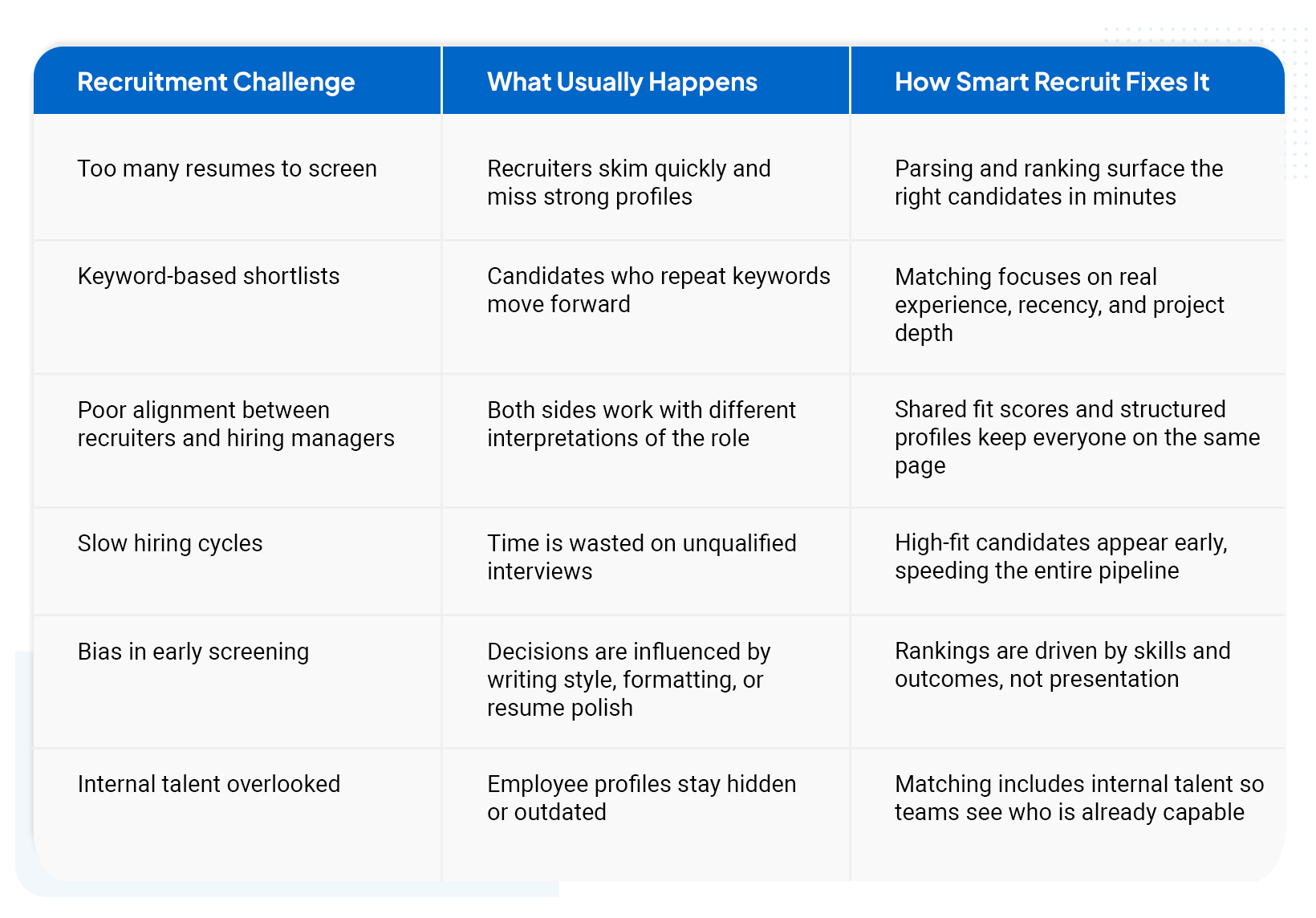
5. The Challenges Intelligent Matching Solves
Real Recruitment Challenge vs. Smart Recruit’s Actual Impact
6. The Smart Recruit Advantage
Many tools can parse a resume. Very few understand the skills behind it or apply that insight across screening, interviewing, and assessments. That is where Smart Recruit stands apart. It brings parsing, matching, interviewing, assessments, and tracking into one workflow so teams work from a single source of truth instead of juggling separate systems.

What Smart Recruit does that typical ATS tools cannot
Smart Recruit adds capability that goes beyond storage and keyword filtering:
- AI-driven skill extraction and auto-tagging that turns messy resumes into comparable profiles.
- Skill-based shortlisting and ranking that highlight real experience instead of repeated terms.
- Automated L1–L2 interviews through Aspira with topic scores and structured feedback.
- Proctoring and fairness checks embedded into assessments.
- Live visibility into recruiter and vendor performance.
- Sourcing support when teams don’t have strong internal databases.
How Smart Recruit’s matching logic works differently
Instead of counting keywords, the engine looks at skill depth, recency, tools used, certifications, and the outcomes tied to each role. It connects related skills, understands seniority from responsibility patterns, and separates surface-level claims from real hands-on work.
The intelligence behind the engine
Smart Recruit uses skill ontologies, cross-skill inference, seniority scoring, and experience normalization to build a unified picture of each candidate. As more profiles move through the system, the matching becomes sharper because the platform learns which skills and backgrounds tend to succeed.
7. Where All of This Is Heading
Hiring is shifting toward a clearer and more evidence based approach. Teams want to understand real capability, compare candidates more objectively, and move faster without losing confidence in their decisions. Job titles, polished resumes, and keyword tricks matter less than the actual work someone can do.
As more companies adopt skills focused evaluation and structured decision making, hiring becomes easier to predict, easier to measure, and easier to scale. The teams that lean into this shift now will build processes that adapt and improve with every cycle, instead of relying on the guesswork and manual effort that slow hiring down today.
The Takeaway for Hiring Teams
Resumes are not the real problem. The challenge is the lack of structure inside them. When scattered details turn into clear insight, hiring moves faster, decisions improve, and recruiters spend more time with candidates who genuinely fit the work. Intelligent matching makes that shift possible by helping teams focus on real capability instead of formatting, keywords, or guesswork.
If you want to see how structured profiles and intelligent matching can strengthen your own hiring process, we can walk you through it and show what that looks like in practice. See it in action.
FAQs:
- What is intelligent candidate matching?
It’s a hiring approach that compares real skills, tools, and project outcomes instead of simple keyword hits. It uses skills-based hiring and talent intelligence to understand capability, not formatting. This helps teams spot qualified candidates quickly and reduce manual screening guesswork.
- How does resume parsing improve screening?
Parsing turns messy resumes into clean structured profiles so teams see skills, certifications, and tools in seconds. This kind of automated resume parsing removes inconsistencies and makes comparison easier, especially in high-volume pipelines where strong candidates often get missed.
- How does Smart Recruit improve resume screening?
Smart Recruit uses AI-driven resume parsing to extract skills, certifications, and work history accurately. It auto-tags profiles, builds skill-based shortlists, and helps recruiters filter faster without manual effort. Everything turns into a clear, structured view so teams can compare candidates consistently. This cuts screening time without adding features that aren’t part of the platform.
- What problems does intelligent matching solve for high-volume hiring?
Intelligent matching filters large applicant pools by highlighting candidates with real, verifiable skills instead of keyword-heavy resumes. It speeds up screening, reduces unqualified interviews, and keeps the pipeline moving. With skill-based filtering, AI-driven parsing, and candidate ranking, strong profiles rise early, helping recruiters focus their time where it actually matters.
- How does intelligent matching change the future of hiring?
It pushes hiring toward skills-first evaluation and consistent, data-backed decisions. Instead of relying on formatting or keyword tricks, teams compare candidates using structured signals like extracted skills, work history, and assessment results. This shift creates clearer shortlists, stronger alignment between stakeholders, and hiring processes that scale more easily across roles and teams.
Related Posts
Discover other posts that deepen your understanding of smart hiring, from AI-led interviews to streamlined candidate management techniques.
-
 Smart Recruit: Hiring Made Faster, Fairer, and Smarter for Every Industry
Structured, transparent hiring aligned with financial regulations.
-
 What to Look for in a Recruitment Platform That Actually Works
Hiring today demands automation, fairness, and full visibility.