Why Applicant Tracking Systems,
Alone Can’t Improve Hiring Decisions
Every delayed hiring decision carries a cost that dashboards rarely show. As roles remain open, revenue opportunities shrink, teams absorb extra workload, and top candidates accept competing offers. The real issue is not talent scarcity. It is hiring delays driven by slow, unclear decisions that stall momentum across the pipeline. Even with a modern applicant tracking system in place, visibility alone does not help teams improve hiring decisions when alignment breaks down.
Most organizations rely on ATS software and hiring analytics to monitor pipeline health, yet inconsistent hiring decisions persist because feedback is scattered across emails, notes, and disconnected scorecards. Without a single decision signal, managers hesitate, recruiters chase alignment, and candidate experience deteriorates. By the time consensus forms, the strongest candidates have already moved on, turning delay into lost confidence and missed hires.
The Consequence: When Decisions Lack Structure, Hiring Slows
When decision-making lacks structure, delays become systemic rather than situational. What begins as a single unresolved interview or unclear feedback loop quickly expands into hiring delays that ripple across the entire workflow. Roles remain open, team workloads increase, and business priorities stall while stakeholders wait for alignment that never arrives.
Over time, these delays create deeper operational risks. Inconsistent hiring decisions emerge when interviewers rely on different criteria or incomplete context. Candidates experience prolonged silence, repeated interviews, or conflicting communication, weakening candidate experience and eroding trust in the employer brand. As uncertainty grows, top candidates disengage, and hiring teams lose confidence in their own outcomes.
The impact is cumulative. Slower decisions lead to missed talent, strained teams, and reduced confidence in the hiring process itself. What appears to be a pipeline problem is, in reality, a consequence of unstructured decisions.
The Structural Gap: Visibility Without Decision Clarity
Applicant tracking systems transformed recruitment by centralizing candidate data and making workflows transparent. Recruiters can monitor pipeline stages, maintain audit trails, and manage high application volumes with far greater efficiency. For enterprise teams, this visibility supports compliance, reporting, and operational control at scale.
These systems solved critical operational challenges:
- Centralized candidate records
- Workflow visibility across stages
- Compliance and reporting support
- Scalable application management
However, visibility does not guarantee decision quality. According to NYC Local Law, systems that merely organize applications are not classified as automated decision tools because they do not evaluate candidates.
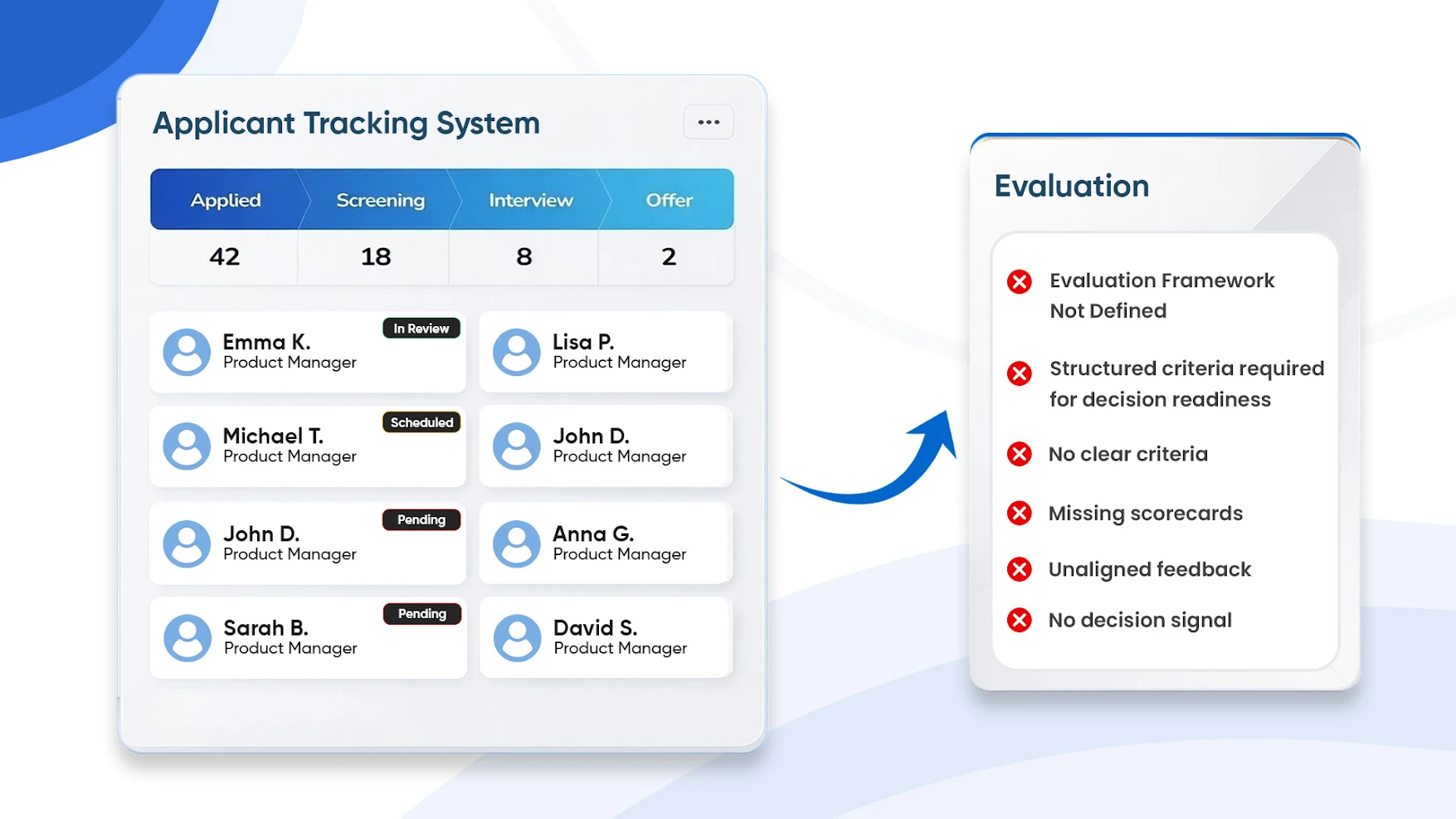
This distinction reveals a structural limitation: applicant tracking systems improve process control, but they do not structure how decisions are made.
Organizations often assume that better tracking leads to better outcomes. Dashboards display pipeline metrics, and hiring analytics reveal time-to-fill trends and recruiter activity. These insights create a sense of control, suggesting that hiring performance is measurable and manageable.
Yet tracking activity is not the same as evaluating talent. Recruitment analytics show movement, not judgment. They reveal where candidates are, not how they compare. More data does not ensure alignment between interviewers, nor does it eliminate inconsistent hiring decisions.
Teams can see their hiring process in detail while still struggling to improve hiring decisions. Visibility exposes the workflow. It does not resolve the decision layer within it.
The Unmanaged Decision Layer in Hiring
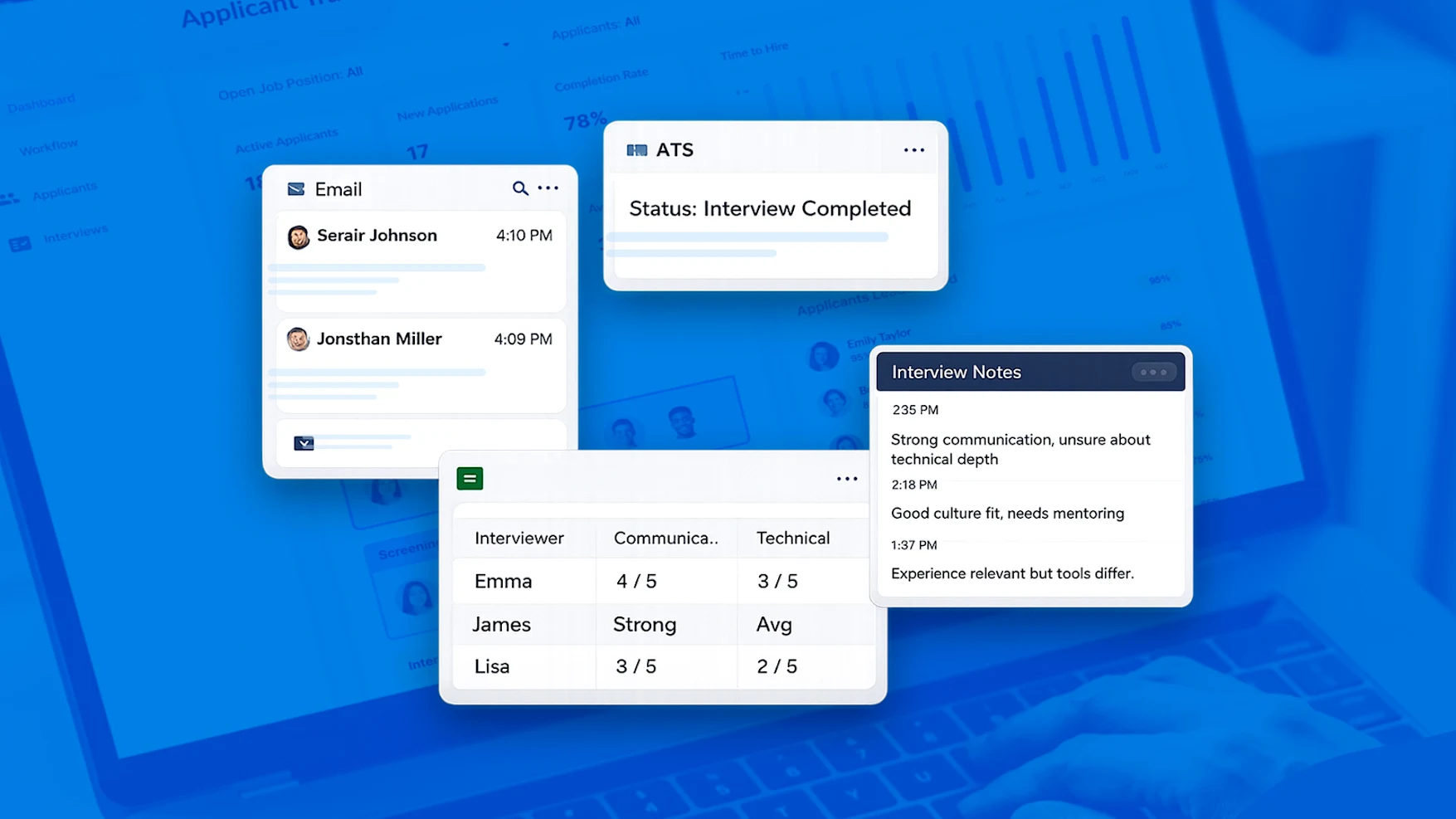
Hiring analytics have made recruitment performance more visible than ever. Teams can track pipeline velocity, conversion rates, and time-to-fill using modern ATS software and recruitment analytics. Yet visibility does not mean alignment. The decision layer remains fragmented, manual, and difficult to coordinate.
Organizations can measure activity across the pipeline but still struggle to improve hiring decisions. Hiring metrics show movement, not agreement. Without structured evaluation frameworks, interview feedback varies by reviewer, creating inconsistent hiring decisions even when the process appears efficient.
As dashboards multiply, data volume increases. More reports do not create clarity. They introduce decision fatigue. Recruiters and hiring managers must reconcile conflicting signals across tools, slowing progress and exposing the ATS limitations that prevent confident outcomes.
Fragmentation is most visible in strategic talent acquisition, where feedback lives in emails, notes, and disconnected systems. Manual consolidation delays decisions, weakens confidence, and contributes to hiring delays that ripple across the organization. Research highlighted by shows that inconsistent evaluation methods can also undermine fairness when decision criteria are unclear.
The result is an unmanaged decision layer. Visibility exists, but decision clarity does not. This structural gap sets the stage for the next risk: when decisions lack structure, compliance exposure increases.
Why Resume Screening and Evaluation Remain Inconsistent
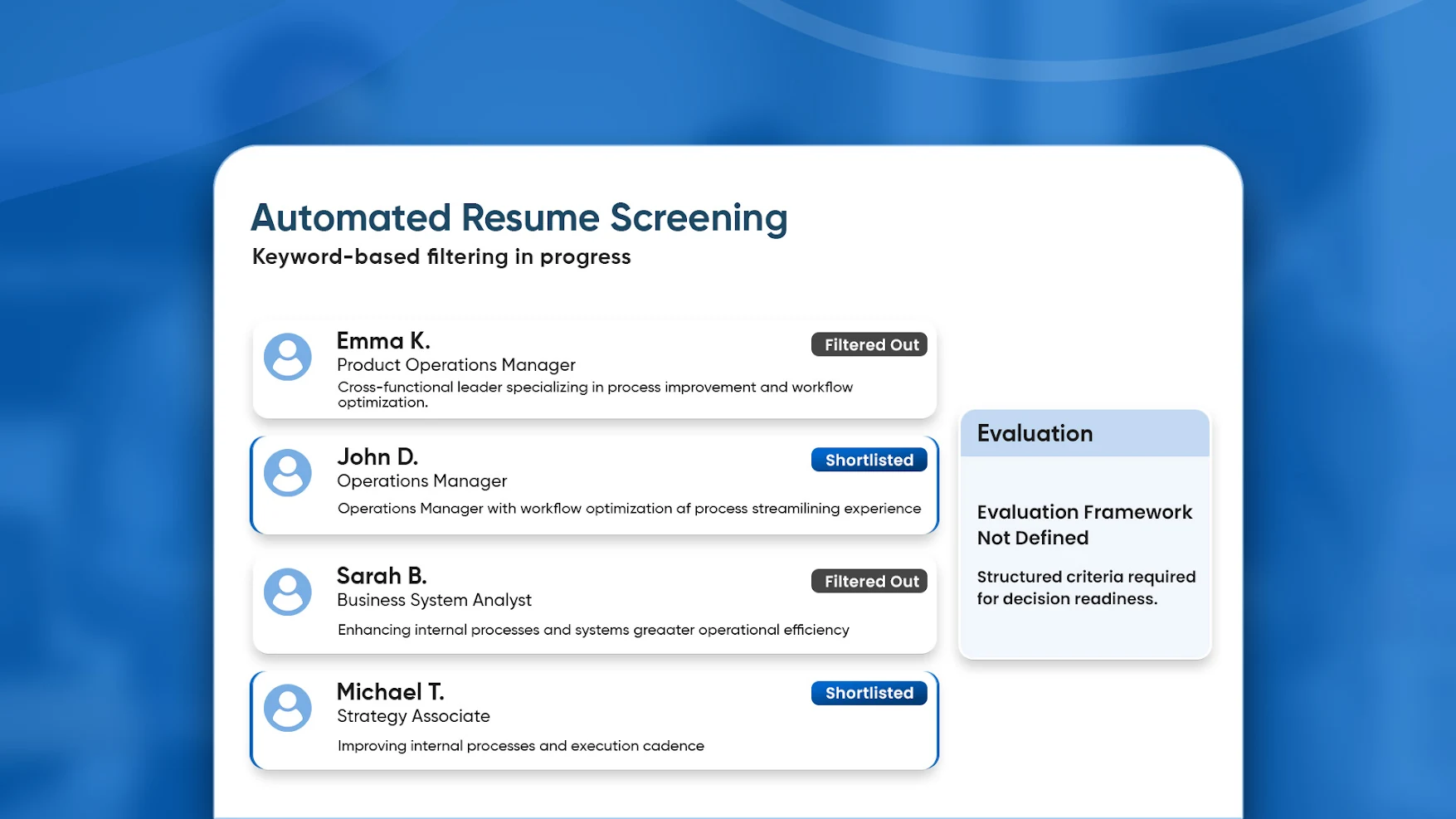
Even with modern ATS software and resume screening software in place, early-stage evaluation remains one of the most inconsistent parts of hiring. Automated filtering accelerates review, but speed does not ensure accuracy or context. Qualified candidates may be overlooked due to rigid keyword matching, while others progress despite weak role alignment. This disconnect exposes one of the core ATS limitations: visibility into the pipeline does not guarantee fair or comparable evaluation.
Related reading: See how resume parsing transforms raw profiles into structured, decision-ready insights that improve screening consistency.
Keyword-driven screening prioritizes terminology over capability. Candidates from adjacent industries or nontraditional backgrounds are often filtered out, even when they possess transferable skills. Without structured evaluation frameworks, screening becomes a gatekeeping mechanism rather than a decision support tool, making it harder to improve hiring decisions.
In later stages, evaluation standards vary across interviewers. Hiring analytics and recruitment metrics can track completion rates but cannot standardize how candidates are assessed. Feedback scattered across notes, emails, and scorecards forces manual consolidation, delaying alignment and weakening confidence in final decisions.
These inconsistencies reveal a deeper structural gap: tools can accelerate workflows, but they cannot ensure decision clarity. When evaluation signals remain fragmented, organizations face not only delays but also increased exposure to compliance and fairness risks.
The Compliance Risk of Unstructured Decisions
Automated hiring tools are receiving increasing scrutiny from regulators concerned about bias, transparency, and accountability.
According to Reuters, employers remain legally responsible for hiring outcomes even when using third-party AI tools.Transparency is becoming a baseline requirement. Organizations must ensure that technology supports fair and accountable decision-making.
Industry perspective: Learn why organizations are moving toward AI-powered hiring systems that reduce guesswork and improve accountability.
From Tracking Systems to Decision Intelligence
As hiring grows more complex, visibility alone is no longer enough. Many organizations are discovering that an applicant tracking system can manage workflows but cannot structure how decisions are made. To improve hiring decisions, teams need systems that align evaluation, unify feedback, and convert fragmented signals into clear insight. This shift marks the evolution from traditional ATS software to decision intelligence.
Structured Evaluation Replaces Subjective Screening
Decision intelligence introduces a structured approach to evaluation. Instead of relying on subjective notes and scattered inputs, hiring teams use shared frameworks that ensure candidates are assessed using comparable criteria. This consistency reduces inconsistent hiring decisions, strengthens alignment between interviewers, and addresses persistent problems with applicant tracking systems.
Unified Signals Replace Fragmented Feedback
Modern hiring workflows generate data from interviews, assessments, and collaboration tools. Without integration, these signals remain fragmented. Decision intelligence consolidates them into a unified view, enabling recruiters to act with clarity rather than reconciliation. According to industry research on hiring technology trends (Gartner), organizations are prioritizing systems that unify evaluation signals to strengthen recruitment analytics and decision quality.
Decision-Ready Insights Accelerate Hiring
Structured evaluation and unified feedback produce decision-ready insights. Instead of assembling data across tools, recruiters receive comparable candidate views that accelerate alignment. This reduces hiring delays, improves candidate experience, and builds confidence in outcomes, laying the foundation for AI recruitment software that supports human judgment rather than replacing it.
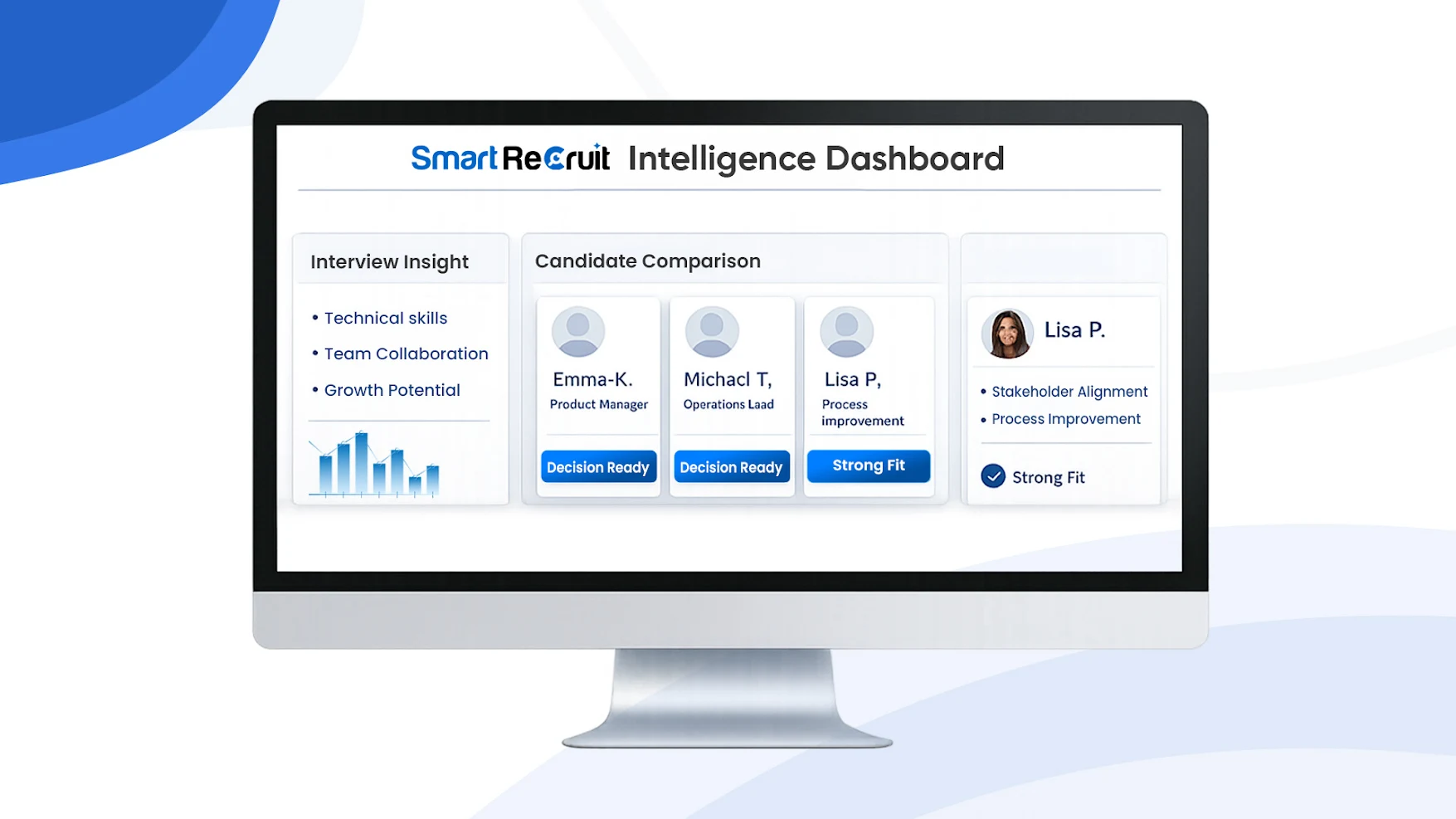
How Smart Recruit Structures the Decision Layer
Recognizing the need for decision clarity is only the first step. The real challenge lies in operationalizing it across complex hiring workflows. Smart Recruit is designed to structure the decision layer in practice, ensuring that evaluation, alignment, and final selection happen within a unified system rather than across disconnected tools.
Instead of adding another layer of software, Smart Recruit acts as the execution layer that connects screening, interviews, evaluations, and approvals into a cohesive workflow.
Execution Without Fragmentation
Recruiters often spend more time coordinating decisions than making them. Smart Recruit reduces this overhead by bringing interview feedback, assessments, and evaluation inputs into one environment. Teams no longer need to reconcile insights across emails, notes, and external tools before moving forward.
This operational clarity reduces hiring delays and enables faster alignment across stakeholders.
Decision Trails That Strengthen Accountability
Unstructured decisions are difficult to explain after the fact. Smart Recruit maintains structured decision trails that document evaluation criteria, feedback, and final outcomes. This strengthens transparency and helps organizations demonstrate fairness and consistency.
By improving traceability, teams reduce the risk of inconsistent hiring decisions while strengthening trust in the process.
Confidence Through Comparable Outcomes
Hiring confidence improves when decisions are supported by comparable insights rather than fragmented impressions. Smart Recruit enables side-by-side candidate comparisons grounded in structured inputs, helping teams move forward with clarity instead of hesitation.
This improves candidate experience by reducing delays and ensuring that decisions are timely and well-communicated.
A system that supports human judgment
Smart Recruit does not replace recruiters or hiring managers. It supports them by structuring execution and aligning signals so that decisions are explainable, defensible, and easier to make.
See how decision-driven hiring works in practice. 𝗕𝗼𝗼𝗸 𝗮 𝟮-𝗪𝗲𝗲𝗸 𝗙𝗿𝗲𝗲 𝗧𝗿𝗶𝗮𝗹 𝗻𝗼𝘄.
FAQs
1. How does Smart Recruit address ATS limitations in hiring workflows?
Smart Recruit addresses ATS limitations by structuring evaluations, consolidating feedback, and generating decision-ready summaries. Instead of only tracking candidates, it helps teams compare applicants consistently, reducing decision delays while preserving human judgment and accountability.
2. Can Smart Recruit improve hiring metrics without replacing recruiters?
Smart Recruit improves hiring metrics by reducing manual coordination, standardizing interview insights, and aligning decision signals. Recruiters remain responsible for final choices, while the platform ensures evaluations are consistent, explainable, and faster to act on.
3. What are the most common problems with applicant tracking systems?
Common problems with applicant tracking systems include inconsistent evaluations, keyword filtering errors, fragmented feedback, and administrative overhead. Platforms like Smart Recruit address these gaps by structuring evaluation inputs and consolidating feedback, helping teams compare candidates more consistently.
4. What are the key ATS limitations that affect hiring outcomes?
ATS limitations include a lack of standardized evaluation, overreliance on resume screening software, and limited support for decision alignment. While ATS platforms track candidates efficiently, Smart Recruit structures how hiring teams assess, compare, and justify decisions using unified evaluation frameworks.
5. How do recruitment metrics fail to improve hiring decisions?
Recruitment metrics measure pipeline speed and conversion rates but do not standardize evaluation criteria. Smart Recruit complements these metrics by structuring interview insights and feedback into comparable signals, helping teams understand decision quality rather than just process efficiency.
Related Posts
Discover other posts that deepen your understanding of smart hiring, from AI-led interviews to streamlined candidate management techniques.
-
 The Hidden Hiring Bottleneck:
How Recruitment Automation Fixes Screening Delays
-
 Step-by-Step Guide to Smarter Hiring with AI-Powered Smart Recruit
Structured, transparent hiring aligned with financial regulations.
-
 What to Look for in a Recruitment Platform That Actually Works
Hiring today demands automation, fairness, and full visibility.
