Why Interview Scheduling Automation
Doesn’t Fix Hiring Delays
Interview scheduling often becomes the slowest and least visible bottleneck in the hiring process. While most teams focus on sourcing and screening, delays begin to surface when candidates need to be aligned with interviewer availability, feedback cycles, and internal coordination.
Even with modern interview scheduling software, hiring teams continue to face delays. The issue is not a lack of tools, but the way the recruitment process still depends on multiple stakeholders to move candidates forward.
As hiring volumes increase, this dependency begins to impact both candidate experience and overall time to hire. Candidates wait for confirmation, recruiters follow up across calendars, and decisions take longer than expected.
This is where the gap becomes clear. Interview scheduling is no longer just an administrative task within the hiring process. It has become a key operational constraint that determines how efficiently hiring moves.
In this article, we explore why interview scheduling continues to slow down hiring, where automation falls short, and what changes when recruitment is built for execution instead of coordination.
Why Interview Scheduling Becomes the Bottleneck in the Hiring Process
As hiring scales, interview scheduling shifts from a simple coordination task to a critical constraint in the recruitment process. What appears as a calendar activity quickly becomes a multi-layer dependency involving recruiters, hiring managers, interview panels, and candidates across different time zones.
Each stage introduces friction. Recruiters spend significant time aligning availability, sending follow-ups, and managing reschedules instead of evaluating talent. Even when strong candidates are identified early, progress slows because interview scheduling depends on multiple confirmations before moving forward.
This directly impacts candidate experience. Delays between application and interview create uncertainty, and candidates often disengage when timelines stretch without clear communication. At the same time, the overall time to hire increases, not due to a lack of talent, but due to coordination delays.
According to SHRM, manual interview scheduling and delayed communication remain key contributors to inefficiencies in hiring workflows. While tools have improved visibility, the underlying workflow dependency on human availability continues to slow the hiring process.
As a result, interview scheduling is no longer a backend activity. It is one of the primary factors determining how efficiently hiring moves at scale.
Why Interview Scheduling Automation Doesn’t Fix Hiring Delays
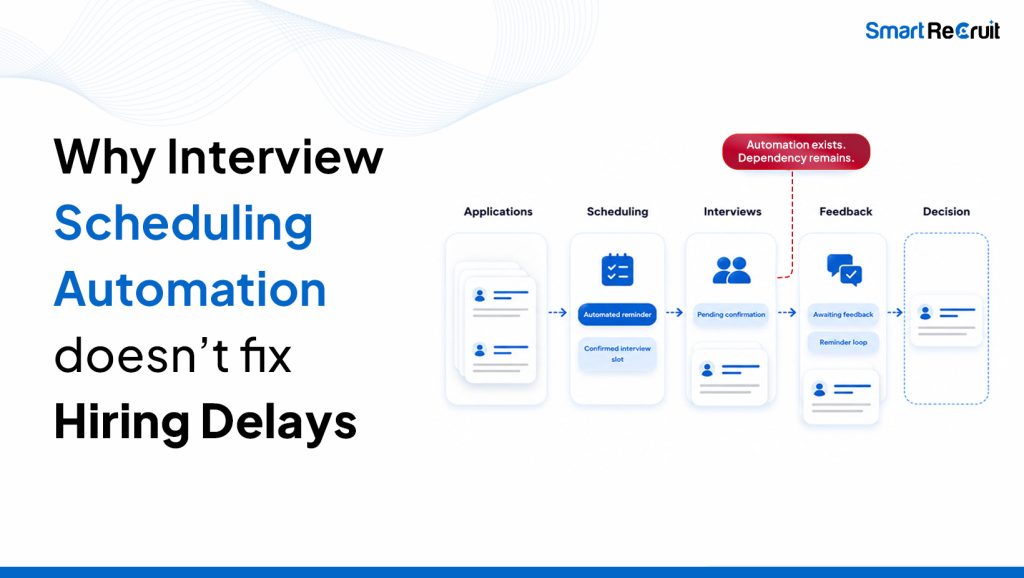
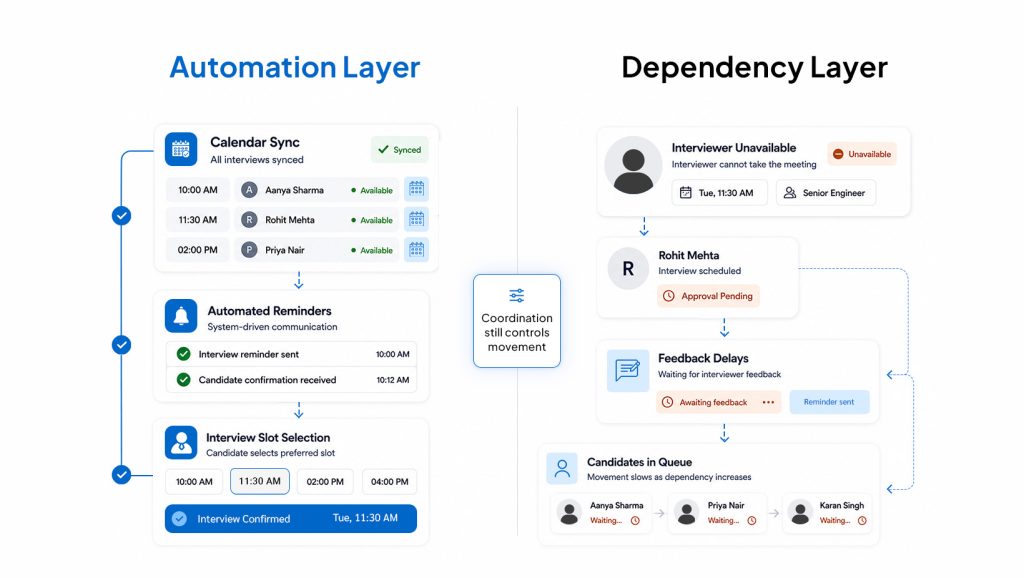
Most teams turn to interview scheduling software to reduce coordination effort. These tools streamline calendar syncing, automate reminders, and allow candidates to select available slots. At a surface level, this improves efficiency within interview scheduling.
However, the core issue remains unchanged. Interview scheduling software still depends on interviewer availability, timely responses, and stakeholder alignment. If hiring managers delay confirmation or panels are unavailable, the process continues to slow down regardless of automation.
This is where many recruitment automation efforts fall short. They optimize coordination, but they do not remove dependency. Recruiters still follow up, reschedule, and manage gaps between stages, which means the hiring process remains constrained by human availability.
In practice, this creates a false sense of progress. The system appears organized, but candidates are still waiting, and decisions are still delayed.
For a deeper look at how traditional systems struggle with decision speed, explore how hiring workflows break down even with structured tracking in place.
The limitation is not in automation itself. It is in relying on tools that assist scheduling without enabling execution across the recruitment process. For a deeper look at how traditional systems struggle with decision speed, explore how hiring workflows break down even with structured tracking in place.
Where Scheduling Friction Slows the Recruitment Process
The impact of interview scheduling becomes most visible after candidates enter the pipeline. At this stage, hiring does not slow due to sourcing gaps, but because progress depends on coordination across multiple stakeholders.
A candidate applies and qualifies quickly, but the next step depends on interview scheduling. Recruiters wait for interviewer availability, panels take time to confirm, and even a single delay can push timelines by days. As this repeats across roles, the entire recruitment process begins to stretch.
This friction compounds across stages:
- Candidates wait for interview slots
- Recruiters follow up on confirmations
- Interviewers delay feedback submission
- Decisions move only after alignment
Each delay affects candidate experience. When communication slows or interviews are postponed, candidates disengage or drop out. SHRM research show that delays in interview scheduling significantly increase candidate frustration and attrition during the hiring process.
The outcome is clear. Even with strong pipelines, time to hire increases because movement depends on coordination rather than execution.
Explore how Smart Recruit interview scheduling platform reduces coordination delays and keeps hiring moving at scale. Contact Us
How Recruitment Automation Improves Interview Scheduling at Scale
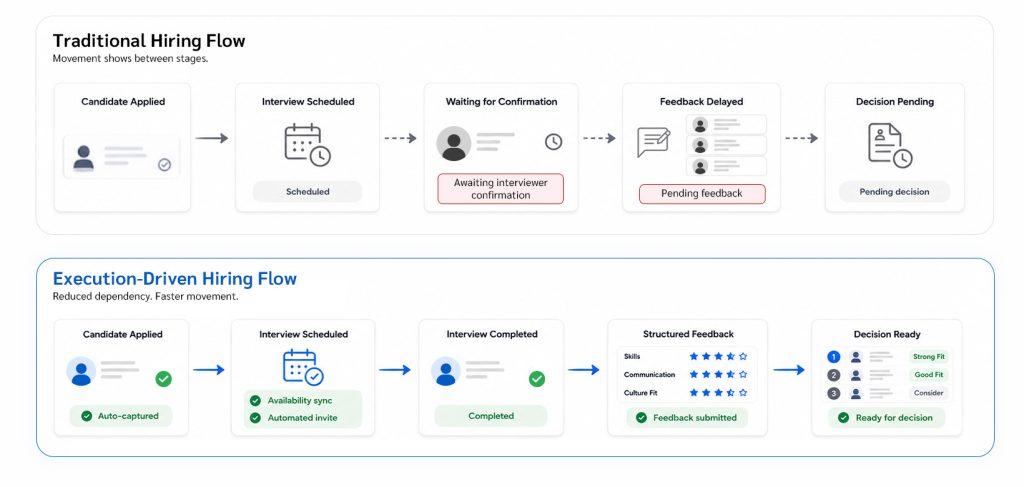
To address delays, organizations are increasingly adopting recruitment automation to improve interview scheduling. However, the real shift is not just in automating tasks, but in improving how the hiring process flows end to end.
Effective systems go beyond basic interview scheduling software. They enable candidates to self-schedule, automate reminders, and align interviewer availability in real time. More importantly, they introduce structured workflows that reduce back-and-forth communication and minimize idle time between stages.
At scale, this directly improves candidate experience. Candidates receive faster confirmations, clearer timelines, and fewer delays, which reduces drop-offs.
It also impacts time to hire. When coordination becomes system-driven instead of manually managed, hiring teams move candidates forward faster and more consistently.For a deeper understanding of how automation improves early-stage hiring flow, explore how recruitment automation fixes screening delays and reduces inefficiencies across the hiring process.
What Enterprise Teams Should Look for in Interview Scheduling Software
For enterprise hiring teams, interview scheduling software should be evaluated as part of the broader recruitment process, not as a standalone tool. The goal is not just to automate calendars, but to reduce coordination dependency and improve hiring efficiency at scale.
First, the system should integrate seamlessly with existing workflows. Strong integration with ATS and other recruitment automation tools ensures that interview scheduling aligns with the overall hiring process, rather than creating parallel systems.
Second, it should handle complexity. This includes time zone management, interviewer availability logic, and the ability to manage multiple roles and high candidate volumes without slowing down.
Third, visibility matters. Leaders need clear insights into delays, bottlenecks, and scheduling gaps that impact candidate experience and time to hire. Without this, inefficiencies remain hidden.
Finally, scalability is critical. As hiring demand increases, the system should support consistent execution without increasing manual coordination.
The best interview scheduling software is not defined by features alone, but by its ability to reduce dependency and improve how hiring moves end to end.
How Smart Recruit Handles Interview Scheduling and Follow-Up
Enterprise hiring does not slow because teams lack tools. It slows when execution depends on coordination at every step. This is where the Smart Recruit interview scheduling platform is designed differently.
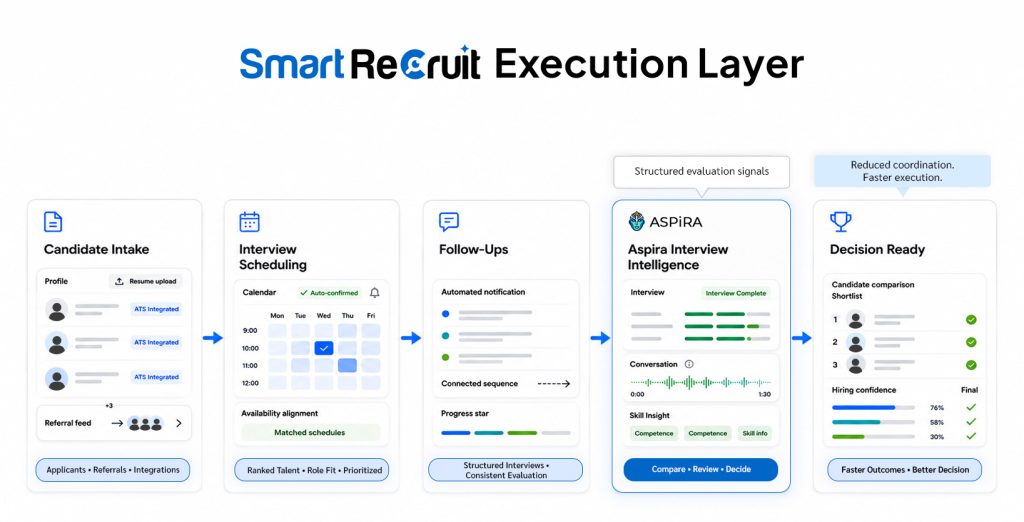
Instead of treating interview scheduling as a standalone activity, Smart Recruit embeds it within a broader execution layer across the recruitment process. Scheduling, reminders, follow-ups, and status updates are structured into a single workflow, reducing the need for constant manual intervention.
Through Smart Recruit recruitment automation, interview coordination becomes system-driven. Availability alignment, candidate communication, and stage progression happen with minimal dependency on individual stakeholders. This helps teams maintain momentum even during high-volume hiring.
Additionally, Aspira by Smart Recruit acts as an interview intelligence layer, bringing structure to early-stage interactions. It ensures that interviews are not only scheduled efficiently, but also contribute to consistent evaluation and faster decision-making.
The result is a more reliable hiring process where interview scheduling no longer delays progress, but supports continuous movement toward decisions.
Final Takeaway
Interview scheduling is no longer a backend coordination task. It is a core driver of how efficiently the hiring process moves. When scheduling depends on manual alignment, delays compound, candidate experience declines, and time to hire increases.
Automation helps, but it does not eliminate workflow dependency. What enterprise teams need is a system that moves hiring forward, not just organizes it.
When recruitment automation is applied to execution, interview scheduling becomes faster, more consistent, and easier to scale.
Contact Us for a 2-week free trial to see how Smart Recruit simplifies interview scheduling at scale.
FAQs
1. What causes interview scheduling delays?
Interview scheduling delays usually occur due to dependency on multiple stakeholders within the hiring process. Recruiters need to align interviewer availability, confirm time slots, and follow up on responses. When even one stakeholder delays, interview scheduling slows down, creating a ripple effect across the hiring process and delaying overall candidate movement.
2. How does interview scheduling software improve candidate experience?
Interview scheduling software improves candidate experience by enabling faster confirmations, reducing back-and-forth communication, and providing clear visibility into interview timelines. It allows candidates to select available slots easily, which minimizes waiting time and uncertainty, making the overall hiring process more efficient and structured.
3. Why doesn’t interview scheduling automation fully fix hiring delays?
While interview scheduling automation improves coordination, it does not remove dependency on human availability. Recruitment automation tools can manage calendars and reminders, but delays still occur when interviewers are unavailable or feedback is slow. This means interview scheduling continues to depend on execution, not just automation.
4. What should enterprises look for in recruitment automation tools?
Enterprises should look for recruitment automation tools that integrate with the hiring process, handle large-scale coordination, and reduce manual dependency. Key capabilities include workflow automation, scheduling efficiency, analytics, and consistent candidate communication, ensuring that hiring moves faster without increasing operational complexity.
5. How does interview scheduling impact time to hire?
Interview scheduling directly affects time to hire because delays in coordinating interviews slow down decision-making. When candidates wait for interview slots or feedback, the hiring process extends unnecessarily. Efficient interview scheduling ensures faster progression through stages, helping organizations reduce time to hire and secure top talent quickly.
Related Posts
Discover other posts that deepen your understanding of smart hiring, from AI-led interviews to streamlined candidate management techniques.
-
 Intelligent Candidate Matching:
How Resume Parsing Turns Profiles Into Real Hiring Insight
-
 Why Industries Need Smart Recruit: AI-Powered Hiring Without the Guesswork
Why Industries Need Smart Recruit: AI-Powered Hiring Without the Guesswork