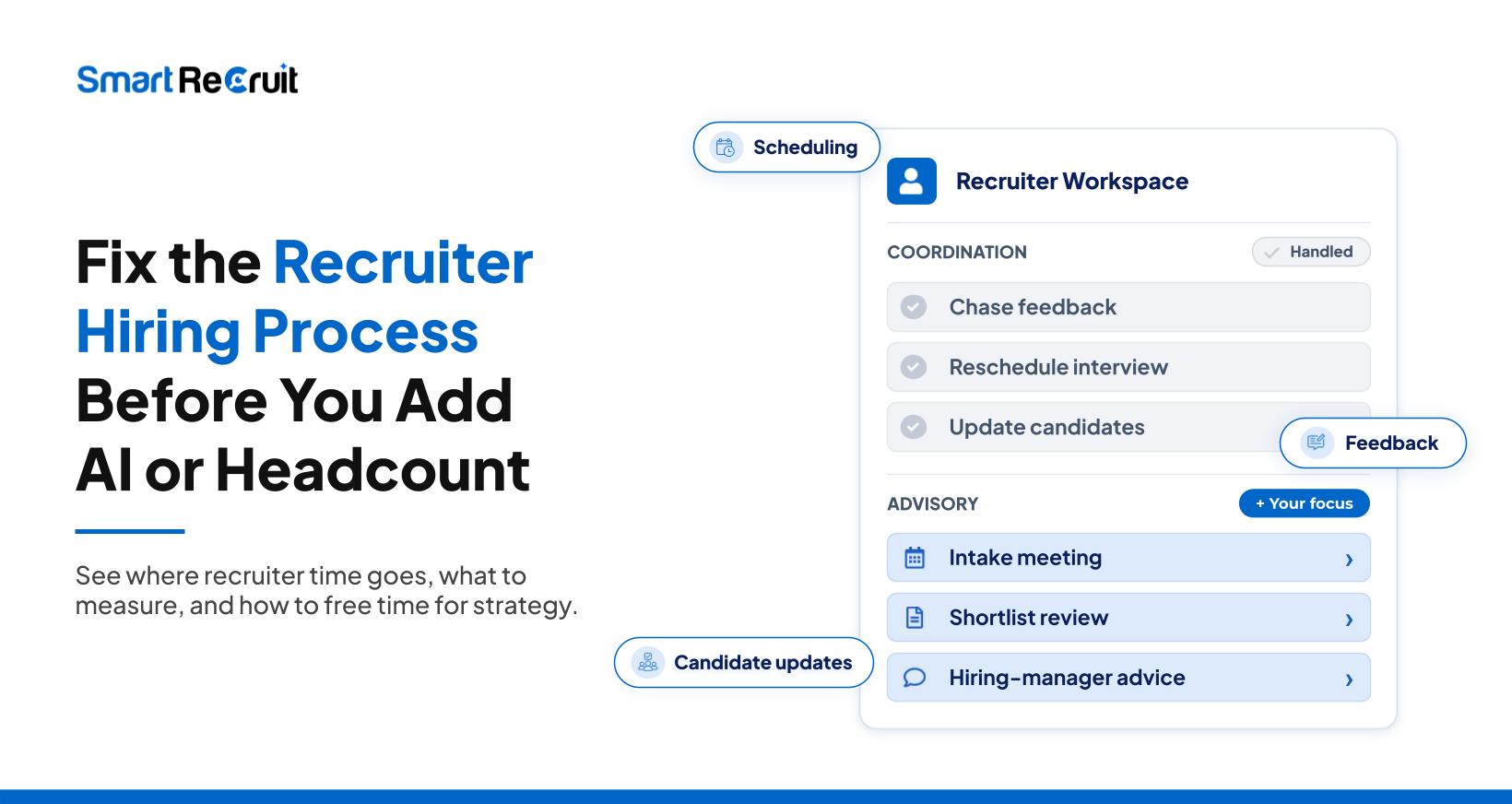
When hiring slows down, leaders reach for two fixes: more recruiters or more AI. Both can help, but neither works on a broken recruiter hiring process. The research points to a quieter cause. Recruiters are asked to advise the business, yet much of their week goes to the mechanics of hiring: chasing feedback, rebooking interviews, updating candidates, and reconciling spreadsheets.
The recruiter hiring process does not need less recruiter involvement. It needs less time spent on coordination and more spent on influencing outcomes. This guide covers where recruiter time goes, what to measure, where AI helps, and where it does not, and what to fix first.
Why the Recruiter Hiring Process Is Changing
Employers are changing what they ask recruiters to do. LinkedIn’s Future of Talent report found that Strategic Talent Advisor is now the largest senior talent category, with its share of job postings roughly doubling year over year. Management skills were about ten times more likely to appear in recruiter job postings than a year earlier, and business skills nearly five times more likely.
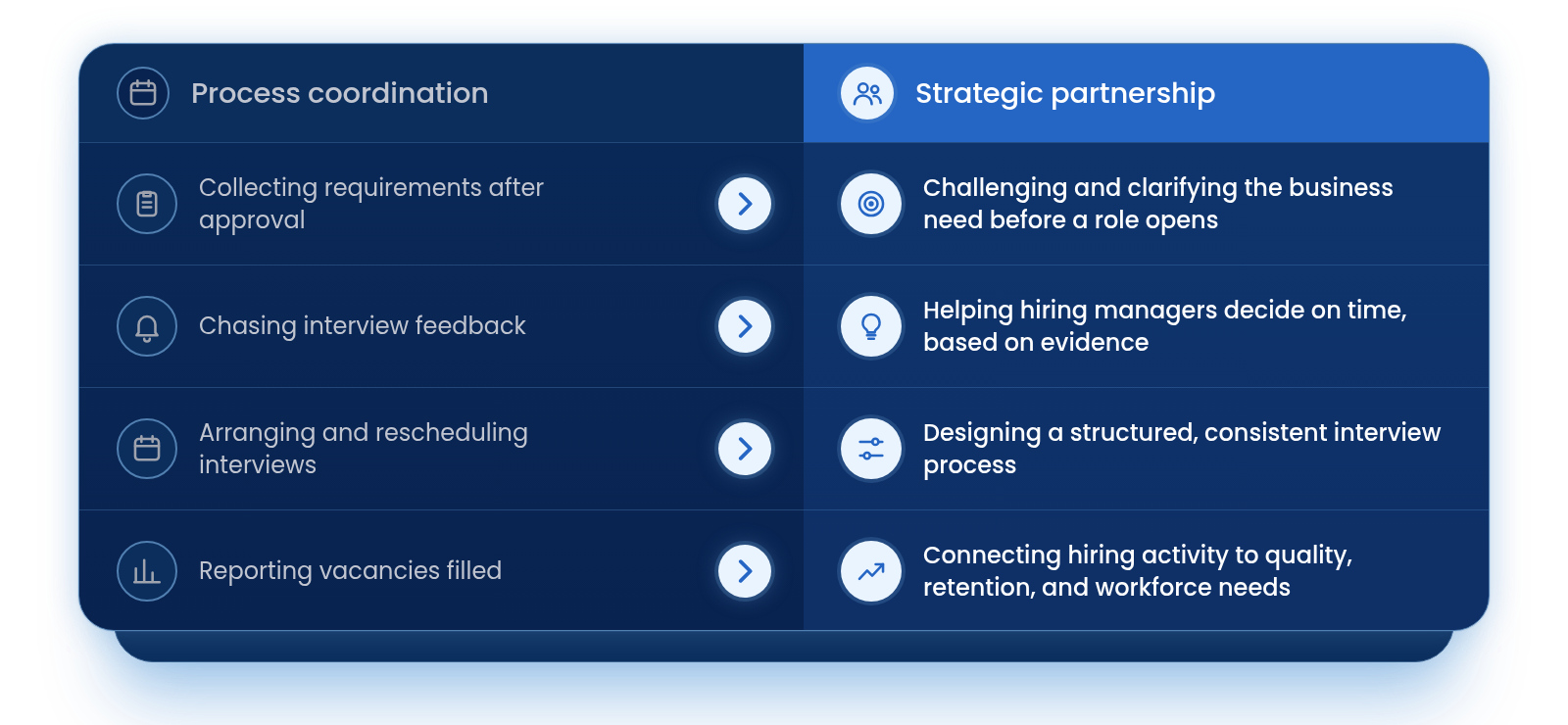
That matters for the recruiter hiring process because advice takes time. A recruiter who clarifies a business need before a role opens, challenges an unrealistic brief, or presents a shortlist with observations is doing different work from one who forwards profiles and chases replies. LinkedIn’s guidance for strategic recruiters says the same: understand business goals, use data, and partner with leadership on future workforce needs. The expectation is rising. Whether the recruiter hiring process leaves room for it is a separate question.
Why More Headcount Alone Won’t Fix Enterprise Recruiting
Capacity is not keeping pace. SHRM’s 2026 benchmarking, covering more than 4,600 organisations, found that extra-large organisations saw a 67% increase in median requisitions per recruiter. More than two in three organisations struggled to hire, and the median time-to-fill for nonexecutive roles was 39 calendar days.
For enterprise recruiting teams, that is the real squeeze: more requisitions per recruiter, with hiring still slow. The instinct is to add people or tools. A better first step is to audit where recruiter time goes, because workload growth that outpaces capacity is an operating-model problem before it is a headcount problem. Adding capacity to an unexamined recruiter hiring process mostly adds more of the same coordination. SHRM’s data is primarily U.S.-based, so read it as an international benchmark, not an India figure.
Recruitment Coordination Is Eating Recruiter Time
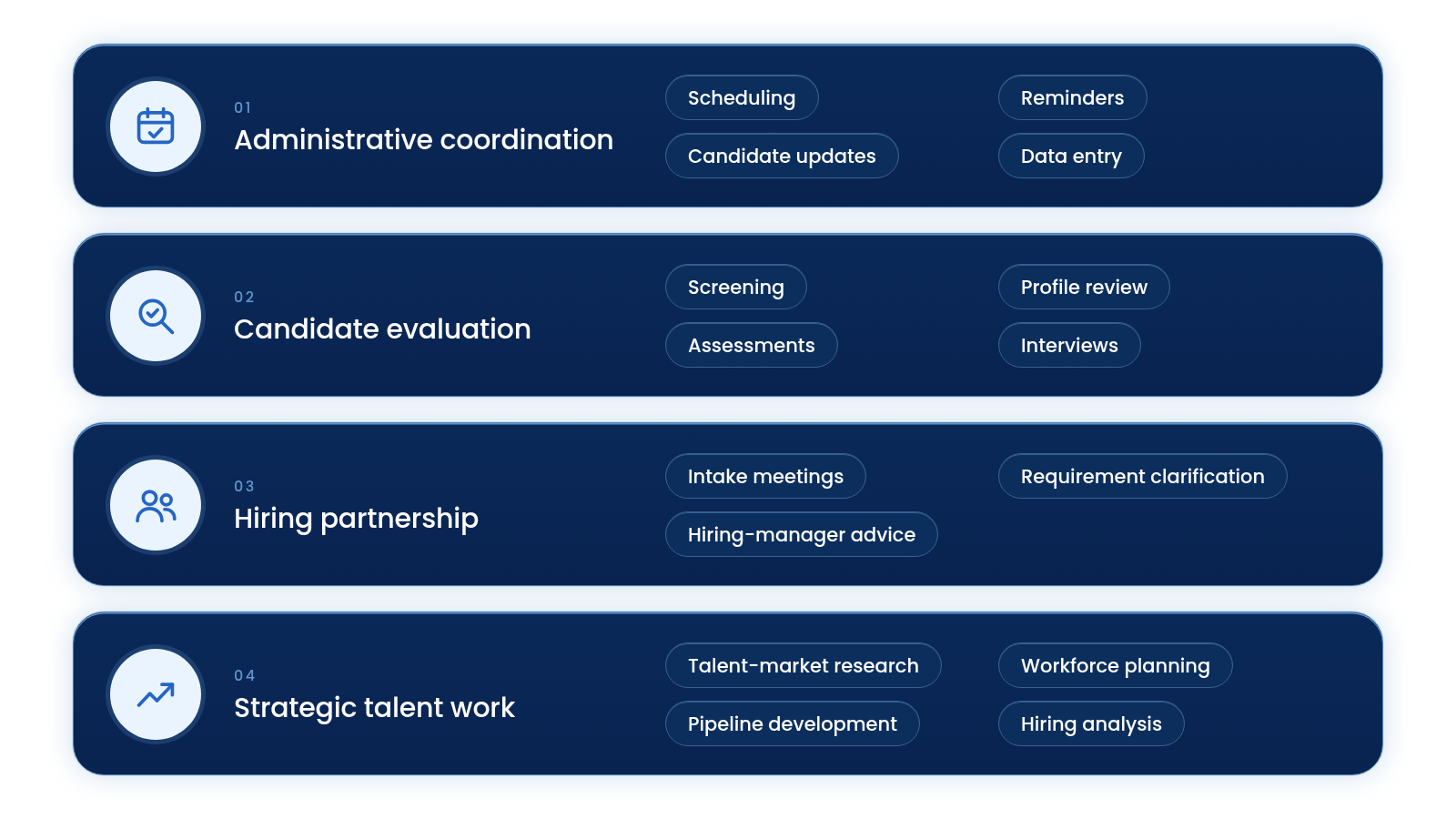
Recruitment coordination is the work of keeping a hiring process moving scheduling, reminders, candidate updates, data entry, and chasing feedback. Recruiter time falls into four buckets: administrative coordination, candidate evaluation, hiring partnership, and strategic talent work. Logging one week of recruiter time against those buckets shows how much room there is for the last two.
The cost of weak coordination reaches candidates too. CIPD found that 27% of UK employers who tried to fill vacancies had new starters fail to turn up on day one, and 41% of employers who recruited in the previous year saw new hires resign within 12 weeks. Communication and candidate experience are not the only causes, but they are the ones a recruiter’s hiring process can influence. CIPD’s data is UK-based, so treat it as a directional signal.
Recruitment coordination is also not the recruiter’s job alone. Hiring managers who delay feedback and panels that cannot agree will stall candidates whatever the recruiter does. Our guide to the interview panel framework for enterprise hiring looks at how structured, independent scoring shortens that wait.
Where Interview Scheduling Helps, and Where It Stops
Interview scheduling is the most visible coordination task and the easiest to automate. Calendars, time zones, reschedules, and reminders are repetitive, rule-based work, and removing them frees real recruiter time. LinkedIn’s Future of Recruiting 2025 research found that 37% of organisations were integrating or experimenting with generative AI in hiring, up from 27% a year earlier. Talent professionals using or experimenting with it reported saving about 20% of their workweek, roughly one workday. Among those who tested it, 35% said they saved time on candidate screening, and 26% said they spent saved time on skills assessments. These are self-reported survey figures, not a guarantee for your team.
But faster booking does not fix a slow decision. Interview scheduling ends where the real delay often begins feedback that sits unsubmitted, an approval waiting on one person, an offer that stalls. A recruiter’s hiring process that is only faster at booking is not yet better, because candidates simply wait at a later stage. For more on how AI is changing recruiter work, read how AI is changing the way recruiters hire.
Spend less time chasing and more time advising. See how Smart Recruit brings scheduling and candidate tracking into one hiring workflow. Contact Us
Your Hiring Metrics Track Activity, Not Outcomes
Many teams optimise for speed and activity while under-measuring the value of the people they hire. SHRM’s 2025 benchmarking found that only 20% of organisations track quality of hire, down from 27% in 2022. Hiring metrics that count requisitions filled and days to fill describe activity, not outcomes.
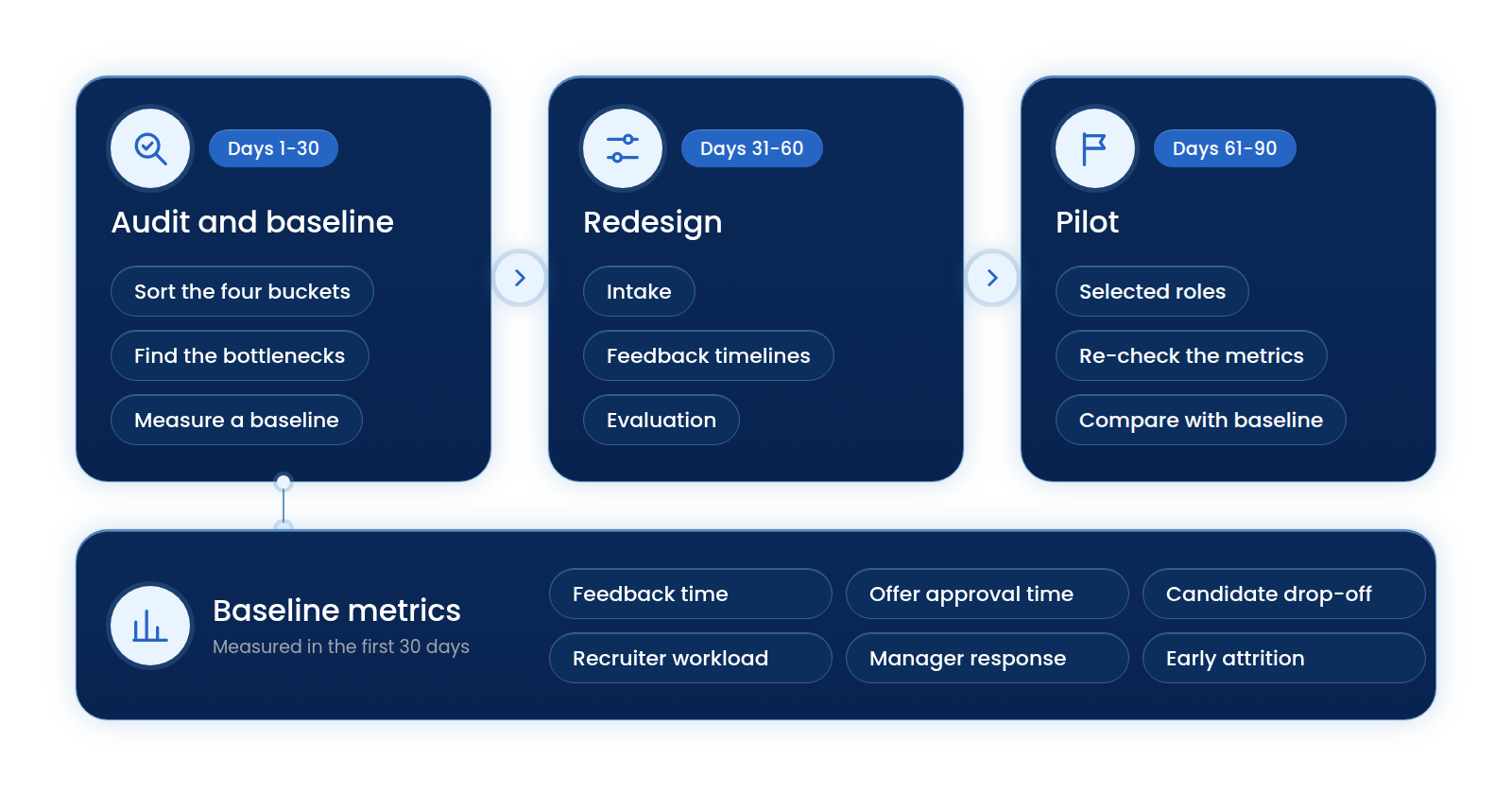
A short audit makes the gap visible. First, sort recruiters’ work into the four buckets. Second, ask which task repeats most, which needs the most manual follow-up, and where candidates wait longest. Third, baseline these hiring metrics:
- Time spent on recruitment coordination per requisition
- Time between interview completion and feedback
- Time between candidate selection and offer approval
- Candidate drop-off at each stage
- Recruiter workload per active requisition
- Hiring-manager response time, early attrition, and hiring-manager satisfaction
Run this on the recruiter’s hiring process before buying anything. A realistic sequence is 30 days to audit and baseline, 30 to redesign intake, feedback timelines, and evaluation, and 30 to pilot on selected roles. Reviewing these hiring metrics again after the pilot shows what changed.
What an AI Hiring Platform Can’t Fix
AI can take on defined, repetitive work, and that matters. It does not make recruiting strategic on its own. Leadership, intake quality, shared accountability, and human judgement decide whether recruiters move into advisory roles, and no AI hiring platform can repair a recruiter hiring process that lacks them.
Trust is the other limit. ACCA’s Global Talent Trends survey of more than 11,000 accountancy and finance professionals found that 48% have reservations about AI algorithms in hiring, and 54% of board-level leaders share doubts. LinkedIn’s MENA research lists the leading barriers to generative AI in recruiting as data and privacy concerns (37%), lack of budget (36%), and accuracy concerns (33%). None of that is an argument against AI. It is an argument for governance: explainability, human review, bias monitoring, access controls, and a named owner for every decision.
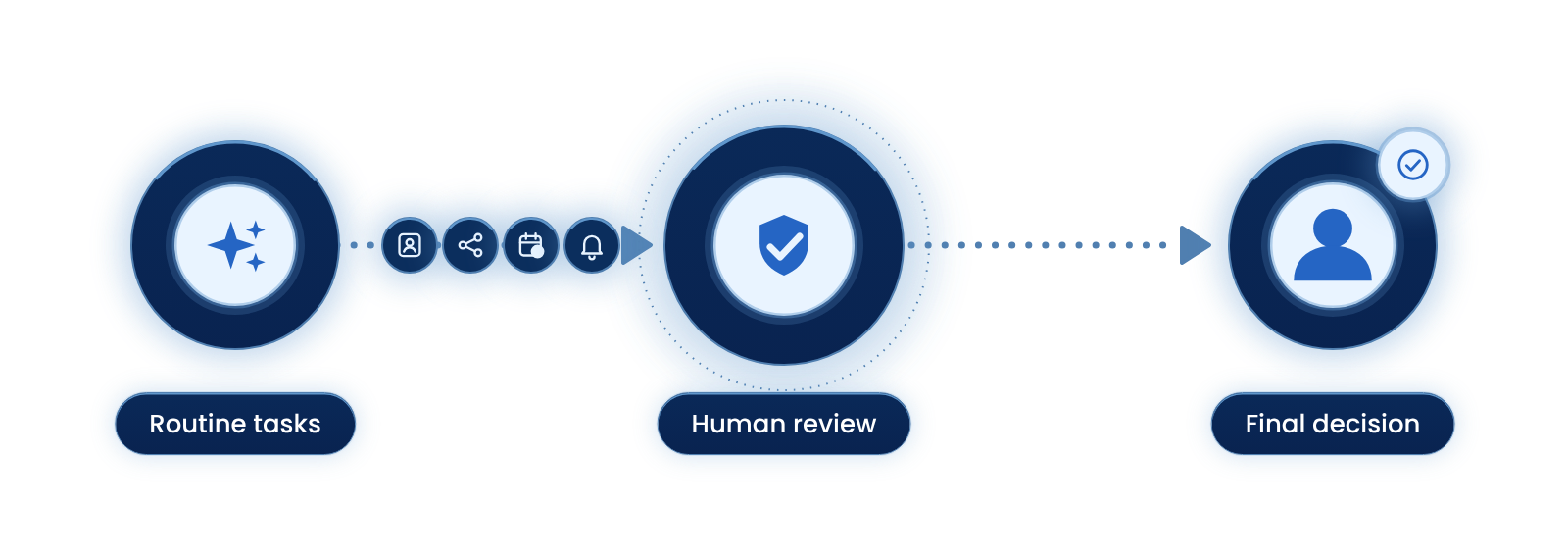
These are global, U.S., and UK benchmarks, so check them against your own India hiring data before quoting them as your numbers. When you evaluate tools, our guide to recruitment automation software and what to look for in 2026 is a useful checklist. A good AI hiring platform shows its evidence and leaves the decision with the recruiter.
Smart Recruit: Cutting the Coordination Load
Smart Recruit is an end-to-end AI hiring platform, built to take the mechanical work out of the recruiter hiring process without taking the recruiter out of it. Resume parsing and candidate matching handle first-pass screening against job requirements. Aspira, its interview intelligence engine, runs structured, adaptive first-round interviews. The interview scheduling module, with candidate self-scheduling, removes booking back-and-forth. Dashboards give leaders visibility into hiring metrics, and audit trails record what happened at each step.
Recruitment coordination is the thread through all of it: one workflow instead of separate tools, so enterprise recruiting teams can see where candidates are waiting. The recruiter keeps the evaluation and the final hiring decision.
Start With the Workflow, Not the Tool
Recruiters do not need to be less involved in hiring. They need to spend less time on the mechanics of hiring and more on influencing its outcomes. That change comes from better intake, shared accountability, structured evaluation, clear ownership, and responsible automation. AI is one enabler among them.
Before adding AI or headcount, audit the recruiter’s hiring process: where recruiter time goes, where candidates wait, and which outcomes you can actually see. Fix those first, then automate what is left. The recruiter hiring process that results are faster and, more importantly, easier to defend.
Ready to take the coordination load off your recruiters?
See how Smart Recruit can strengthen your recruiter hiring process. Contact Us
FAQs
What is recruitment coordination, and why does it burden recruiters?
Recruitment coordination is the work of keeping hiring moving scheduling, reminders, candidate updates, and chasing feedback. It burdens recruiters because it repeats every requisition and leaves less time for advising hiring managers. Smart Recruit keeps these steps in one workflow, so recruiters can see where candidates are waiting and what needs action.
Which hiring metrics should recruiters track?
Start with measures that show where hiring stalls: time from interview to feedback, time from selection to offer approval, candidate drop-off by stage, hiring-manager response time, and recruiter workload per requisition. Add outcome measures such as early attrition and hiring manager satisfaction. Good hiring metrics describe both speed and quality.
How is enterprise recruiting different from standard hiring?
Large organisations run more requisitions across more stakeholders, so coordination failures multiply. SHRM found a 67% rise in median requisitions per recruiter at extra-large organisations. The recruiter hiring process needs clear ownership, shared standards, and visibility across teams, not just more recruiters.
Can an AI hiring platform replace recruiters?
No. An AI hiring platform can handle defined, repetitive tasks such as resume parsing, matching, and scheduling, but judgement, fairness, and sensitive conversations stay with people. In ACCA’s survey, 48% of respondents had reservations about AI algorithms in hiring. Smart Recruit’s audit trails and structured evaluation give reviewers evidence to examine, and the recruiter keeps the final decision.
Does interview scheduling automation really speed up hiring?
It removes booking back-and-forth, but speed also depends on what happens after the interview. Track the time from interview to feedback and from feedback to decision. Smart Recruit’s interview scheduling module, with candidate self-scheduling, handles the booking, while tracking keeps the later gaps visible.