ATS vs Recruitment Automation Platform:
Where ATS Breaks Down
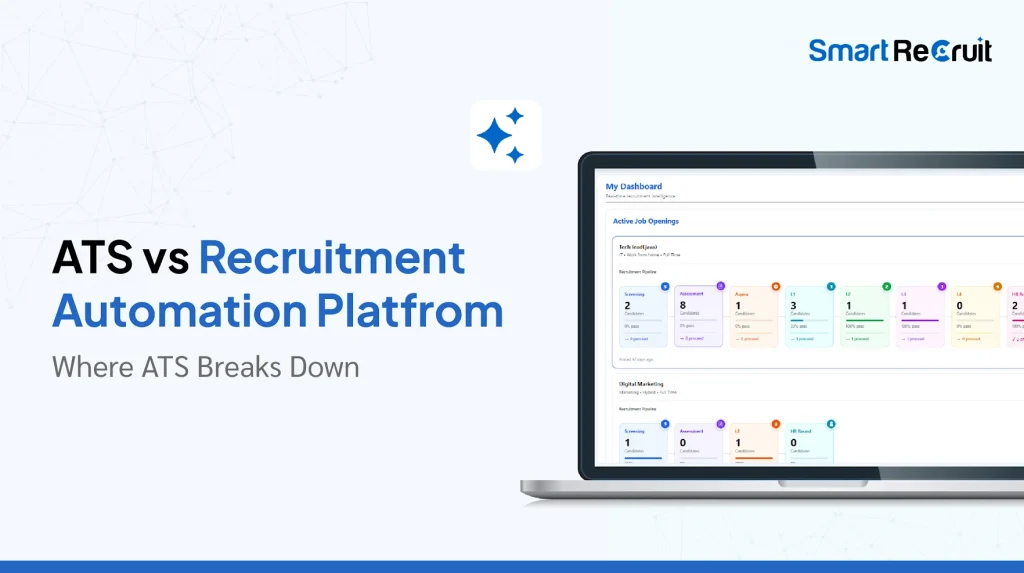
Hiring often feels slower than it should, even when the right systems are in place. Most teams rely on an ATS to track applications and manage pipelines, yet roles stay open, shortlists arrive late, and decisions take longer than expected. The issue is not visibility, but execution.
In recruitment automation platform conversations, this gap becomes clear. ATS helps track candidates, but it does not move decisions forward at scale. As high-volume hiring increases, ATS limitations begin to surface across screening, coordination, and early-stage evaluation.
This article explores where ATS breaks down and what changes when hiring execution is structured for scale.
What ATS Was Designed for in Hiring
Applicant Tracking Systems were built to bring structure to hiring, not to execute it.
At their core, ATS platforms manage candidate data, track applications across stages, and ensure compliance throughout the hiring process. They centralize information, provide visibility to recruiters and hiring managers, and act as a system of record for every role. For growing teams, this foundation is essential.
In most organizations, the ATS becomes the backbone of applicant tracking system integration, connecting sourcing channels, career pages, and internal workflows into a single pipeline. It answers key questions around candidate status, pipeline volume, and next steps.
This works well at manageable volumes. However, as hiring demand grows, ATS systems begin to show their limits. According to SHRM, recruiters handling more than 20 requisitions begin to experience significant manual workload pressure, making it difficult to sustain consistent screening and evaluation at scale.
The challenge is not effectiveness, but scope. ATS was never designed to handle the execution layer of hiring.
ATS Limitations in High-Volume Hiring
Applicant Tracking Systems were built to bring structure to hiring, not to execute it. At their core, ATS platforms manage candidate data, track applications across stages, and ensure compliance, giving recruiters and hiring managers clear visibility across the pipeline.
In most organizations, the ATS becomes the backbone of applicant tracking system integration, connecting sourcing channels, career pages, and internal workflows into one system. It helps answer key questions such as:
- Where candidates are in the process
- How many are in each stage
- What actions are pending
This works well at manageable volumes. However, as hiring demand grows, ATS systems begin to show their limits. They track movement but do not accelerate it, and they store feedback without structuring decisions.
The challenge is not effectiveness, but scope. ATS was never designed to handle execution at scale.
Where ATS Breaks at Scale
ATS systems do not fail suddenly. They break at predictable pressure points as hiring demand increases.
The first signal is recruiter overload. As application volume rises, manual effort grows faster than capacity, impacting recruitment KPIs like time to first screen and overall time to hire. At the same time, fragmented workflows across emails, scheduling tools, and vendor inputs create constant context switching, slowing decisions and reducing consistency.
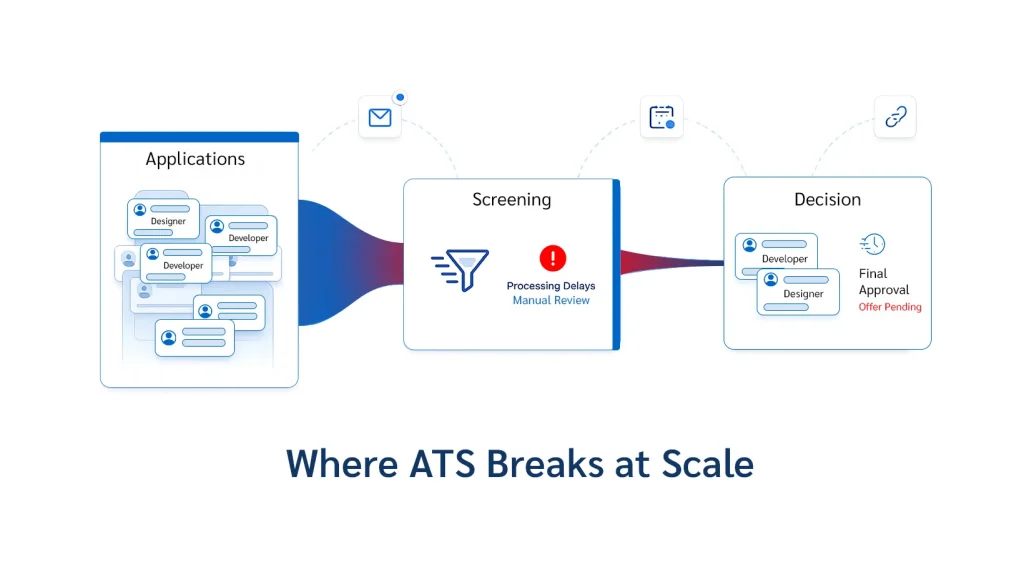
Another key breakdown is decision lag. According to HBR, multi-stakeholder decision environments can introduce up to 40% delay in decision-making, making it harder for hiring managers to compare candidates and move forward quickly.
The impact becomes visible in outcomes. Delays increase drop-offs, and candidate experience improvement becomes difficult to sustain.
These issues compound over time, exposing the gap between tracking hiring and actually moving it forward.
What a Recruitment Automation Platform Solves
If ATS systems organize hiring, a recruitment automation platform is built to move it forward. The difference lies in execution, reducing the effort required to progress candidates instead of just managing workflows.
The first shift happens in screening, where structured workflows reduce manual effort and improve consistency, as explained in detail in How Recruitment Automation Fixes Screening Delays. Candidate data is structured early, so recruiters no longer need to manually interpret every resume, improving both speed and consistency. The second shift is in early-stage assessment, where repetitive qualification calls are replaced with structured, asynchronous evaluation, ensuring every candidate is assessed on the same criteria. This is where an AI hiring platform begins to deliver real impact.
The final shift is at the decision level. Feedback is unified into a single view, improving alignment and reducing delays.
The outcome is clear. Recruitment workflow automation increases hiring throughput and reduces time-to-hire without adding team overhead.
ATS vs Recruitment Automation Platform
At a glance, both systems seem to support the same hiring process. In practice, they solve very different problems.
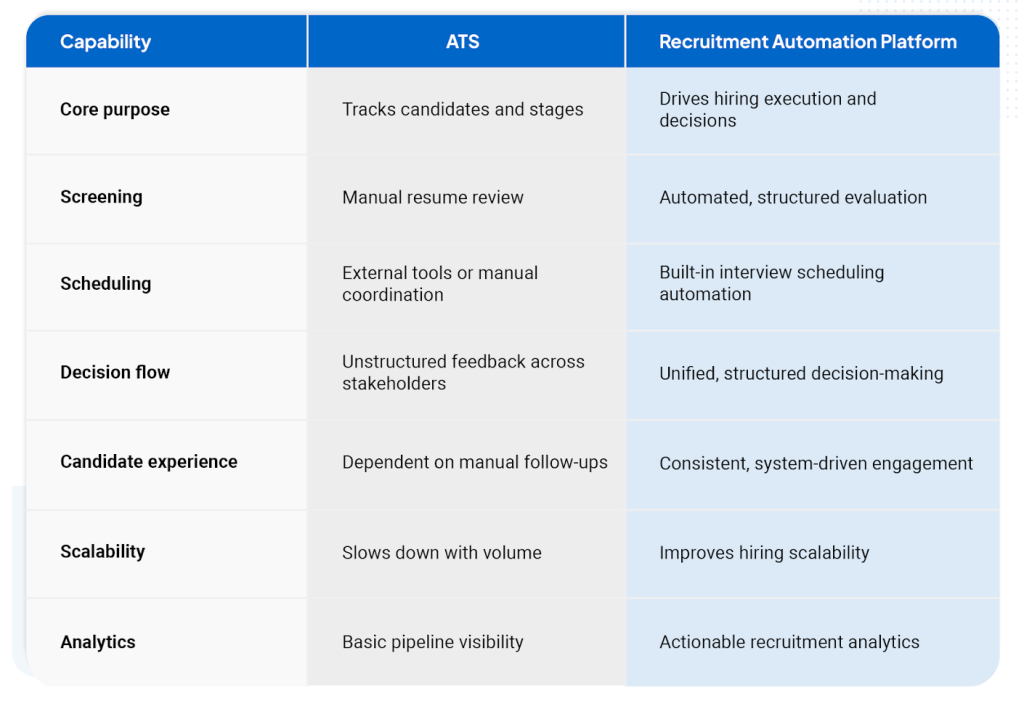
An ATS is built for visibility and control. A recruitment automation platform is built for execution and speed. The distinction becomes critical as hiring scales.
Here is a clear comparison:
See how recruitment automation works in real hiring workflows with Smart Recruit. Contact Us
This is where the difference between ATS vs recruitment automation platform becomes clear.
ATS platforms help you see the pipeline. They answer where candidates are in the process. But they do not reduce the effort required to move them forward. As a result, manual screening bottlenecks and coordination delays remain.
A recruitment automation platform vs ATS approach shifts the focus. Instead of managing steps, it structures how those steps happen. Screening becomes standardized. Scheduling becomes seamless. Decisions become comparable.
For hiring leaders, this is the real shift. From tracking activity to improving outcomes.
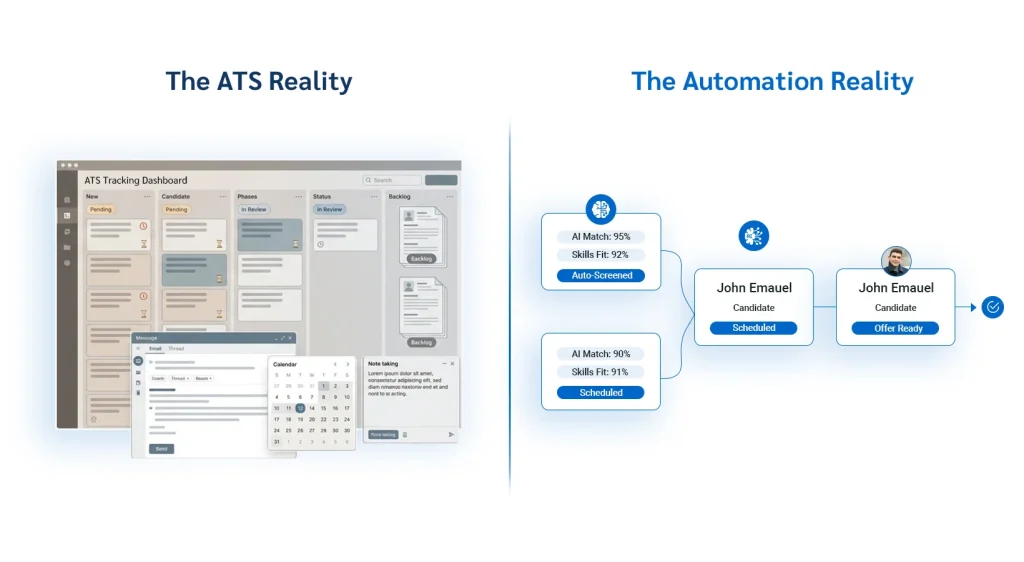
Real Enterprise Hiring Scenario at Scale
Let us consider a typical enterprise hiring scenario. A role opens and within a few days, over 200 applications come in. The ATS captures everything, and the pipeline looks strong on the surface.
But execution tells a different story. Recruiters work through backlogs while juggling multiple roles, and shortlisting takes days. By the time candidates are reviewed, some have already moved on. As hiring progresses, delays shift to coordination, panel scheduling, SME availability, and scattered feedback slow decisions further.
This is where high-volume hiring breaks, not at sourcing, but at execution.
The impact becomes clear:
- Time-to-hire increases
- Hiring scalability becomes difficult
- Candidate experience declines
Pipeline visibility exists, but decision speed does not. Even with a well-managed ATS, these breakdowns persist because it tracks activity, not execution.
When to Switch from ATS to a Recruitment Automation Platform
Most hiring teams do not decide to switch systems. They reach a point where existing systems stop keeping up.
The signals are usually operational, not technical. Pipelines look healthy, but hiring outcomes slow down. Recruiters stay busy, but hiring scalability does not improve. This is where the limitation is no longer about tools. It is about execution.
A few clear indicators show when an ATS is no longer enough:
- Shortlists consistently take longer than expected
- Recruiters spend more time on coordination than evaluation
- Manual screening bottlenecks increase with every new role
- Interview scheduling becomes a recurring delay
- Recruitment KPIs such as time-to-hire and candidate drop-off begin to worsen
At this stage, adding more recruiters or tools rarely solves the problem. It often increases complexity. More people mean more coordination. More tools mean more fragmentation.
The shift happens when teams recognize that hiring is not just about managing workflows. It is about structuring how decisions are made and how quickly they move forward.
This is where a recruitment automation platform becomes relevant. It does not replace your ATS. It complements it by addressing the execution layer, where most delays actually occur.
For hiring leaders, the decision point is simple. If your process is visible but not moving faster, it is time to rethink how execution is structured.
Smart Recruit in Practice
Most hiring teams do not need another tool. They need a system that helps them move decisions forward without adding coordination overhead.
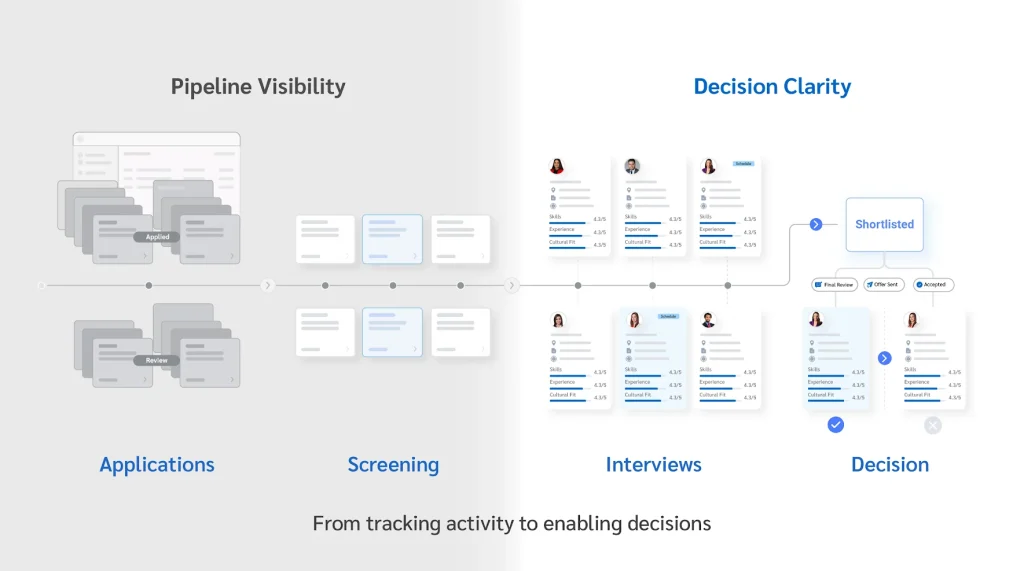
This is where Smart Recruit operates differently. Instead of focusing only on tracking or visibility, it works as a decision layer across the hiring process. The goal is simple. Reduce manual effort, structure evaluation, and improve how quickly teams move from application to shortlist.
With Smart Recruit AI, candidate data is structured early, so recruiters spend less time interpreting resumes and more time evaluating fit. Early-stage screening is standardized through structured evaluation, reducing repetitive qualification calls and ensuring consistency, as discussed in Aspira Turn First Interviews into a Hiring Advantage. As candidates move forward, feedback is captured in a unified view, making it easier for hiring managers to compare and decide without delays.
This approach directly impacts hiring outcomes. Screening becomes faster, coordination reduces, and decisions become clearer. Instead of managing multiple disconnected steps, hiring teams operate on a system that supports execution at scale.
That is where Smart Recruit automation changes the experience. It does not replace your existing setup. It strengthens it by removing the friction that slows hiring down.
Final Takeaway
ATS platforms were built to manage hiring. But hiring today is not just about management. It is about execution at scale.
As volume increases, the challenge is no longer visibility. It is how quickly and consistently decisions move forward. That is where most hiring systems begin to slow down, not because candidates are missing, but because execution cannot keep up.
A recruitment automation platform changes that equation. It reduces manual effort, structures evaluation, and improves how hiring teams operate under pressure. The result is not just faster hiring. It is clearer, more consistent decision-making across the pipeline.
For teams hiring at scale, the shift is not about replacing systems. It is about strengthening the layer that actually drives outcomes.
See how Smart Recruit improves hiring execution at scale.
Start your 2-week free trial or get in touch to explore how your hiring process can move faster without added complexity.
FAQs
1. What are the main ATS limitations?
ATS limitations include static keyword screening rejecting 75% qualified candidates, manual workflows creating 23-hour screening delays per hire, and poor scalability at 20+ requisitions per recruiter. These force recruiter bypasses, ghosting, and compliance gaps that automation platforms eliminate.
2. How does recruitment workflow automation reduce time-to-hire?
Recruitment workflow automation eliminates delays between stages: instant screening, self-scheduling interviews, automated feedback loops. SHRM data shows 30-50% time-to-hire reduction by removing manual handoffs. High-volume hiring drops from 44 to 22 days with systematic execution.
3. What is applicant tracking system integration and why does it matter?
Applicant tracking system integration connects ATS data with scheduling, scoring, and analytics tools. Weak integrations create data silos causing 40% decision delays (HBR). Automation platforms unify workflows, enabling real-time execution across fragmented HR tech stacks.
4. How does high-volume hiring expose ATS limitations?
High-volume hiring overwhelms ATS with 300+ resumes per role, static parsing rejects qualified talent, and manual coordination spikes to 23 hours per hire. Automation platforms scale seamlessly with intelligent matching and autonomous workflows, maintaining quality at volume.
5. What is a recruitment automation platform?
Recruitment automation platforms execute end-to-end hiring through AI orchestration—screening, scheduling, matching, decisions. Unlike ATS tracking-only systems, they autonomously manage processes, cutting manual work 70% and scaling beyond 300+ resumes per role seamlessly.
Related Posts
Discover other posts that deepen your understanding of smart hiring, from AI-led interviews to streamlined candidate management techniques.