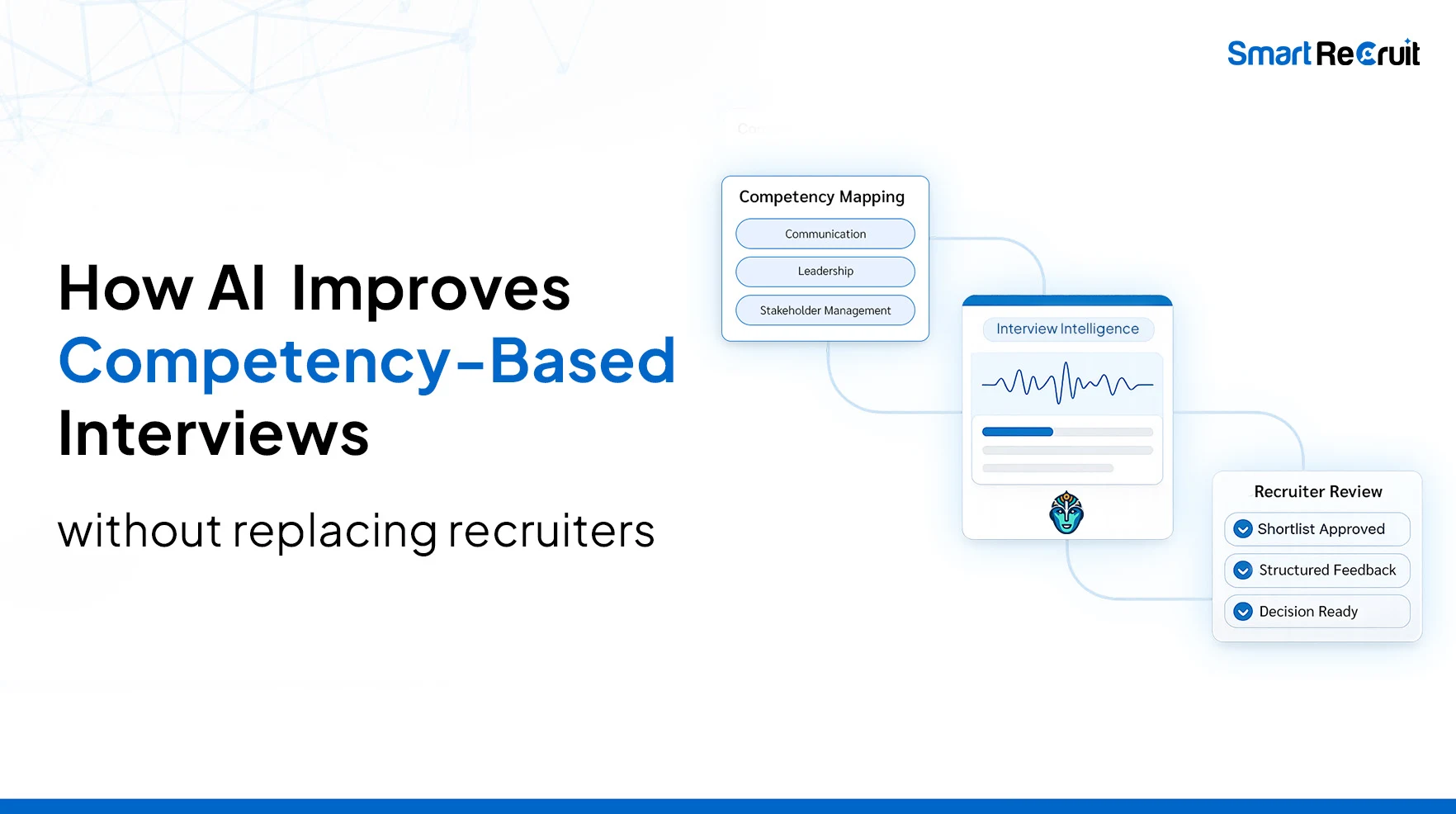
How AI Improves Competency-Based Interviews
Without Replacing Recruiters
Competency-based interviews are widely considered the strongest method for evaluating candidates at scale, yet most enterprise organizations still struggle to execute them consistently. As research on AI in recruitment consistently shows the gap between knowing what good hiring looks like and actually delivering it across distributed teams remains one of the most persistent operational challenges in talent acquisition.One of the most visible symptoms is inconsistent candidate assessment across interviewers and hiring rounds.
The problem is not a lack of frameworks. Most enterprise hiring teams already define competencies, train interviewers, and build structured evaluation criteria. The breakdown happens in execution: across multiple interviewers, feedback cycles, and hiring stages where consistency is hardest to maintain.
This is where AI-assisted interview workflows are changing the equation. Not by removing recruiters from the process, but by giving them better tools to organize, standardize, and review competency-based interviews at scale.
Why Competency-Based Interviews Still Matter in Enterprise Hiring
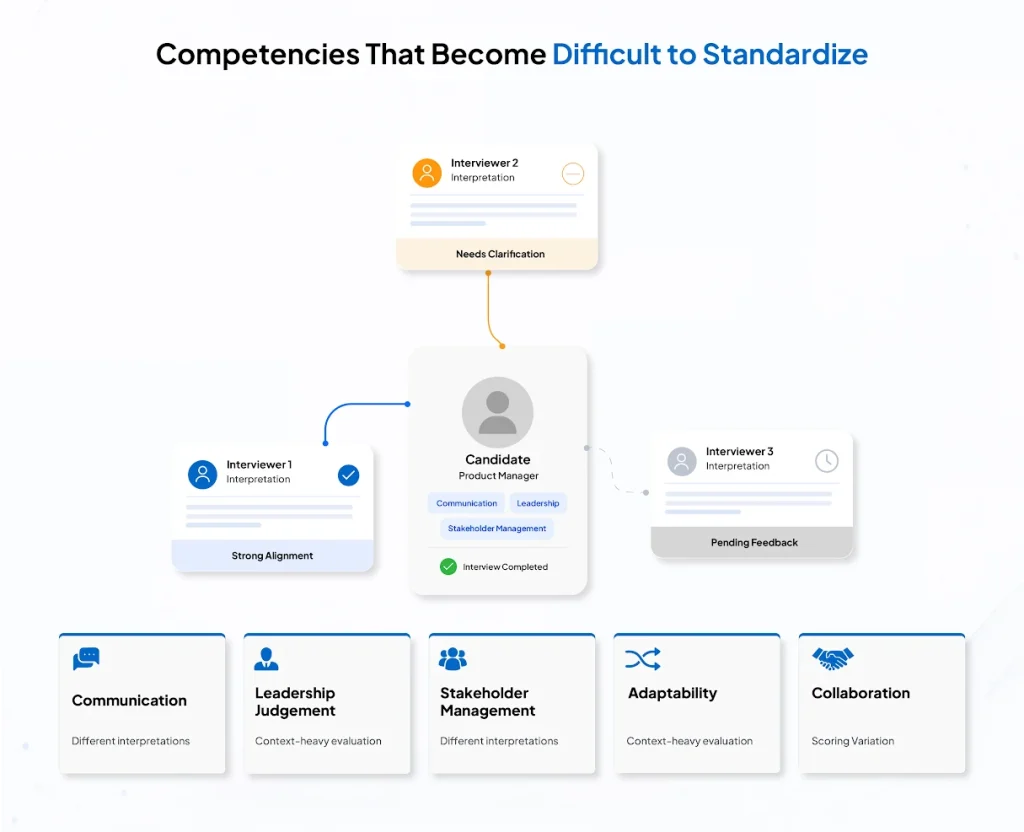
Traditional interviews vary significantly depending on interviewer style, questioning approach, and how each individual interprets candidate responses. This variability may be manageable in smaller hiring environments, but in enterprise settings where multiple interviewers evaluate candidates across teams, geographies, and hiring rounds, it becomes an operational liability.
Competency-based interviews address this by aligning every evaluation against predefined skills, behaviors, and role-specific criteria, rather than relying on the judgment of individual interviewers. According to SHRM‘s structured interviewing framework, this approach helps organizations improve candidate assessment quality and create more reliable, defensible hiring decisions across teams.
The competencies that matter most in enterprise roles: communication, leadership judgment, stakeholder management, adaptability, and cross-functional collaboration are also the hardest to evaluate consistently. Without a shared assessment framework, interviewers apply different standards to the same candidate behaviors, making comparison across rounds and decision-makers unreliable.
Competency-based interviews solve this by creating a common evaluation language across the hiring team. The challenge, as enterprise hiring operations scale, is maintaining that consistency in practice.
Related reading: Why Applicant Tracking Systems Alone Can’t Improve Hiring Decisions
Why Traditional Competency-Based Interviews Break Down at Scale
Even organizations with well-defined competency frameworks struggle to execute them consistently across large hiring operations. The breakdown typically happens not in how interviews are designed, but in how they are coordinated. Fragmented feedback collection, inconsistent interviewer briefings, and multiple approval layers all slow down candidate movement between stages in ways that are difficult to track or fix.
As hiring volume increases, recruiters spend a disproportionate amount of time chasing feedback and aligning interviewers rather than advancing hiring decisions. Evaluation quality ends up depending more on which interviewer assessed the candidate than on the competency framework itself. Candidate comparisons become harder to make reliably, and pipeline visibility narrows at exactly the point where it matters most. This is the operational gap that data-driven hiring tools are designed to address.
AI Should Support Recruiters, Not Replace Them
As interview workflows grow more complex across enterprise hiring environments, a practical question emerges: what role should AI actually play in the process?
Research published in Cognitive Technology and Work (Chen, 2022) found that AI and recruiters perform best when working in collaboration rather than in isolation. AI handles structured data organization and pattern recognition across candidate responses, while recruiters apply contextual judgment to the actual hiring decision. The same research noted that AI tools can help reduce certain unconscious biases during early evaluation stages, but that final hiring decisions benefit significantly from recruiter interpretation of factors that fall outside standardized scoring models.
This distinction matters in day-to-day hiring. Competencies like leadership potential, organizational alignment, and team fit require contextual reading that a scoring model cannot fully capture. A candidate’s performance on a structured interview question can be measured accurately. Whether that candidate’s working style fits a specific team or business context is a judgment that still belongs with the recruiter.
LinkedIn’s Future of Recruiting research reflects this direction at an industry level. Organizations are increasingly prioritizing hiring systems that combine operational efficiency with stronger recruiter decision support, rather than systems that shift judgment away from the people best placed to exercise it.
AI-assisted interview workflows deliver the most value when they give recruiters better-organized information, clearer evaluation signals, and more time for the decisions that require human interpretation.
What Interview Intelligence Actually Means
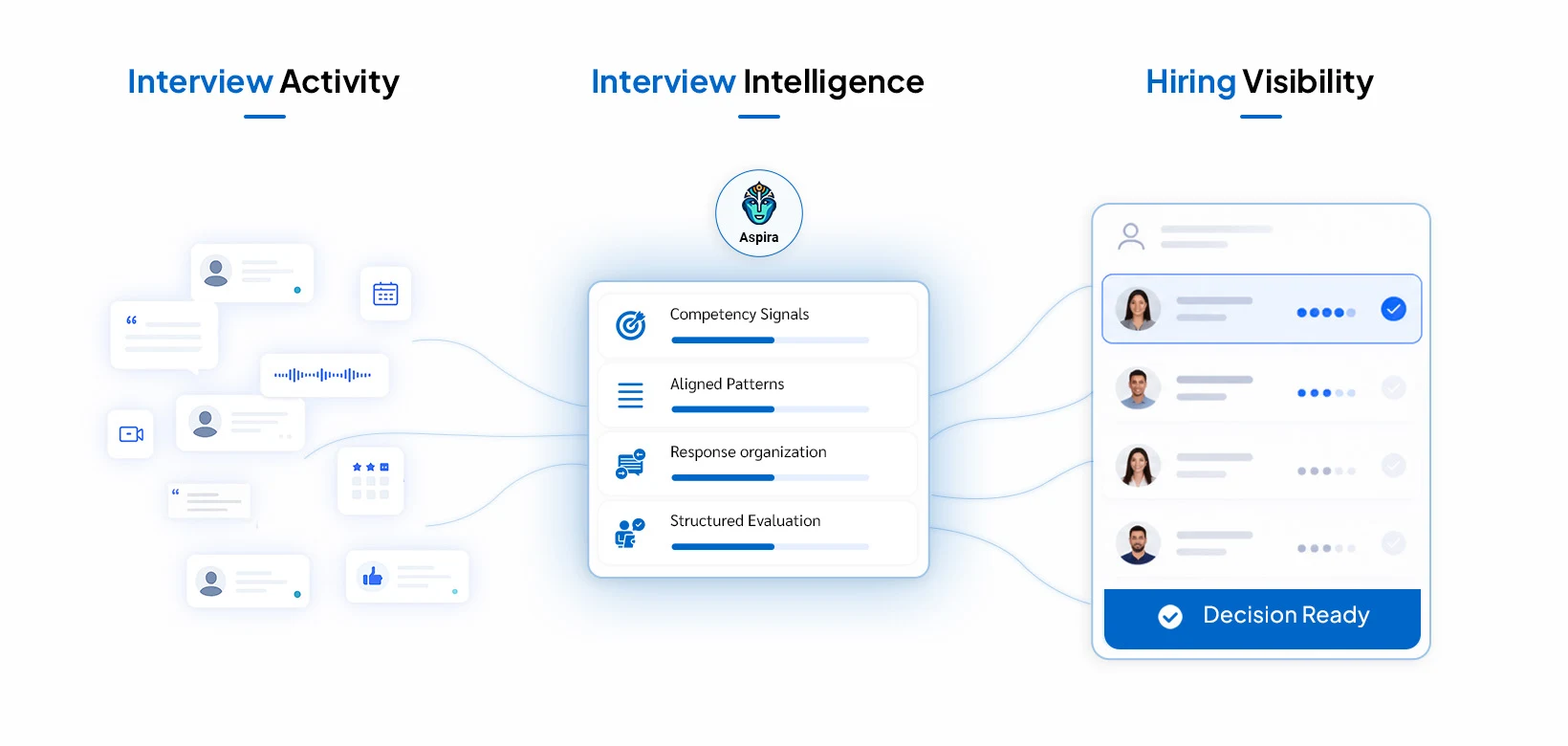
Interview intelligence is the structured layer that sits between raw candidate responses and hiring decisions. It organizes competency signals, interviewer observations, and evaluation data into a format that recruiters can review systematically, rather than having to reconstruct from scattered notes and disconnected feedback threads.
Gartner’s research on data-driven hiring & generative AI across hiring workflows confirms that AI-assisted evaluation tools improve both the speed and consistency of candidate assessment when properly integrated into structured interview processes. The key word is integrated. Interview intelligence does not replace the interview itself. It is an organizing layer that makes the output of every interview more usable and more consistent across the hiring team.
This matters most in distributed hiring environments where multiple interviewers, panel members, and decision-makers need to reach consistent conclusions about the same candidate. Rather than consolidating several different sets of interview notes manually, recruiters work from a centralized view of candidate performance, scored against the same competency framework, organized by stage, and traceable to specific response points.
How AI Improves Competency-Based Interview Execution
Effective competency-based interview execution starts before the interview takes place. Enterprise hiring teams first define role requirements, core competencies, and evaluation criteria for the position. This creates the structured foundation that every subsequent assessment is measured against, ensuring candidates are evaluated on consistent role-specific expectations rather than the individual preferences of whoever happens to be conducting the interview.
AI supports this process by generating competency-aligned interview questions based on role, required skills, and hiring objectives. Rather than relying on ad hoc questioning, data-driven hiring platforms give recruiters structured frameworks that improve candidate comparison across rounds. This is particularly useful in distributed hiring environments where interviewers may have different levels of familiarity with the role or with structured evaluation methods.
When AI-assisted platforms like Aspira by Smart Recruit are integrated into the workflow, each interview produces structured response capture, competency mapping, and evaluation signals that recruiters can access from a centralized dashboard. SHRM‘s structured interviewing guidelines identify this kind of centralized, competency-aligned evaluation as a key factor in improving hiring consistency across large teams.
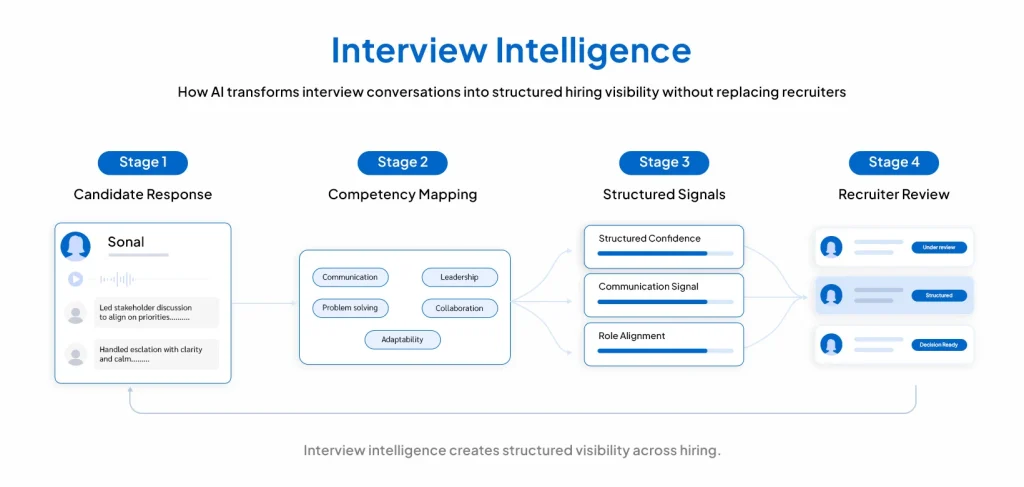
Recruiters then review structured scoring signals and candidate assessment data to make more evidence-backed hiring decisions, with full visibility into how each candidate performed against the competency framework and without the coordination overhead that traditional interview processes require.
Related reading: Aspira: Turn First Interviews Into a Hiring Advantage
How Enterprise Teams Should Evaluate AI Tools for Competency-Based Interviews
Enterprise teams evaluating AI interview platforms should look beyond automation claims and assess how each platform actually functions within competency-based interview workflows. The most important criteria are whether the platform aligns interviews to predefined competencies rather than generating generic questions, whether scoring logic is transparent and traceable for each candidate response, whether recruiters retain full visibility into how evaluations are generated, and whether the system reduces coordination overhead without weakening candidate assessment quality.
Platforms that fall short on these criteria typically create rigid interview experiences with inconsistent scoring, generic questions that are not aligned to role requirements, and limited recruiter access to candidate reasoning. Smart Recruit’s Aspira is built around structured response capture, competency-aligned interview design, and centralized evaluation visibility, giving enterprise hiring teams a consistent framework for assessing candidates across distributed teams without removing recruiters from the review process.
The goal is not to automate the interview. It is to make every interview more structured, more consistent, and more useful to the people who are ultimately responsible for the hiring decision.
Final Takeaway
Competency-based interviews remain the most reliable method for evaluating candidates consistently across enterprise hiring environments. They reduce subjectivity, improve candidate comparison, and create defensible evaluation records that distributed hiring teams need to make confident decisions at scale.
The operational challenge is not whether to use competency-based interviews. It is whether the systems supporting them can maintain consistency as hiring operations grow across teams and geographies. Execution quality becomes the differentiating factor between organizations that hire well and those that hire quickly but inconsistently.
The strongest AI-assisted hiring systems address this without displacing recruiter judgment. They organize interview data, standardize evaluation against competency frameworks, and surface the signals that help recruiters make better decisions, while keeping the final call where it belongs: with the people who understand the role, the team, and the organization.
Looking to improve competency-based interviews with structured AI-assisted workflows?
Contact us or Book a 2-Week Free Trial to explore how Aspira supports enterprise hiring teams.
FAQs
What are competency-based interviews?
Competency-based interviews evaluate candidates against a defined set of skills, behaviors, and role-specific criteria that the hiring team establishes before the interview takes place. Unlike unstructured conversational interviews, this approach ensures that every candidate is assessed on the same standards, which improves fairness and makes candidate comparison more reliable across hiring rounds.
How does AI improve competency-based interviews?
AI improves competency-based interviews by helping teams generate role-aligned questions, organize candidate responses into structured evaluation formats, and centralize scoring signals across interviewers. This reduces the coordination overhead that typically delays interview feedback and makes it easier for hiring teams to compare candidates against consistent criteria.
What is interview intelligence in hiring?
Interview intelligence is the layer of structured data organization that sits between a completed interview and a hiring decision. It captures competency signals, interviewer observations, and candidate responses in a format that recruiters can review systematically, rather than having to reconstruct assessments from scattered notes across multiple feedback sources.
Why are structured interviews better for enterprise hiring?
Structured interviews align every interviewer to the same evaluation criteria, which reduces the variability that comes from individual questioning styles and differences in how interviewers interpret candidate responses. In enterprise environments where multiple interviewers assess candidates across stages and locations, this consistency is critical for maintaining evaluation quality and making comparable hiring decisions at scale.
What should companies look for in AI interview software?
The strongest AI interview platforms support competency-aligned question design, transparent scoring logic, centralized candidate evaluation visibility, and meaningful recruiter access to interview insights. Platforms that automate without preserving recruiter visibility tend to produce inconsistent evaluation quality and reduce recruiter confidence in the process overall.
Related Posts
Discover other posts that deepen your understanding of smart hiring, from AI-led interviews to streamlined candidate management techniques.
-
 What to Look for in a Recruitment Platform That Actually Works
Hiring today demands automation, fairness, and full visibility.