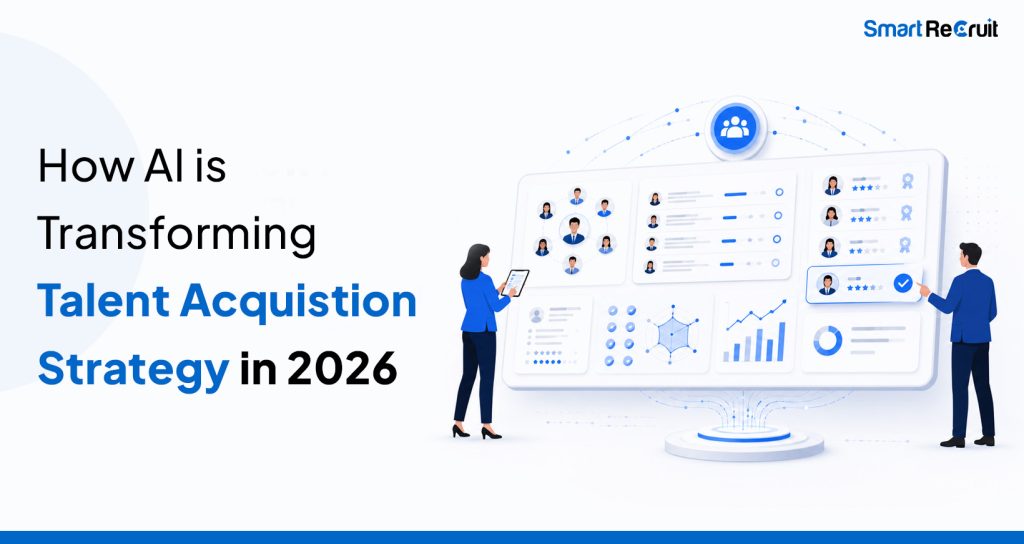
How AI Is Transforming
Talent Acquisition Strategy in 2026
Hiring teams are under more pressure than at any point in the last decade. Talent shortages are affecting critical roles across industries; candidate expectations have shifted significantly, and recruiters are being asked to deliver faster outcomes with the same or fewer resources.
Many organizations are responding by re-examining their talent acquisition strategy; not just to hire faster, but to hire better. Artificial intelligence is increasingly central to that conversation, reshaping how organizations source, screen, evaluate, and engage talent at scale. The question is no longer whether AI belongs in talent acquisition. It is how to use it in a way that strengthens, rather than replaces, the human judgment that makes hiring decisions work.
Why Traditional Talent Acquisition Strategies Are Struggling to Deliver Results
Today, hiring leaders face a very different reality.
Talent shortages continue to affect critical roles across industries, while competition for qualified candidates has intensified. According to SHRM, organizations are navigating persistent workforce challenges, changing employee expectations, and increasing pressure to improve hiring outcomes in a highly competitive labor market. At the same time, recruiting teams are expected to reduce time-to-hire, control cost per hire, and improve hiring quality without significantly increasing resources.
The challenge is no longer limited to attracting talent. Modern hiring teams must maintain consistency, visibility, and decision quality across increasingly complex recruitment processes. As hiring volumes grow, manual coordination, fragmented workflows, and disconnected evaluation practices can create delays, reduce recruiter efficiency, and make hiring outcomes less predictable.
This is why many organizations are reassessing their talent acquisition strategy. The question is not simply how to attract more candidates, but how to build a hiring process that can scale efficiently while supporting better decisions. As a result, recruitment leaders are increasingly turning to technology and automation to improve hiring performance, but not all solutions address the right problems.
Are Existing Recruitment Technology and Automation Solving the Wrong Problems?
Recruitment technology: applicant tracking systems, scheduling tools, communication platforms, and workflow automation, has helped recruiters reduce administrative effort and manage larger hiring volumes more efficiently. However, greater automation does not automatically translate into better hiring outcomes.
This is where recruitment automation often falls short. Automating individual activities can improve efficiency, but it does not necessarily address the underlying factors that influence hiring quality. If screening, assessment, and decision-making remain fragmented, organizations may simply execute inefficient processes faster rather than improving outcomes.
As explored in our article on why applicant tracking systems alone can’t improve hiring decisions, technology creates the greatest value when it supports better evaluation and decision-making, not just process administration.
As recruitment technology continues to evolve, the focus is shifting from managing applications to identifying the right candidates more effectively. This raises another important question: if the best talent is not actively applying, how should organizations rethink candidate sourcing and talent sourcing strategies to stay competitive?
Why Candidate Sourcing Is Now a Competitive Advantage
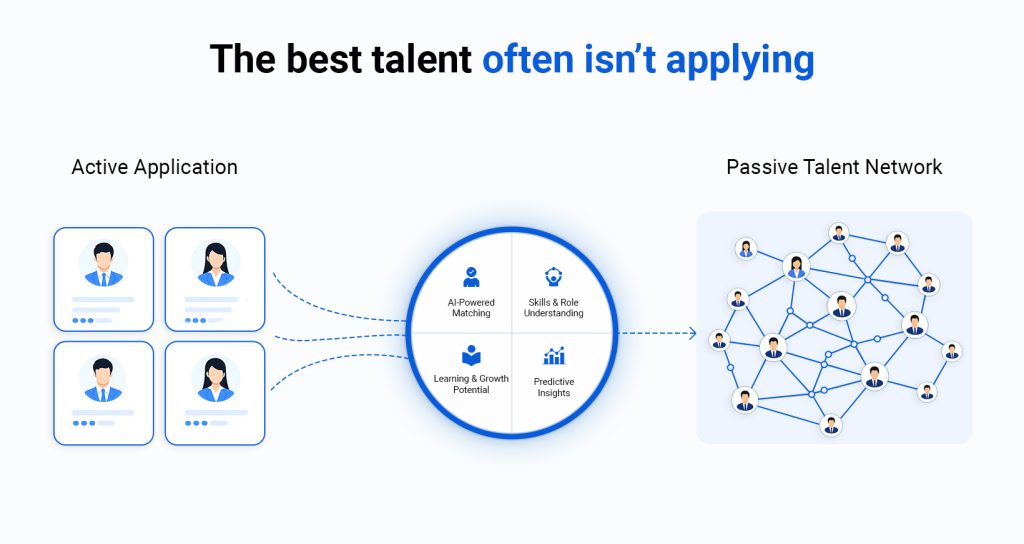
In a highly competitive hiring market, access to talent has become a differentiator in itself. Organizations that rely exclusively on inbound applications often compete for the same active job seekers as everyone else, limiting both candidate quality and hiring flexibility. As a result, proactive sourcing has become an increasingly important component of a modern talent acquisition strategy.
Many of the most qualified professionals are not actively searching for new opportunities. Reaching this passive talent requires a more proactive approach that combines market intelligence, talent mapping, and targeted outreach. Increasingly, organizations are using AI-assisted sourcing tools to identify potential candidates, uncover relevant skill matches, and expand access to talent pools that might otherwise remain invisible through traditional recruiting channels.
Effective sourcing is not simply about generating more candidates. It is about improving the quality of the talent pipeline and increasing the likelihood that recruiters engage individuals who are aligned with role requirements from the outset. Strong sourcing strategies can improve response rates, accelerate shortlist creation, and reduce time spent evaluating unsuitable applicants.
However, sourcing is only the beginning of the hiring journey. Even the strongest talent pipeline can lose value if organizations lack consistent methods for evaluating candidates once they enter the recruitment process. This makes candidate screening and assessment equally critical to hiring success.
The Hidden Cost of Poor Candidate Screening and Assessment
The quality of a hiring decision is often determined long before a candidate reaches the final interview stage. Yet many organizations continue to struggle with evaluation processes that rely heavily on manual review, inconsistent criteria, and recruiter capacity. As application volumes grow, identifying the right candidates becomes increasingly difficult without introducing delays or overlooking qualified talent.
Poor screening practices create costs that extend beyond recruiter workload. Weak evaluation processes can result in unsuitable candidates progressing through the hiring funnel, increased interview effort, and lower confidence in outcomes. Over time, these inefficiencies can affect both hiring quality and overall recruitment performance.
This is why many organizations are moving toward more structured evaluation approaches that connect screening, assessment, and interview readiness within a single workflow.
This is why structured interview workflows are increasingly central to high-volume screening operations. When every candidate is assessed against the same competency framework, shortlisting becomes faster, more consistent, and easier to defend at the decision stage.
As discussed in our article on how recruitment automation fixes screening delays, improving screening quality is often the first step toward building a more efficient hiring process.
However, improving evaluation quality is only part of the challenge. Organizations also need visibility into which hiring activities are producing the best outcomes, a gap that recruitment analytics is increasingly helping teams address.
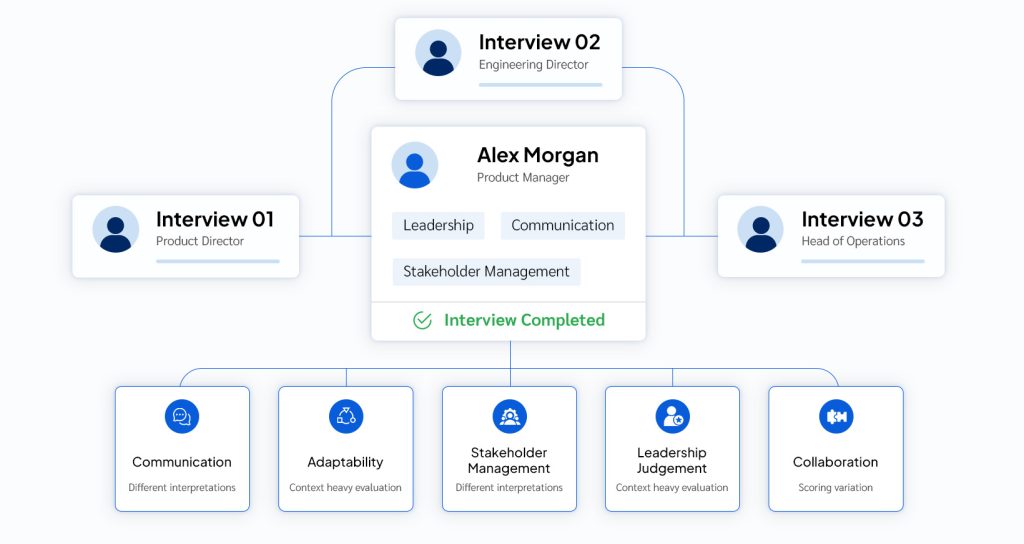
Recruitment Analytics: The Missing Link in Most Talent Acquisition Strategies
Many organizations collect large amounts of recruiting data but struggle to translate it into actionable hiring insight. While metrics such as applications received or interviews completed provide visibility into activity levels, they rarely explain whether a talent acquisition strategy is producing stronger hiring outcomes.
This is where recruitment analytics becomes critical. By examining hiring metrics such as cost per hire, quality of hire, source effectiveness, stage conversion rates, and funnel drop-off points, organizations can better understand which parts of the hiring process are creating value and which are introducing inefficiencies. Rather than relying on assumptions, hiring leaders can use data to identify patterns, improve resource allocation, and act on clearer hiring insights.
The most effective analytics strategies go beyond measuring volume. They help organizations evaluate screening effectiveness, assessment outcomes, and overall hiring performance across the recruitment lifecycle; connecting data across every stage to give hiring leaders a single view of where the process is working and where candidates are dropping off.
Once teams can clearly measure what is working and what is not, they are in a stronger position to build a talent acquisition strategy that combines technology, process design, and human judgment more effectively.
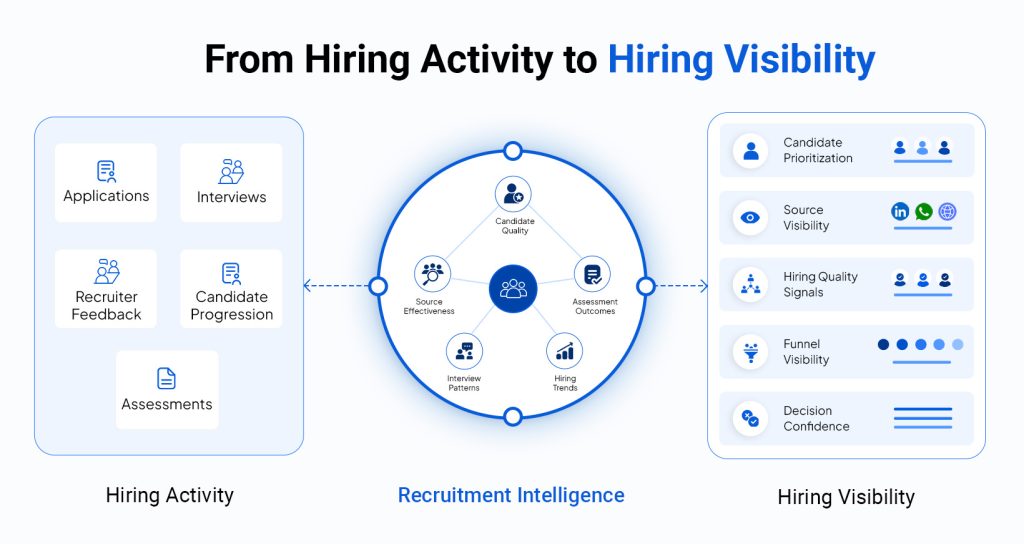
Building an AI-Driven Talent Acquisition Strategy That Actually Works
The organizations achieving the strongest hiring outcomes are not using AI to replace recruiters. They are using it to strengthen every stage of the hiring process. An effective talent acquisition strategy combines recruitment technology, process design, and human judgment to create a more scalable and consistent hiring operation.
In practice, this begins with improving sourcing through broader talent discovery and better matching. From there, recruitment automation accelerates screening, reduces manual effort, and keeps qualified candidates moving efficiently. Structured assessment frameworks create stronger evaluation standards, while interview intelligence gives recruiters greater visibility during decision-making.
The final layer is recruitment analytics. By connecting sourcing, screening, assessment, and hiring outcomes, organizations can continuously refine how talent is identified, evaluated, and selected.
This is where platforms such as Smart Recruit create value. Rather than automating isolated tasks, Smart Recruit brings sourcing, structured screening through Aspira, assessment, interview intelligence, and analytics into a connected workflow; one that supports faster, more consistent hiring outcomes across the full recruitment lifecycle.
As AI adoption continues to grow, the next challenge for hiring leaders is understanding how these capabilities will shape the future of talent acquisition itself.
How Smart Recruit Supports a More Effective Talent Acquisition Strategy
Most enterprise hiring teams face the same structural problem. Sourcing, screening, assessment, interview evaluation, and analytics are managed as separate activities, often across different tools and teams. The result is gaps in visibility, inconsistency in how candidates are evaluated, and delays that accumulate across the hiring lifecycle. Smart Recruit is built to address this directly. It is an end-to-end AI-powered hiring platform that connects every stage of the recruitment process within a single workflow, giving hiring leaders the consistency and visibility they need to make better decisions at scale.
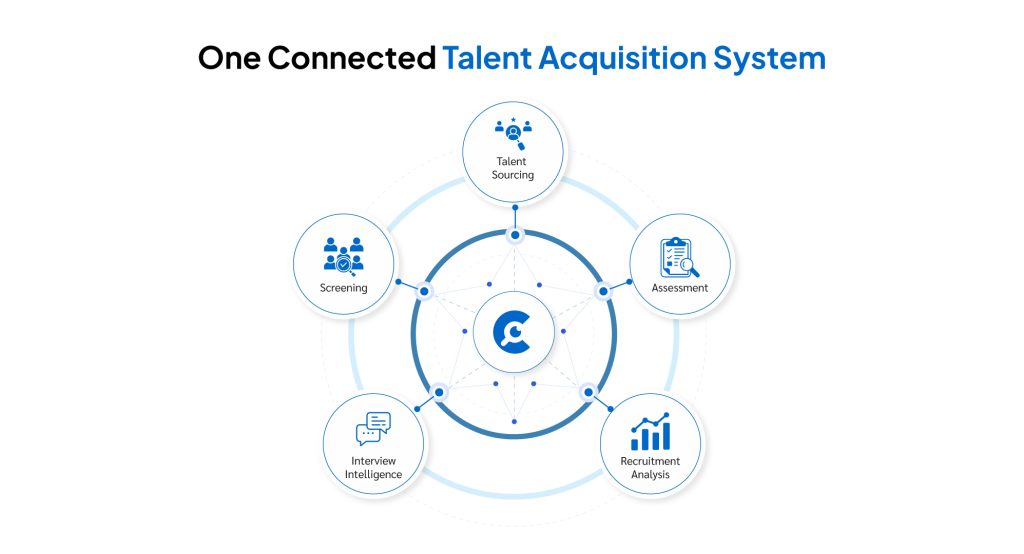
Here is what that looks like in practice:
- Sourcing is supported through AI-assisted candidate discovery that goes beyond active applicants to identify talent aligned with specific role requirements.
- Screening is managed through Aspira, Smart Recruit’s AI interview engine, which conducts structured, competency-aligned interviews at scale. Every candidate is assessed against the same framework, producing scored and traceable outputs that make shortlisting faster and more defensible.
- Analytics connects pipeline performance, stage conversion rates, source effectiveness, and candidate quality across every active role in a single view.
For enterprise teams looking to improve hiring consistency, reduce time-to-hire, and build a talent acquisition strategy that holds up as hiring volumes and market conditions change, Smart Recruit provides the infrastructure to do that without replacing the recruiter judgment that makes hiring decisions work. Contact Us and start a 2-Week Free Trial to see it in practice.
FAQs
When is AI assisted hiring worth the investment?
AI assisted hiring is worth the investment when organizations need to improve hiring efficiency, manage high application volumes, or reduce repetitive recruiting tasks. It can help streamline screening, scheduling, and candidate evaluation while allowing recruiters to focus on higher-value hiring activities.
How can Smart Recruit support talent acquisition?
Smart Recruit helps organizations streamline talent acquisition through AI-powered sourcing, candidate screening, recruitment automation, and analytics. By centralizing hiring workflows and improving recruiter efficiency, it supports faster, more informed hiring decisions.
What is the difference between candidate sourcing and talent sourcing?
Candidate sourcing focuses on identifying individuals for current job openings, while talent sourcing is a broader, ongoing effort to build relationships with potential future candidates. Both help organizations strengthen their hiring pipeline and reduce reliance on inbound applications.
How do recruitment analytics improve hiring outcomes?
Recruitment analytics help organizations measure hiring performance using metrics such as cost per hire, quality of hire, and conversion rates. These insights support data-driven decisions and continuous improvement across the recruitment process.
How does AI improve candidate screening and assessment?
AI helps hiring teams analyze candidate information more efficiently, identify relevant qualifications, and support consistent evaluation processes. When combined with human judgment, it improves screening efficiency and strengthens candidate assessment quality. Platforms like Smart Recruit combine AI-assisted screening with structured interview workflows through Aspira, ensuring that evaluation is consistent, auditable, and connected across every hiring stage.
Related Posts
Discover other posts that deepen your understanding of smart hiring, from AI-led interviews to streamlined candidate management techniques.
-
 Aspira: Turn First Interviews Into a Hiring Advantage
This is where Aspira changes the equation.