Recruitment Coordination
The Missing Layer in Enterprise Vendor Management
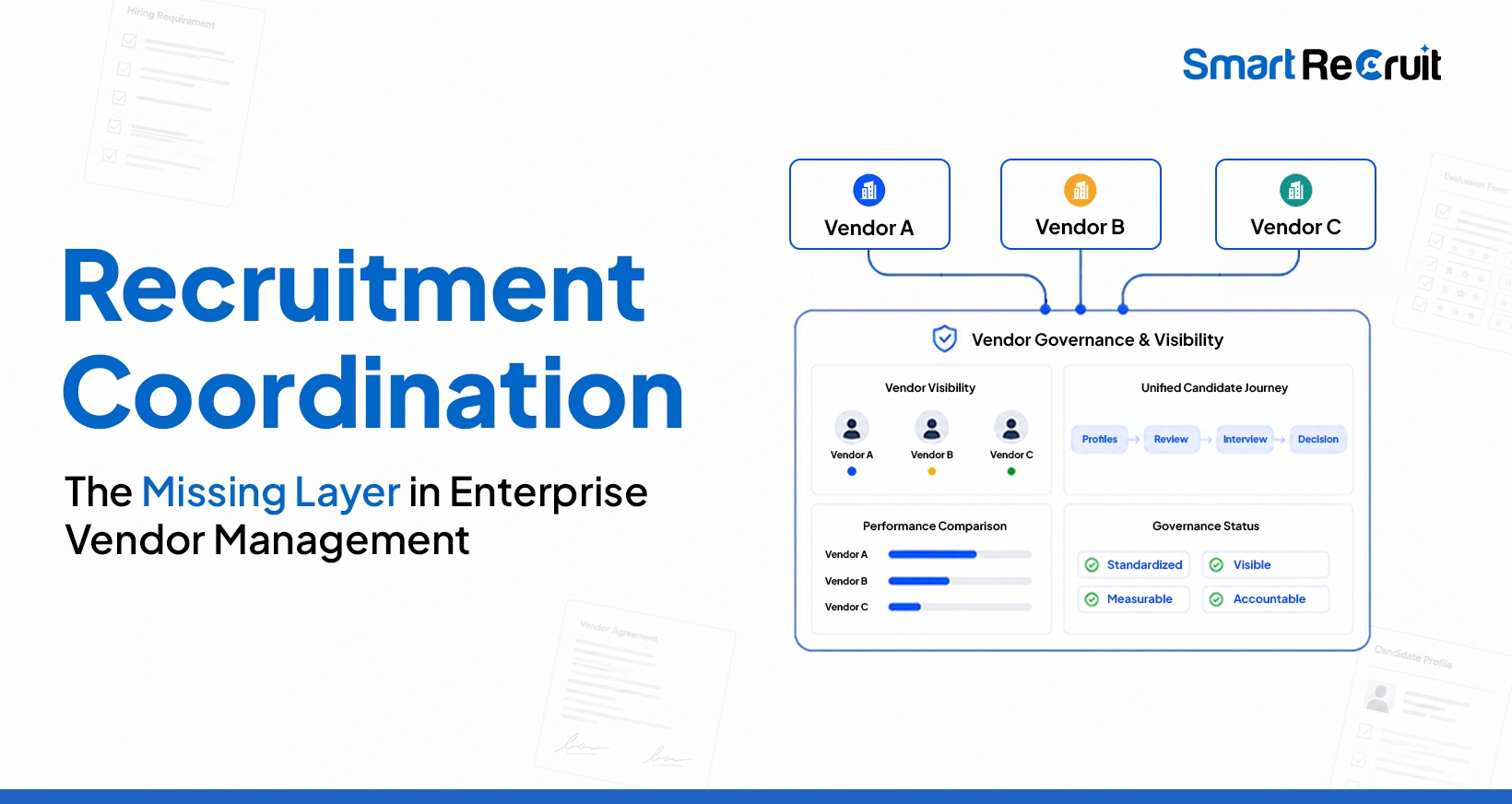
Enterprise hiring rarely breaks down because of a sourcing shortage. It breaks down in the middle, in the handoffs between vendors, recruiters, and hiring managers, where no single layer owns the full picture. That middle layer has a name: recruitment coordination. It connects vendor activity, candidate flow, and hiring outcomes into something a TA leader can manage, not just observe after the fact.
Most enterprises don’t have that structure. What they have instead is a patchwork of vendor relationships held together by email threads, spreadsheets, and individual recruiter judgment. Candidates get submitted twice by two different agencies. Vendor quality swings with no clear pattern, and when a CHRO asks why timelines stretched, nobody has a clean answer. For any enterprise hiring at volume, recruitment coordination is the difference between running a process and running a system.
As hiring volumes climb through 2026, TA leaders are noticing that the tools they’ve already bought (ATS platforms, vendor portals, scheduling software) aren’t solving the problem costing them the most time. The gap isn’t sourcing. It’s what happens between sourcing and the hiring decision, and closing it takes structure, shared data, and a platform built around performance accountability.
Why Vendor Evaluation Breaks Down at the Coordination Layer
In most enterprise environments, vendor evaluation lives at the contract level, not the performance level. Organizations negotiate rate cards, set terms, and assign requisitions to staffing partners, then rarely measure what those partners deliver in practice, across roles and time.
The breakdown is predictable. One vendor emails resumes, another uploads through a portal, a third routes everything through the ATS. With no shared intake standard, recruiters spend their time normalizing formats instead of evaluating candidates. Shortlist quality swings not because vendors differ wildly in skill, but because nobody has defined what a qualified submission looks like for a given role.
Real vendor evaluation needs a layer between the vendor and the hiring decision: a defined submission framework, consistent criteria, and a feedback loop that tells vendors where they’re falling short. Without recruitment coordination providing that structure, vendor management stays stuck at the contract level and never reaches the performance level where enterprise outcomes are decided.
Most TA functions were built for a smaller, simpler vendor footprint, and the coordination layer hasn’t scaled with it, leaving a widening gap between what enterprises pay vendors and what they get back.
Standardizing Hiring Vendors Across Enterprise Teams
The problem most TA leaders have with hiring vendors isn’t a shortage of agency partners. It’s the absence of a standard process for how those partners plug into the hiring workflow.
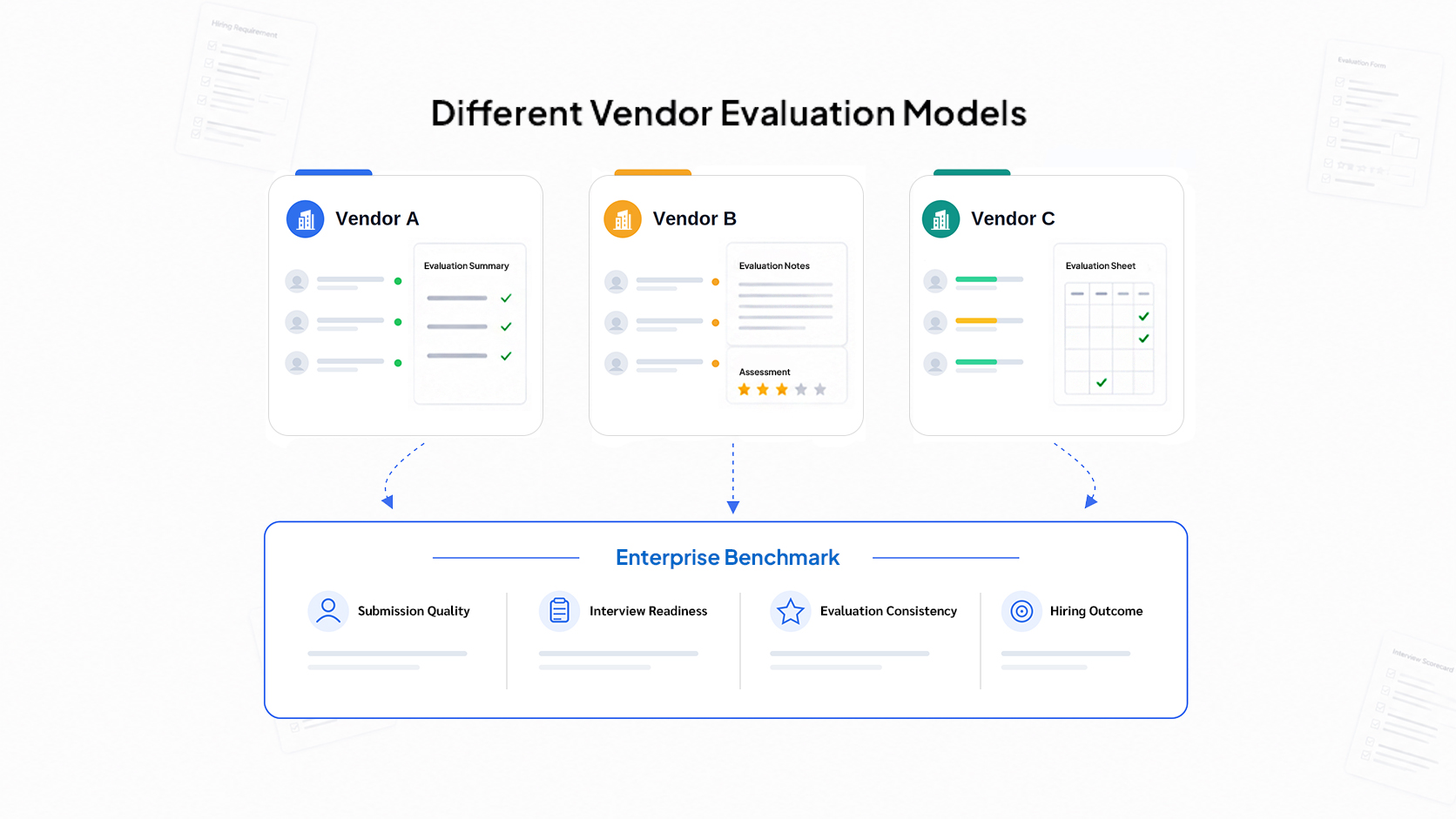
Different business units favor different vendors, and different roles pull in different sourcing approaches. String enough of that together and you get a fragmented vendor ecosystem where performance can’t be compared, and accountability can’t be enforced. A TA head in one division may swear by a particular staffing firm, while another hiring for near-identical roles works with an entirely different vendor set, with no shared reporting or common benchmark.
Standardizing hiring vendors comes down to three things: one intake process every vendor follows regardless of business unit, one shortlist quality bar that applies across all submissions, and a feedback loop that closes the gap between what a vendor sends and what actually gets hired.
This is exactly the layer that interview scheduling automation can’t fix on its own. As Why Interview Scheduling Automation Doesn’t Fix Hiring Delays lays out, scheduling sits downstream, and the fragmentation happens earlier, before a candidate ever reaches the interview stage. Tightening scheduling without fixing coordination just moves candidates faster through a process that’s still broken.
Recruitment coordination is what makes standardization possible across a distributed vendor ecosystem. Without it, even strong vendor relationships operate as silos, and TA leaders end up reconciling inconsistent outputs instead of managing toward one result.
Contingent Workforce Management and the Governance Gap
Nowhere is the case for stronger recruitment coordination clearer than in contingent workforce management. According to AIHR’s Contingent Workforce Management Guide, 65% of businesses plan to increase their use of contingent labor over the next two years. Contingent workers are now a permanent part of the workforce mix, and they need the same governance rigor as permanent hires.
Most organizations aren’t set up for that rigor. Contingent workforce management still lives inside procurement in a lot of enterprises, sitting outside the performance frameworks that govern permanent hiring. Vendors get judged on cost and speed, not fit or downstream outcomes, and nobody can easily compare contingent hiring performance across agencies, business units, or geographies.
Managing contingent labor well at enterprise scale needs the same coordination infrastructure as permanent hiring: standardized vendor intake, shared evaluation criteria, and performance data that reveals patterns instead of just logging transactions. Recruitment coordination is the governance layer that turns that infrastructure into something operational. Without it, contingent workforce management stays a cost-control exercise rather than a talent strategy, with no reliable way to hold staffing partners accountable beyond submission volume.
The gap widens further for enterprises hiring across multiple geographies, where vendors often work from different assumptions about what “qualified” means for the same role. Without a coordination layer setting shared criteria, regional teams are effectively running separate, unconnected hiring programs.
Struggling to turn vendor relationships into usable data?
Smart Recruit gives enterprise hiring teams the coordination infrastructure to make every vendor relationship measurable. Start your 2-Week Free Trial
What a Vendor Dashboard Actually Needs to Show
The default tool most enterprise TA teams reach for is a dashboard, usually pulled from an ATS or a bolted-on reporting layer. The issue isn’t that dashboards don’t exist. It’s that most of them track the wrong things.
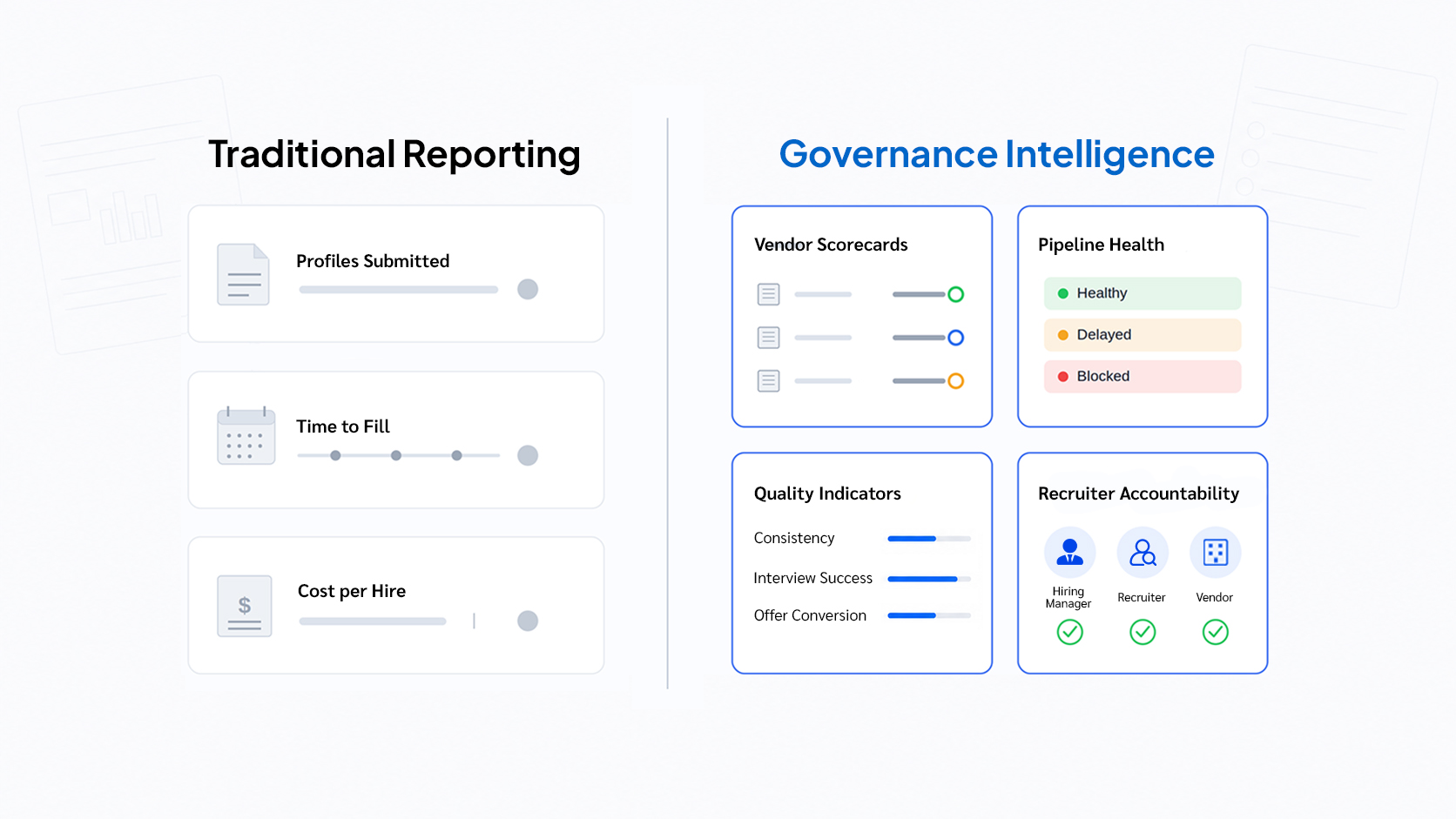
Submission volume, days to fill, cost per hire: these show up in nearly every vendor dashboard, and they only describe what already happened. None of them explain why one vendor consistently produces stronger hires, or which vendor relationships justify their rate premium.
Ardent Partners’ 2025 VMS Technology Advisor Report names AI innovation, compliance and risk mitigation, and analytics depth as the leading evaluation criteria for enterprise vendor management platforms today. Its broader point is that the strongest platforms are moving away from transactional tracking and toward visibility, compliance, and decision support as their core value.
A dashboard built for real recruitment governance needs to surface submission-to-offer conversion by vendor, panel feedback patterns by role, candidate drop-off by source, and time-in-stage data that flags coordination problems before they become hiring delays. Recruitment coordination is what feeds that dashboard clean, comparable data in the first place.
That’s the real difference between a reporting tool and a governance tool. A reporting tool tells you what happened. A governance tool tells you what needs to change: which vendor is underperforming, where delay is building up, which roles keep producing weak shortlists.
How Smart Recruit Closes the Recruitment Coordination Gap
Every problem raised so far traces back to the same structural gap: enterprises have vendor relationships, but not the recruitment coordination infrastructure to make those relationships measurable, comparable, and improvable over time.
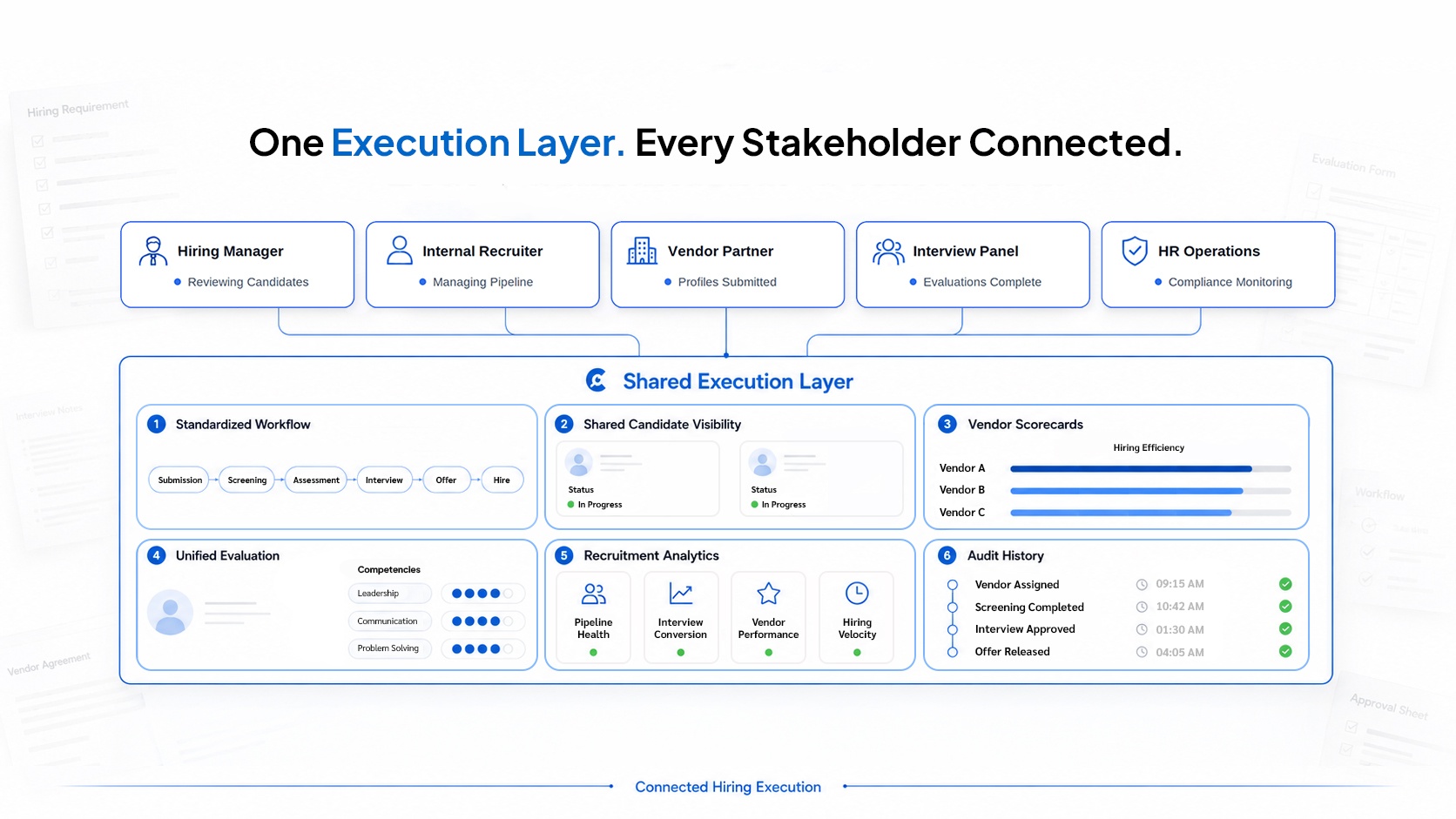
Smart Recruit closes that gap directly. The platform routes vendor activity through one structured hiring workflow: every submission goes through the same intake, every candidate is evaluated against the same criteria, and every piece of feedback lands in the same system, whether it comes from a recruiter, a hiring manager, or an AI-assisted interview through Aspira.
That’s a genuinely different model from the ATS-only approach most enterprise teams still lean on. As covered in ATS vs Recruitment Automation Platform: Where ATS Breaks Down, an ATS tracks where a candidate sits in a pipeline, but it has nothing to say about the quality of the evaluation that put them there. It records movement. It doesn’t create accountability.
Smart Recruit’s vendor performance reporting brings submission quality, stage-by-stage conversion, source-level drop-off, and recruiter-level accountability into a single view, giving TA leaders the evidence to have real performance conversations with hiring vendors, not just activity updates.
Enterprise recruitment at scale needs structure, shared data, and a platform that treats vendor management as a performance discipline, not an administrative afterthought. Smart Recruit brings all three into one connected workflow, and because coordination is built into how hiring already runs on the platform, that evidence gets generated without extra work from the recruiting team.
Why Enterprise Leaders Must Prioritize Recruitment Coordination
In an environment where agility and compliance are paramount, recruitment coordination is the missing layer that can elevate enterprise vendor management. It ensures that staffing vendors operate transparently, deliver quality candidates, and align with organizational goals.
By adopting AI-driven solutions like Smart Recruit, organizations can automate routine tasks, gain actionable insights, and foster vendor relationships built on trust and performance. This strategic focus not only accelerates hiring but also enhances compliance and reduces operational risk.
Final Takeaway
Enterprise vendor management is only going to get more complex as contingent labor grows as a share of the workforce and hiring volumes force coordination across more vendors and geographies at once. The organizations that handle this well won’t be the ones with the most vendor relationships. They’ll be the ones with the strongest recruitment coordination infrastructure underneath every one of those relationships.
The difference between a vendor relationship and a vendor performance program is structure. Recruitment coordination builds that structure, and right now it’s the layer missing from how most enterprise hiring teams operate. Fixing it doesn’t mean replacing the tools already in place. It means connecting them into one coherent system of accountability.
Ready to build a vendor management model that scales?
Contact Us or start a 2-Week Free Trial to see how Smart Recruit brings recruitment coordination to the enterprise.
FAQs
What is recruitment coordination, and why does it matter in enterprise hiring?
Recruitment coordination is the operational layer connecting vendor activity, candidate flow, and hiring decisions into one structured process. Without it, submissions, feedback, and outcomes stay siloed, making it nearly impossible to measure vendor performance or hold anyone accountable at scale. Enterprises missing this layer typically can’t explain why a hiring decision was made, or which vendors are genuinely delivering value.
How does vendor evaluation differ from vendor management?
Vendor management covers contracts, rate cards, and administrative terms. Vendor evaluation goes further, measuring how each vendor performs against defined quality criteria and hiring outcomes over time. Recruitment coordination is what makes that evaluation possible in practice: it’s the standardized data infrastructure real comparisons require.
What should a vendor dashboard actually show?
A dashboard built for real governance should surface submission-to-offer conversion, panel feedback patterns, source-level drop-off, and time-in-stage data, not just submission volume, days to fill, and cost per hire. Recruitment coordination is what feeds a dashboard with clean, comparable data in the first place.
Why does enterprise recruitment need a different coordination model than standard hiring?
Enterprise recruitment runs across multiple vendors, distributed teams, and layered approval chains that standard workflows weren’t designed for. A single requisition might involve three vendors across two geographies. Without coordination standardizing intake, evaluation, and reporting, the process depends on individual relationships rather than shared structure, and that’s exactly where enterprise hiring tends to break down.
What challenges does contingent workforce management create for TA teams?
Contingent workforce management adds governance complexity most permanent hiring programs weren’t built for. Vendors are managed through different channels, compliance checks happen unevenly, and performance data rarely gets centralized. With 65% of businesses planning to increase contingent labor use (AIHR), that gap is only growing.
Related Posts
Discover other posts that deepen your understanding of smart hiring, from AI-led interviews to streamlined candidate management techniques.
-
 Smart Recruit: Hiring Made Faster, Fairer, and Smarter for Every Industry
Structured, transparent hiring aligned with financial regulations.
-
 High Volume Hiring:
The Exact Failure Points Slowing Your Hiring Pipeline
-
 What to Look for in a Recruitment Platform That Actually Works
Hiring today demands automation, fairness, and full visibility.
