Recruitment Automation Software
What to Actually Look For in 2026
The real question is: Can the technology improve how your entire hiring operation works?
Recruiting leaders today manage high application volumes, multiple stakeholders, complex hiring workflows, and growing pressure to demonstrate measurable outcomes. AI and automation are increasingly becoming part of this transformation, but organizations still need to determine where automation creates real value and where human judgment remains essential.
In 2026, enterprises should evaluate recruitment technology based on workflow automation, AI capabilities, integration, scalability, governance, and measurable business impact not simply the number of features a platform offers.
What Is Recruitment Automation Software in 2026?
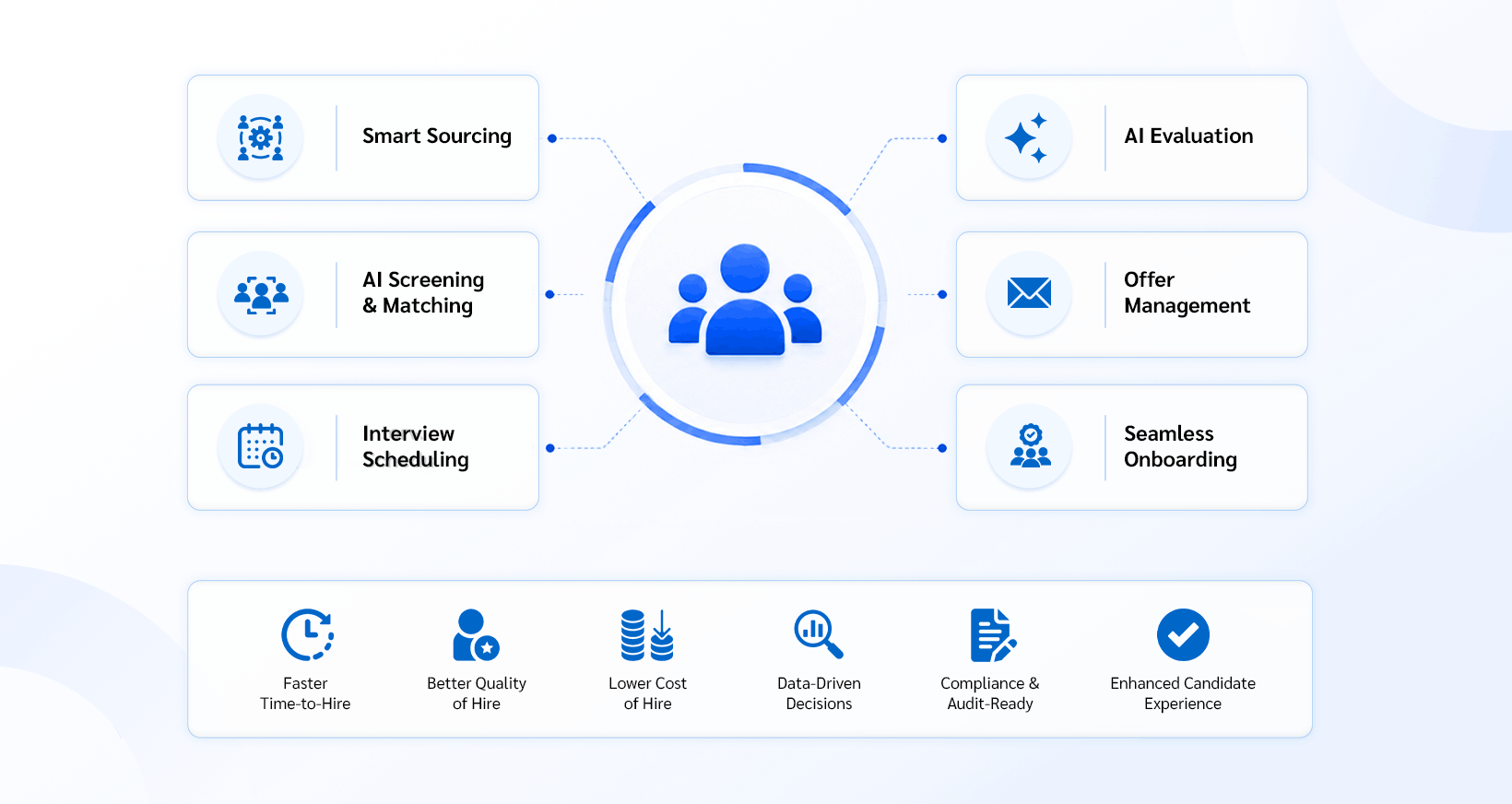
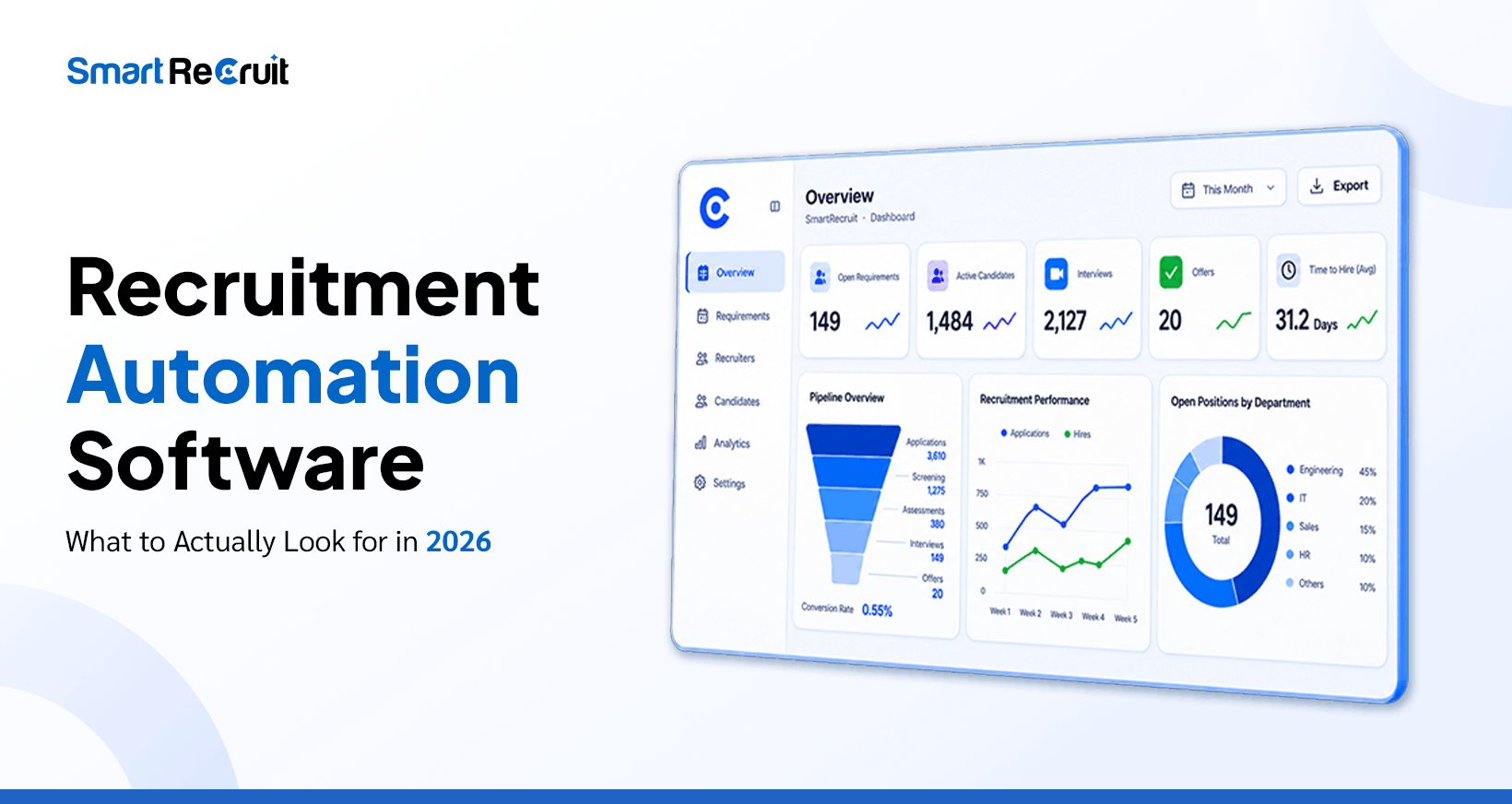
Recruitment automation software uses technology, workflows, and AI to automate and connect multiple stages of the hiring lifecycle from job creation and candidate screening to interviewing, evaluation, communication, and reporting.
The key difference from traditional recruitment systems is that automation is not limited to tracking candidates. It can help move candidates through the hiring process.
For example, instead of simply showing a recruiter that 500 candidates are waiting for review, an automated platform can screen profiles against defined criteria, identify relevant candidates, trigger assessments, coordinate interviews, collect evaluations, and move qualified candidates to the next stage.
The goal is not to remove recruiters from hiring. It is to reduce repetitive operational work so recruiters and hiring managers can focus on decisions that require experience, context, and judgment.
Recruitment Automation Software vs. an ATS: What Has Changed?
An ATS remains an important system of record for many organizations. However, enterprise recruitment increasingly requires capabilities beyond storing applications and tracking candidate stages.
An ATS primarily answers:
“Where is this candidate in the hiring process?”
Modern recruitment automation should also answer:
“What should happen next, and can the system execute it?”
This distinction becomes critical when organizations manage hundreds of vacancies, thousands of candidates, multiple recruiters, hiring managers, interviewers, and external vendors.
For a deeper comparison, see ATS vs Recruitment Automation Platform: Where ATS Breaks Down.
The strongest platforms therefore combine candidate data, workflow automation, AI, evaluation, communication, and analytics into one connected hiring process.
Here Are 8 Things Recruitment Software Should Have
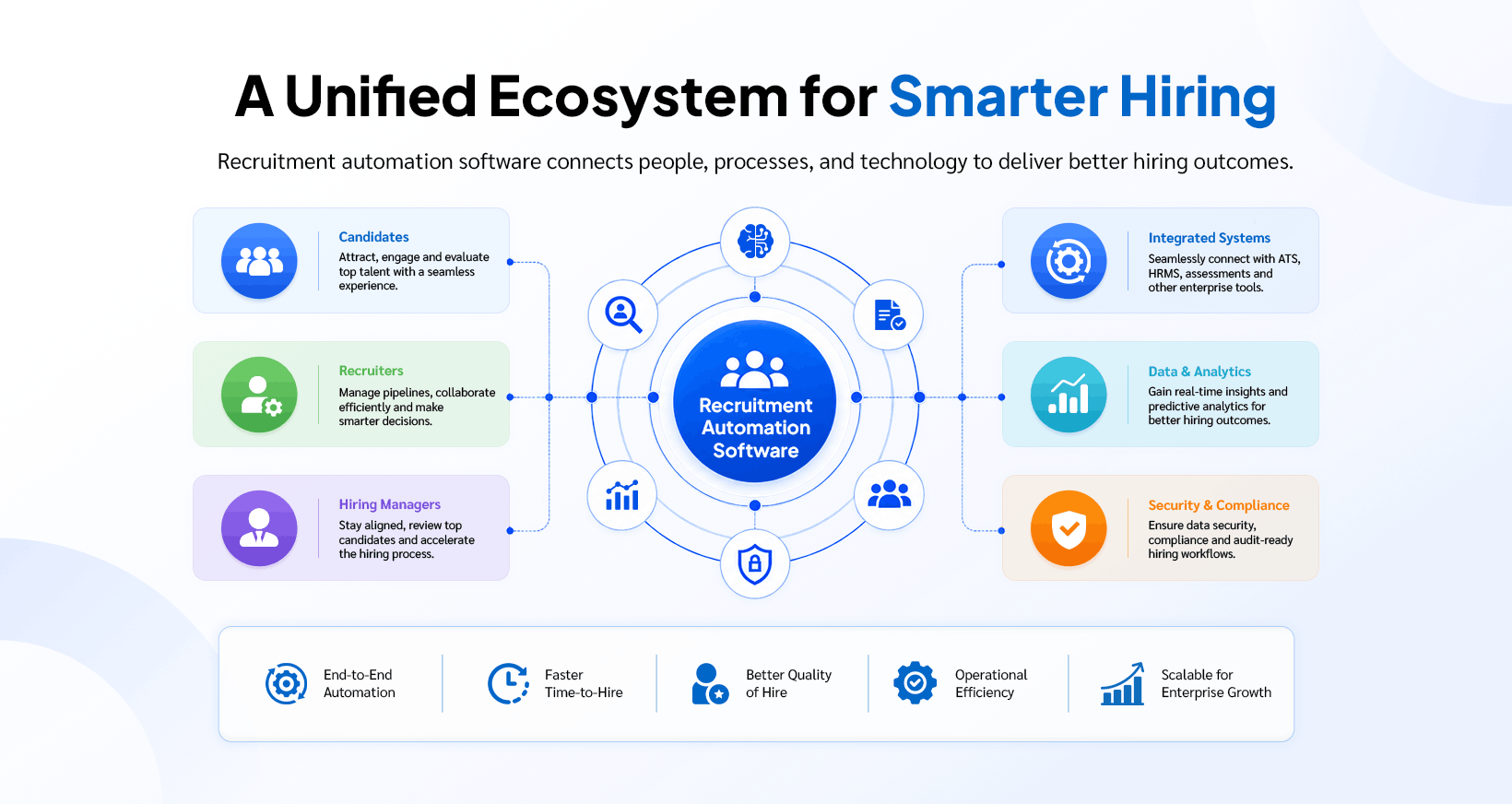
1. End-to-End Workflow Automation
The first question enterprise buyers should ask is:
Does the platform automate individual tasks, or does it automate the hiring workflow?
Look for automation across the complete journey:
Job creation → sourcing → screening → matching → assessment → interview → evaluation → offer → reporting
Automating one activity may save minutes. Connecting multiple stages can change how the recruitment function operates.
The objective should be fewer manual handoffs, fewer repetitive actions, and greater process consistency.
2. AI-Powered Candidate Matching and Screening
Keyword-based resume matching is no longer sufficient for complex enterprise hiring.
Modern AI recruitment software should understand the relationship between job requirements, candidate skills, experience, qualifications, and role relevance.
The important distinction is between finding keywords and understanding candidate-role fit.
Enterprise buyers should therefore evaluate whether AI can provide meaningful recommendations rather than simply assigning candidates a score.
This becomes particularly valuable when recruiters must evaluate hundreds or thousands of applications for specialized or high-volume roles.
3. AI Interviewing and Structured Evaluation
Interviewing is another area where automation can significantly improve recruitment operations.
Look for:
- Structured interviews
- Role-specific questions
- Automated candidate interactions
- Consistent evaluation criteria
- Interview reports
- Candidate scoring
- Human review
A 2026 field experiment involving approximately 70,000 applicants found that candidates interviewed by AI voice agents were 12% more likely to receive offers, while human recruiters continued to make the hiring decisions. The research the potential value of structured AI-supported information collection.
The takeaway for enterprises is not that AI should replace interviewers. It is that AI can help create more consistent and scalable evaluation, while humans retain responsibility for consequential hiring decisions.
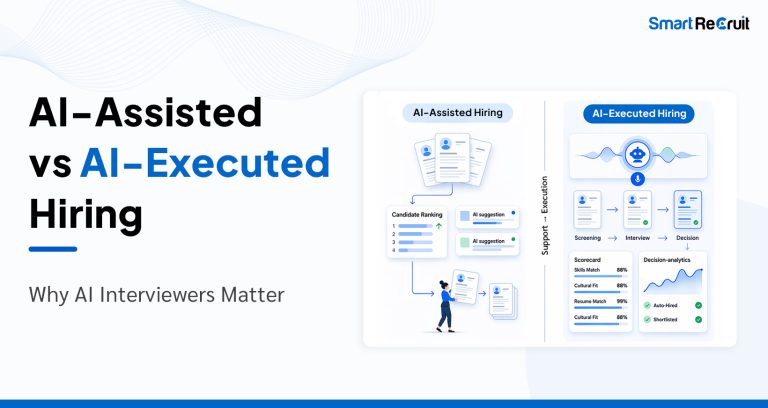
For more on this approach, explore AI-Assisted vs AI-Executed Hiring: Why AI Interviewers Matter.
4. Workflow Orchestration and Recruitment Coordination
Enterprise recruitment rarely involves only recruiters and candidates.
Hiring managers, interviewers, HR teams, business leaders, vendors, and candidates may all participate in the same process.
This creates a coordination challenge.
A strong platform should therefore automate not only recruiter tasks but also the movement of information and actions between stakeholders.
Evaluate whether it can support:
- Hiring manager approvals
- Interview coordination
- Candidate communication
- Vendor participation
- SLA and TAT tracking
- Evaluation workflows
- Hiring-stage transitions
The value of automation increases when it reduces the coordination effort required across the entire hiring ecosystem.
5. Integrations and Enterprise Compatibility
Even a powerful recruitment platform becomes difficult to adopt if it operates in isolation.
Before investing, evaluate compatibility with:
- ATS and HCM systems
- Job boards
- Email and calendars
- Microsoft Teams and meeting platforms
- HR systems
- APIs
- Single sign-on
- Existing recruitment databases
The executive question should be:
Will this platform simplify our recruitment ecosystem or create another disconnected layer?
Enterprise recruitment technology should fit into the existing technology landscape rather than forcing teams to work around another silo.
6. Analytics, Auditability and Hiring Governance
Recruitment analytics should go beyond counting applications and hires.
Leadership needs visibility into:
- Time-to-hire
- Time spent at each stage
- Candidate conversion
- Source effectiveness
- Recruiter productivity
- Interview outcomes
- SLA and TAT performance
- Hiring funnel drop-offs
- Role-level performance
- Audit trails
This becomes even more important as organizations introduce AI into hiring.
SHRM’s 2026 State of AI in HR research identifies enhanced productivity, cost savings, improved decision-making, and employee satisfaction among the top metrics organizations use to measure AI investment success. However, 56% of HR professionals reported that their organizations do not formally measure the success of their AI investments.
That creates an important buying criterion:
Don’t just automate recruitment. Make the impact measurable.
7. Scalability and High-Volume Hiring
A platform that works well with 50 candidates may behave very differently when an organization processes thousands.
Enterprise buyers should test how the platform handles:
- Multiple job openings
- Large candidate databases
- Bulk candidate processing
- Multiple recruiters
- Multiple locations
- High-volume screening
- Vendor collaboration
- Large-scale reporting
Scalability is not simply a technology specification. It is an operational requirement.
The platform should maintain consistent workflows as hiring volumes, teams, and business requirements increase.
8. Security, Governance and Responsible AI
AI in recruitment creates another critical question:
How much control does the organization retain over automated decisions?
Enterprise recruitment automation should provide appropriate controls around:
- Data security
- User permissions
- Audit logs
- Privacy
- AI transparency
- Human oversight
- Evaluation criteria
- Data retention
A 2026 study of recruiting professionals found that generative AI can influence how recruiters define roles, interpret candidate information, and structure evaluations, even when recruiters remain responsible for final decisions.
Responsible automation should therefore strengthen human decision-making rather than make it invisible.
Don’t Buy Recruitment Automation Software Based on Features Alone
A platform can offer AI matching, automated screening, interview automation, analytics, and dozens of other features and still fail to create meaningful business value.
Enterprise buyers should evaluate the technology against five outcomes:
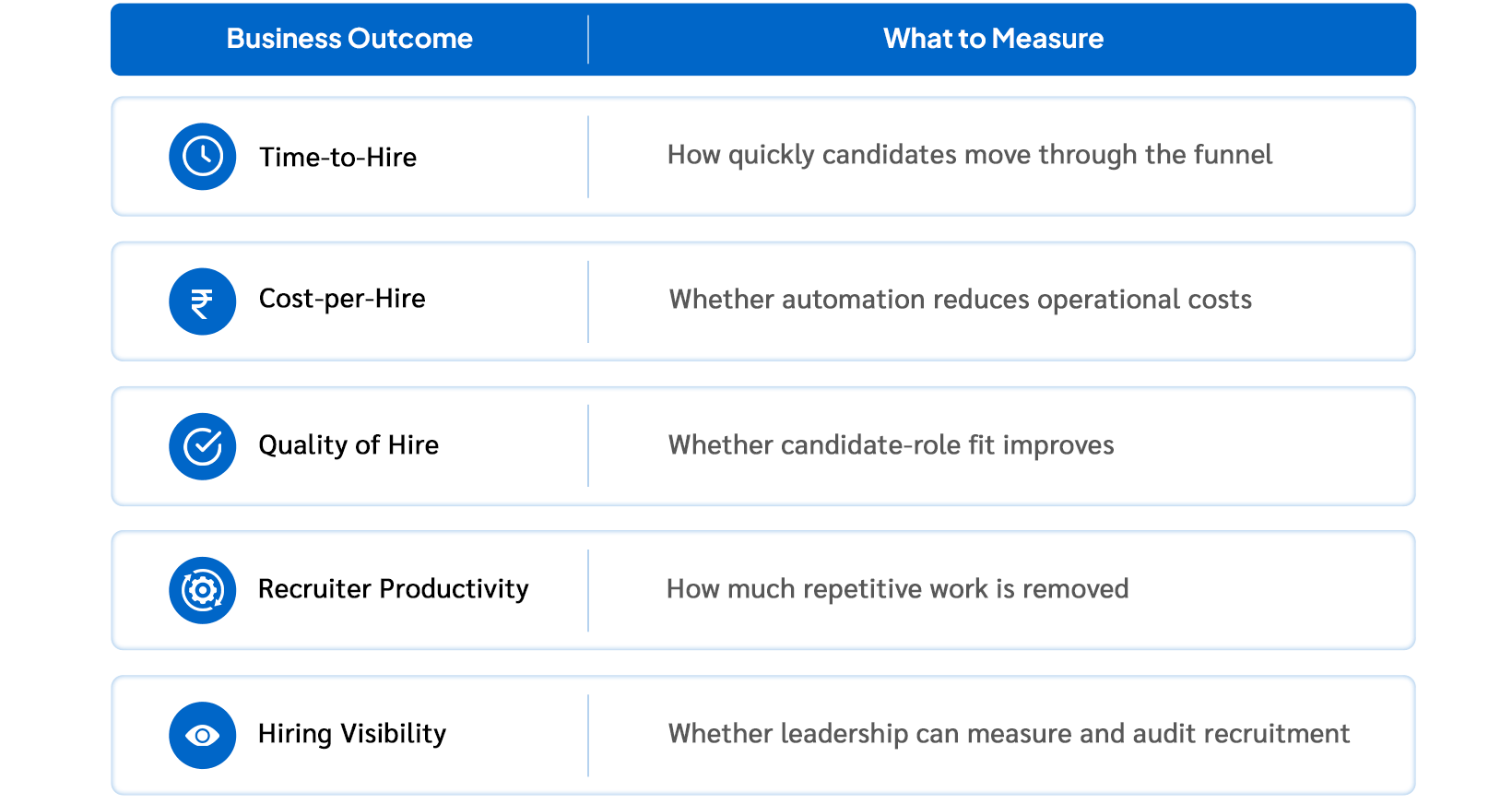
This is the difference between buying automation technology and investing in recruitment transformation.
See Recruitment Automation in Action
The best way to evaluate a recruitment platform is to see how it handles an actual hiring workflow not simply review a feature list.
Smart Recruit combines AI-powered candidate matching, screening, interviewing, workflow automation, and hiring intelligence to help enterprises create a more connected and decision-driven recruitment process.
What to Ask Before Choosing Recruitment Automation Software
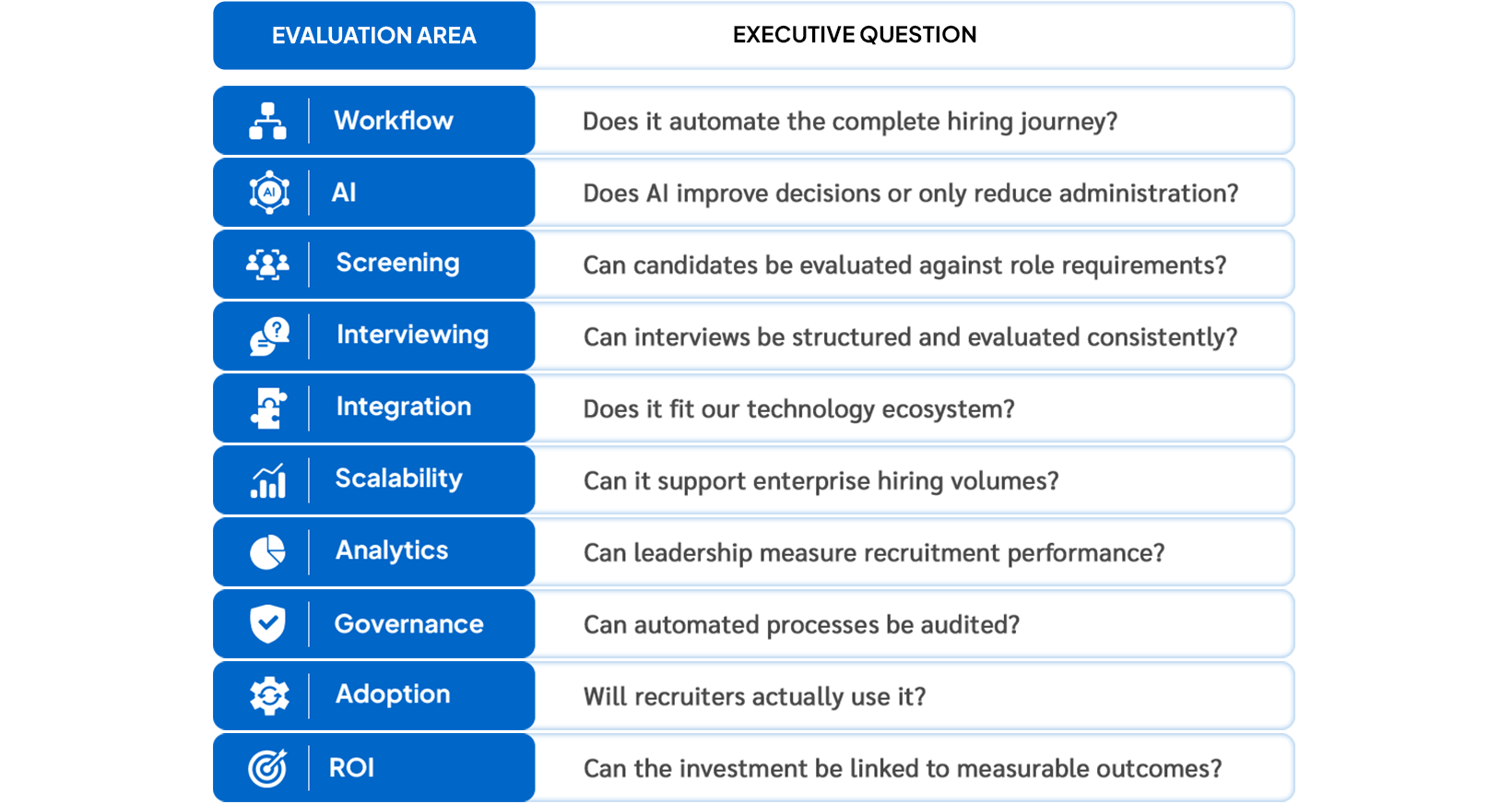
Choosing recruitment automation software requires looking beyond individual features and evaluating how well the platform supports the broader hiring operation. The right solution should connect workflows, improve decision-making, integrate with the existing technology ecosystem, scale with hiring demands, and provide measurable business value. Before making a decision, enterprise recruiting leaders should use these questions to assess whether a platform can deliver meaningful improvements across the hiring lifecycle.
Before selecting a platform, enterprise recruiting leaders should ask:
Why Smart Recruit Fits the 2026 Recruitment Model
The next generation of recruitment technology is moving beyond applicant tracking.
Smart Recruit brings together AI-powered candidate matching, intelligent screening, AI interviewing through Aspira, recruitment workflow automation, candidate evaluation, analytics, and hiring coordination.
The objective is not simply to automate more recruiter activities. It is to create a hiring environment where candidates can be evaluated consistently, recruiters spend less time on repetitive coordination, and leadership gains greater visibility into recruitment performance.
For enterprises, that distinction matters.
The future of recruitment is unlikely to be entirely human or entirely automated. It will be a combination of AI-driven execution and human-driven judgment, supported by technology that connects the entire hiring process.
Conclusion
The right recruitment automation software should do more than make recruiters faster; it should make the entire hiring operation more consistent, scalable, measurable, and decision-driven. In 2026, enterprise recruiting leaders should evaluate platforms based on their ability to automate workflows, apply AI-powered intelligence, integrate and scale across the existing recruitment ecosystem, and maintain strong governance with measurable outcomes.
The winning platform will not necessarily be the one that promises the most automation, but the one that understands where automation creates value, where human judgment matters, and how to connect the two. For organizations evaluating recruitment automation today, the question is no longer whether AI should be part of hiring, but whether the technology can actually automate the complexity of enterprise hiring.
Smart Recruit combines AI-powered candidate matching, screening, interviewing, workflow automation, and hiring intelligence to help enterprises create a more connected and decision-driven recruitment process.
Frequently Asked Questions
Can recruitment automation software work with existing HR systems?
Yes. Enterprise recruitment automation software should be capable of integrating with existing ATS, HRIS, job boards, communication tools, assessment platforms, and other systems in the hiring ecosystem. Integration capabilities should be evaluated based on the organization’s current technology stack and future scalability requirements.
How long does it take to implement recruitment automation software?
Implementation time depends on the organization’s hiring workflows, integrations, data requirements, and level of customization. A straightforward deployment can be relatively quick, while enterprise implementations may require additional time for ATS or HRIS integration, workflow configuration, security reviews, testing, and user adoption. Organizations should evaluate implementation support and migration requirements before selecting a platform.
What are the risks of using recruitment automation software?
Key risks can include poor-quality data, inappropriate automation of sensitive decisions, lack of transparency, integration failures, security concerns, and over-reliance on AI outputs. Enterprises should prioritize platforms with clear governance, auditability, data protection, configurable workflows, and appropriate human oversight.
Can recruitment automation automate interviews?
Yes. Modern platforms can support AI-led interviews, structured questions, candidate interactions, evaluation, and interview reporting. However, organizations should maintain appropriate human oversight over hiring decisions.
How does AI improve recruitment automation?
AI can help understand job requirements, match candidates to roles, screen profiles, structure interviews, summarize information, identify patterns, and support recruitment analytics. The strongest implementations use AI to reduce repetitive work while keeping humans involved in important hiring decisions.
Related Posts
Discover other posts that deepen your understanding of smart hiring, from AI-led interviews to streamlined candidate management techniques.