Interview Panel Framework
Reduce Hiring Delays and Improve Decision Quality
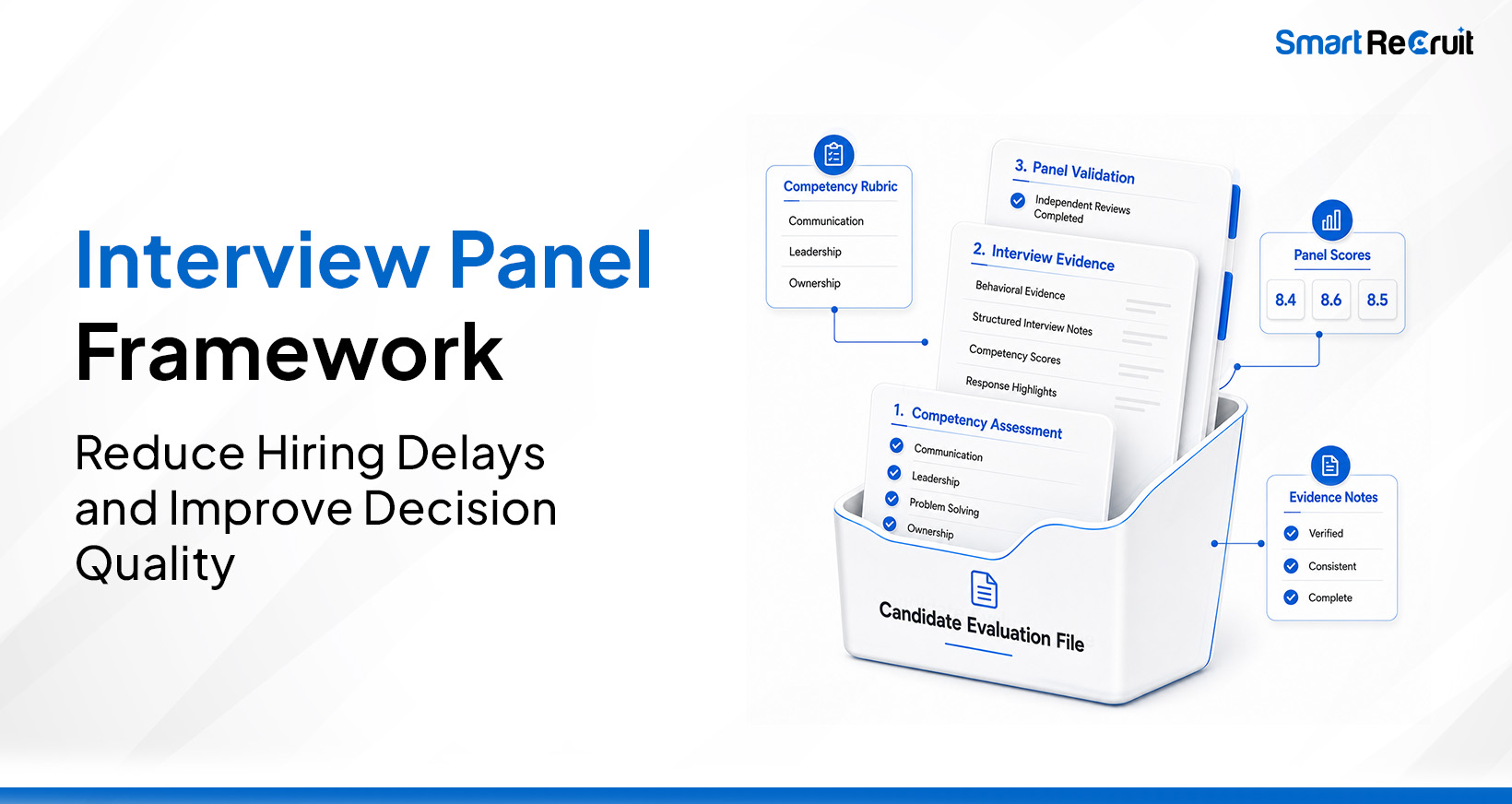
Most enterprise recruiting teams treat the interview panel as their quality gate: the point where enough qualified people look at a candidate that the hiring decision must be sound. In practice, an interview panel often does something different. It slows the decision down without necessarily improving it. Adding more evaluators doesn’t automatically add more signal, and for a lot of TA functions, the panel stage is where strong candidates quietly stall.
That’s not an argument against panels. It’s an argument for being honest about what they’re actually good at and building the structure around them that makes them worth the time they cost. As ERE’s analysis of panel interviews puts it, the format itself isn’t the problem. What enterprises do with it, or fail to structure around it, usually is.
The Interview Panel Isn’t the Problem. The Process Is.
An interview panel is supposed to reduce individual bias by adding perspectives. In enterprise settings, it often does the opposite: it amplifies whoever is most senior or most vocal in the room, while quieter, more accurate assessments get diluted in the discussion.
Kerry Consulting’s Research on executive hiring panels found that personality dynamics inside the panel itself, not candidate quality, frequently drive misalignment on senior hires. A panel of five people evaluating the same candidate can walk in with five different rubrics and walk out with a consensus that reflects group dynamics more than competency-based interviews should. Forbes has documented similar patterns: interview panels frequently produce groupthink, where early comments from a senior voice anchor everyone else’s scoring before independent judgment has a chance to form.
The fix isn’t fewer panelists. It’s a shared rubric before anyone walks into the room. A competency-based interview approach means every panelist scores the same three or four dimensions, technical depth, stakeholder communication, ownership of past decisions, on the same scale, rather than each person bringing their own informal sense of “good.” Without that shared structure, an interview panel isn’t really evaluating a candidate against defined criteria. It’s running an informal negotiation among interviewers, and the candidate’s fate depends on who happens to be in the room.
Interview Scheduling Isn’t the Bottleneck. Panel Consensus Is.
When enterprise hiring slows down, interview scheduling usually gets blamed first. Coordinating calendars across five panelists, a hiring manager, and a candidate is genuinely hard, and it’s the most visible friction point in the process.
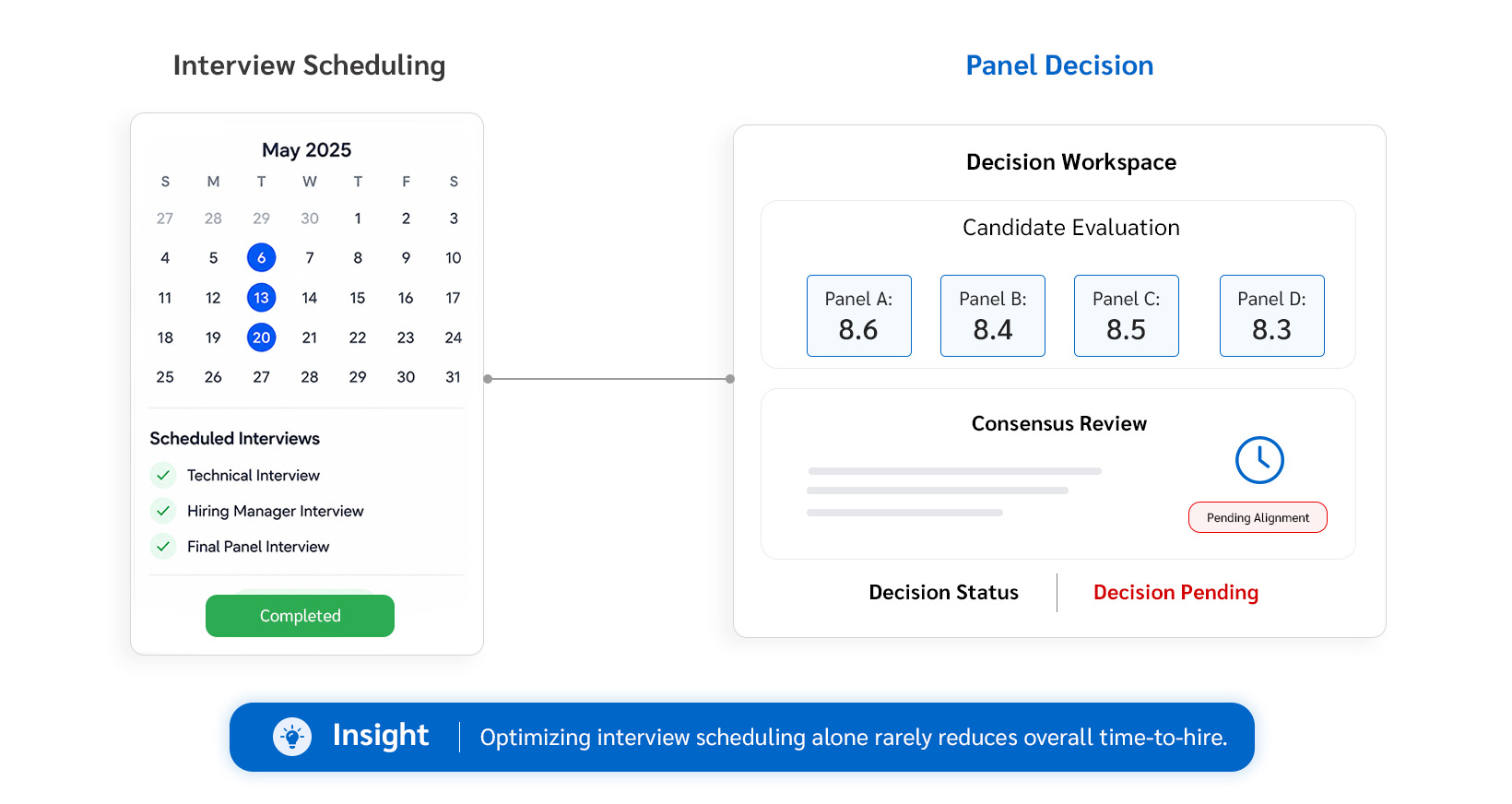
But scheduling isn’t where most of the delay actually lives. As Smart Recruit’s Article on Scheduling Automation lays out, automating interview scheduling only speeds up how fast a candidate reaches the panel. It does nothing for what happens after: five separate opinions that still need to be reconciled into one decision. Faster interview scheduling into a slow consensus process just means candidates wait at a different stage instead of a shorter one.
The pattern holds across enterprise hiring more broadly: complexity compounds as more stakeholders get added to a single loop, and scheduling tools alone can’t resolve decision-making that depends on group agreement, not calendar availability. The bottleneck moves. It doesn’t disappear.
This is the core problem with treating an interview panel as a scheduling challenge. The real fix isn’t getting people into a room faster. It’s giving them a structure that turns their combined input into a decision without requiring full agreement first. Teams that invest heavily in interview scheduling tools while leaving the panel’s decision process untouched tend to see the same time-to-offer numbers, just with the delay relocated to a later stage.
Still optimizing faster scheduling instead of faster decisions? Smart Recruit gives panels a shared evaluation structure, so consensus doesn’t have to happen in a meeting.
Recruitment Coordination Prevents Hiring Delays Before They Begin.
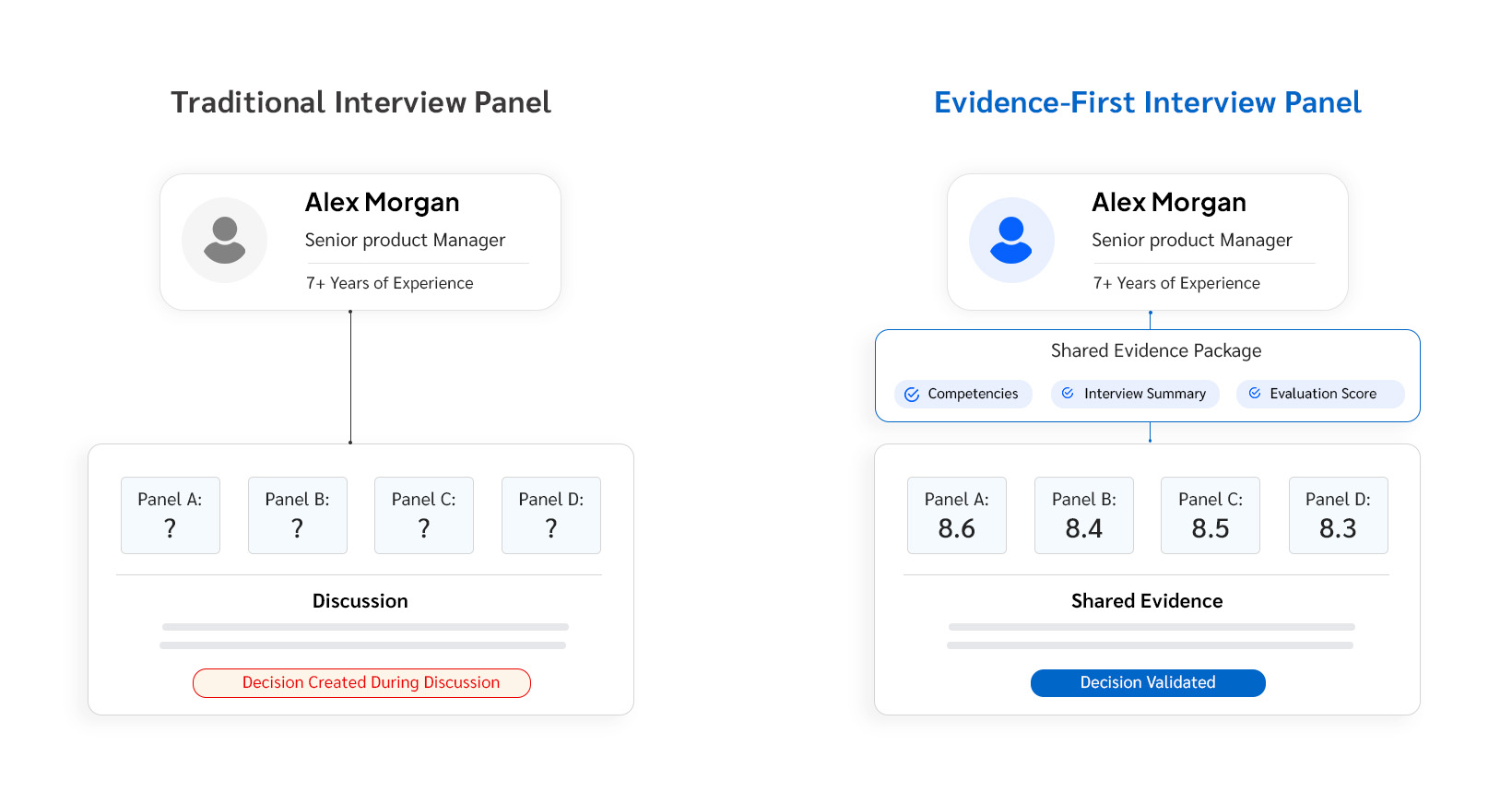
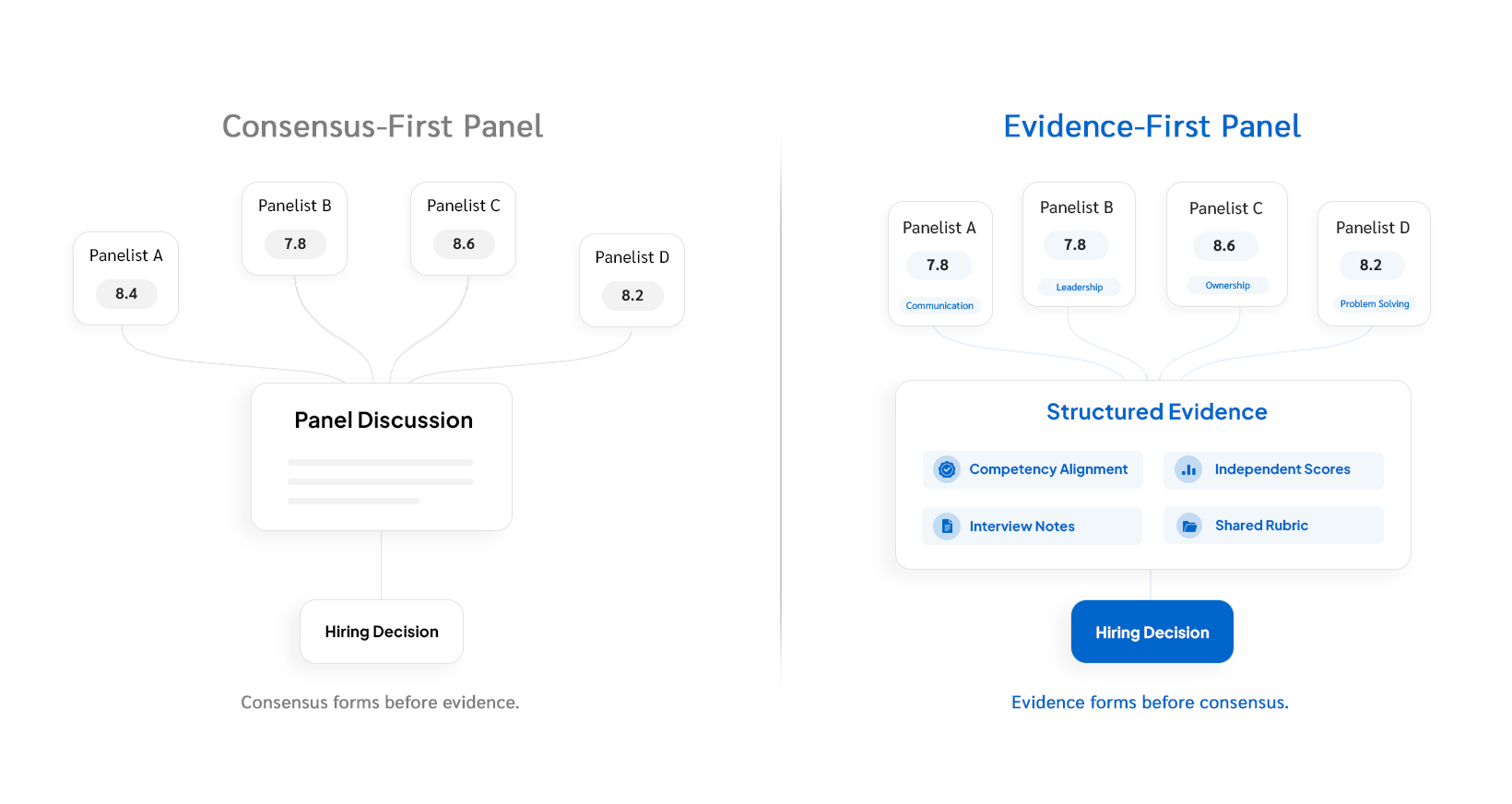
An evidence-first panel workflow changes the order of operations. Instead of a group discussion that produces a shared impression, each panelist scores the candidate independently against the same competency framework before any discussion happens. The panel then meets to reconcile scores, not to form them from scratch.
The logic is straightforward: structured, independent scoring captured before group discussion produces more consistent outcomes than open-ended panel conversation, because it removes the anchoring effect of whoever speaks first. Panel interviews don’t inherently solve the consistency problem enterprises assume they solve just by existing. The panel format is only the container. What fills it determines whether the outcome holds up.
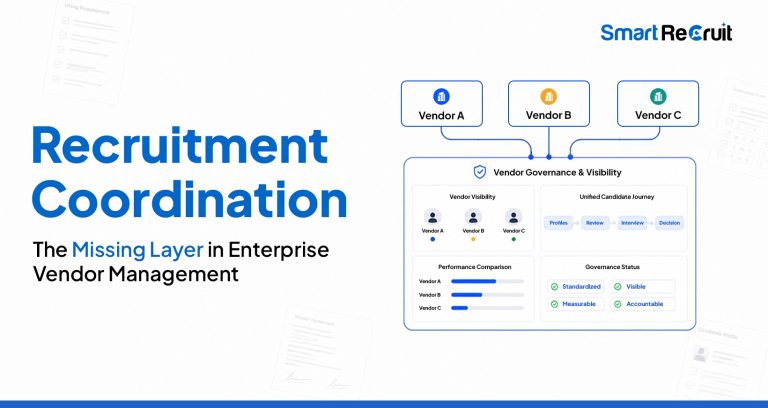
This is exactly the layer most enterprise hiring processes are missing, and it’s the same recruitment coordination problem that runs through enterprise vendor management too. As Recruitment Coordination: The Missing Layer in Enterprise Vendor Management covers, the issue is rarely a lack of people or process steps. It’s the absence of a shared structure that makes everyone’s input comparable in the first place. A panel with no shared rubric has the same problem as a set of vendors with no shared evaluation criteria: activity without accountability.
Your Recruitment Dashboard Is Probably Blind to the Panel Stage
Most enterprise recruiting teams can report how many candidates went through interview panels. Far fewer can point to a recruitment dashboard that says whether the panel stage is actually working.
Recruitment analytics built around panel performance need to track things most standard reporting skips: score variance between panelists on the same candidate, panel-to-offer conversion by role, and time spent between the last interview and a hiring decision. High variance between panelists is a signal the rubric isn’t shared. A long gap between interview and decision is a signal the panel is stuck on reconciliation, not evaluation.
Recruitment dashboards built for this purpose surface those patterns instead of just logging that a panel happened. A useful recruitment dashboard flags when one panelist’s scores run higher or lower than the rest, when a role type routinely stalls at the panel stage regardless of who’s on it, or when time-to-decision creeps up for a business unit. None of that shows up in a simple headcount report, which is what most dashboards still default to.
Without that visibility, TA leaders assume the panel stage works because it’s always been part of the process, not because recruitment analytics confirm it. Teams that build dashboards around decision quality, not interview volume, catch which parts of their panel process add signal and which just add time.
AI Interview Platform: The Foundation of Evidence-First Hiring.
Part of what makes interview panels slow is that they’re often the first structured evaluation a candidate receives. Every panelist is forming a first impression at the same time, on the same call, with nothing to anchor against.
This is where an AI interview platform changes what the panel is working with. Aspira, Smart Recruit’s interview intelligence engine, runs a structured, adaptive first-round interview that produces a consistent evaluation before the candidate ever reaches a panel: competency scores, response patterns, and a documented record the panel can reference instead of relitigating from zero. The panel’s job narrows from “form an opinion about this person” to “confirm or challenge a specific, evidence-backed assessment.”
That’s a faster task too. Panels reconciling against a shared baseline reach a decision faster than panels building shared understanding from scratch. It also changes what the panel is for: instead of five people independently deciding whether they like a candidate, Aspira gives them a common starting point for the discussion.
Smart Recruit: The End-to-End Platform Behind Every Panel Decision
Everything covered so far, structured intake, Aspira’s first-round evaluation, independent panel scoring, and recruitment analytics on panel performance, is meant to live inside one platform rather than getting stitched together after the fact. Smart Recruit is built as an end-to-end hiring platform for enterprise recruiting, not a single tool bolted onto an existing ATS. Recruitment coordination is the structure underneath it: the same standard that governs how vendors submit candidates also governs how panelists score them, and how Aspira’s evaluation carries into the panel stage.
That doesn’t mean interview panels stop mattering. For senior and cross-functional roles, where alignment across departments matters as much as any single competency, a panel is still the right format. What changes is what it’s working from. Inside Smart Recruit, panelists open a candidate record that already includes Aspira’s structured evaluation, prior panel scores from comparable roles, and dashboard context on how the requisition compares to others in flight. The conversation starts from evidence, not five blank slates.
That’s what turns an interview panel from a scheduling headache into a confirmation step worth running.
Fewer Panels Isn’t the Fix. More Structure Is.
An interview panel isn’t the problem. One with no shared structure, arriving late in a process with no prior evidence to work from, is. Teams that treat the panel as a confirmation step, backed by independent scoring and a documented rubric, get faster decisions and more consistent ones. Teams that treat the interview panel as the evaluation itself get neither.
Fixing this doesn’t mean removing panels from enterprise recruiting. It means giving them less to figure out and more to confirm, and building the recruitment coordination, recruitment analytics, and AI interview platform support that makes that possible before the interview panel ever convenes.
Ready to make your panel stage a confirmation step instead of a bottleneck?
Contact Us to see how Smart Recruit brings structured evidence to every stage before the panel ever meets.
FAQs
Does automating interview scheduling fix panel stage delays?
Not on its own. Interview scheduling automation gets candidates to the panel faster, but the delay enterprise teams feel usually happens after the interviews, during reconciliation among panelists. Scheduling and decision-making are different bottlenecks and fixing one doesn’t fix the other. An interview panel still needs a shared rubric and a reconciliation process regardless of how quickly it was scheduled.
How does recruitment coordination relate to interview panels?
Recruitment coordination is the shared structure connecting vendor activity, candidate evaluation, and hiring decisions into one process. Interview panels run into the same failure mode as uncoordinated vendor relationships: without a shared rubric or standard, each panelist’s input can’t be compared or reconciled consistently.
What role does an AI interview platform play before a panel stage?
An AI interview platform can run a structured first-round interview and produce a documented, competency-based evaluation before a candidate reaches the panel, giving panelists a shared baseline to confirm or challenge instead of each forming an independent first impression from scratch.
What should recruitment dashboards track for panel effectiveness?
Recruitment dashboards built for panel performance should surface score variance between panelists, panel-to-offer conversion by role, and the time between final interview and decision, not just how many candidates went through the panel stage. Recruitment analytics that ignore these signals tend to make the panel look effective by default, simply because it has always been part of the process.
Are competency based interviews more reliable than open-ended panel discussions?
Generally, yes. Competency based interviews score candidates against defined criteria before group discussion happens, which reduces the anchoring effect of whoever speaks first in an interview panel. Open-ended discussion without a shared framework tends to reflect group dynamics as much as candidate quality.
Related Posts
Discover other posts that deepen your understanding of smart hiring, from AI-led interviews to streamlined candidate management techniques.
-
 Why Industries Need Smart Recruit: AI-Powered Hiring Without the Guesswork
Why Industries Need Smart Recruit: AI-Powered Hiring Without the Guesswork
-
 Recruitment Coordination
The Missing Layer in Enterprise Vendor Management
-
 Step-by-Step Guide to Smarter Hiring with AI-Powered Smart Recruit
Structured, transparent hiring aligned with financial regulations.
